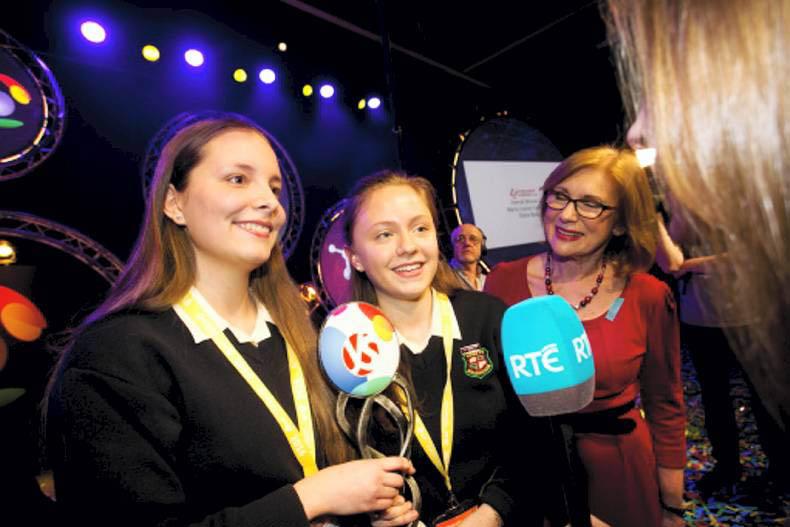
Maria Louise Fufezan (16) and Diana Bura (15) took home the top prize for their project, "An Investigation into the Effects of Enzymes used in Animal Feed Additives on the Lifespan of Caenorhabditis Elegans".
Both girls were presented with a cheque for €5,000, the opportunity to represent Ireland at the 28th European Union Young Scientist competition in Brussels later this year and the BTYSTE perpetual trophy.
Speaking to the Irish Farmers Journal in Dublin's RDS the day after their win, the girls, who are both of Romanian descent, said the victory was a "massive shock" and they only entered the competition to "spread their ideas and findings with the public".
Maria said the win was "unbelievable" and they were becoming increasingly worried as the names of runner-ups were called out. It soon became clear to them that it was "this award or it was nothing".
Farming implications
Their project is of particular interest to the agricultural industry and looks at the effects of enzymes added to animal feed on worms and soil fertility.
The girls say that since the banning of hormones and antibiotics in meat production in Europe, enzymes in animal feed have become a way of enhancing the growth of animals and producing larger quantities of meat.
Maria and Diana studied the effects on earthworms of the three most common enzymes used in animal feeds in Europe, phytase, xylanase and beta glucanase, and found them to be mainly detrimental.
The detrimental effects included inhibited roaming abilities, a shortened lifespan and a reduced ability to source food.
The girls say that the implications of their experiment for farmers are substantial.
"Soil fertility around farms where they use these substances is at risk," Maria said. ''These earthworms die off and they can't carry out their function in the eco-system. For example, they cannot break down dead matter."
For their next project, the girls will be examining whether these enzymes are still present in the faeces of animals. If it is, the girls say spreading slurry, which is used as a fertiliser, could end up "killing the actual fertiliser", that is, the earthworm.
The students faced some steep competition to secure the win, with almost 1,200 entrants from across Ireland competing in the RDS for the coveted title of BT Young Scientist(s) & Technologist(s) of the Year 2016.
The individual runner-up award also went to a student from Loreto Secondary School, Balbriggan. Renuka Chintapalli won for her project ‘'Developing a predictive tool for identifying FLNc-associated biomarkers of oesophageal cancer metastasis'’.
Listen to the full interview with the BT Young Scientist and Technology Exhibition winners for 2016 below
Related stories
Watch: Agricultural-related projects at the BT Young Scientist competition.
If you are interested in a career in the agri-industry, come along to the Irish Farmers Journal’s Agri Careers Fair, which takes place in the RDS on 3 March 2015. For more information, click here.
Maria Louise Fufezan (16) and Diana Bura (15) took home the top prize for their project, "An Investigation into the Effects of Enzymes used in Animal Feed Additives on the Lifespan of Caenorhabditis Elegans".
Both girls were presented with a cheque for €5,000, the opportunity to represent Ireland at the 28th European Union Young Scientist competition in Brussels later this year and the BTYSTE perpetual trophy.
Speaking to the Irish Farmers Journal in Dublin's RDS the day after their win, the girls, who are both of Romanian descent, said the victory was a "massive shock" and they only entered the competition to "spread their ideas and findings with the public".
Maria said the win was "unbelievable" and they were becoming increasingly worried as the names of runner-ups were called out. It soon became clear to them that it was "this award or it was nothing".
Farming implications
Their project is of particular interest to the agricultural industry and looks at the effects of enzymes added to animal feed on worms and soil fertility.
The girls say that since the banning of hormones and antibiotics in meat production in Europe, enzymes in animal feed have become a way of enhancing the growth of animals and producing larger quantities of meat.
Maria and Diana studied the effects on earthworms of the three most common enzymes used in animal feeds in Europe, phytase, xylanase and beta glucanase, and found them to be mainly detrimental.
The detrimental effects included inhibited roaming abilities, a shortened lifespan and a reduced ability to source food.
The girls say that the implications of their experiment for farmers are substantial.
"Soil fertility around farms where they use these substances is at risk," Maria said. ''These earthworms die off and they can't carry out their function in the eco-system. For example, they cannot break down dead matter."
For their next project, the girls will be examining whether these enzymes are still present in the faeces of animals. If it is, the girls say spreading slurry, which is used as a fertiliser, could end up "killing the actual fertiliser", that is, the earthworm.
The students faced some steep competition to secure the win, with almost 1,200 entrants from across Ireland competing in the RDS for the coveted title of BT Young Scientist(s) & Technologist(s) of the Year 2016.
The individual runner-up award also went to a student from Loreto Secondary School, Balbriggan. Renuka Chintapalli won for her project ‘'Developing a predictive tool for identifying FLNc-associated biomarkers of oesophageal cancer metastasis'’.
Listen to the full interview with the BT Young Scientist and Technology Exhibition winners for 2016 below
Related stories
Watch: Agricultural-related projects at the BT Young Scientist competition.
If you are interested in a career in the agri-industry, come along to the Irish Farmers Journal’s Agri Careers Fair, which takes place in the RDS on 3 March 2015. For more information, click here.





SHARING OPTIONS