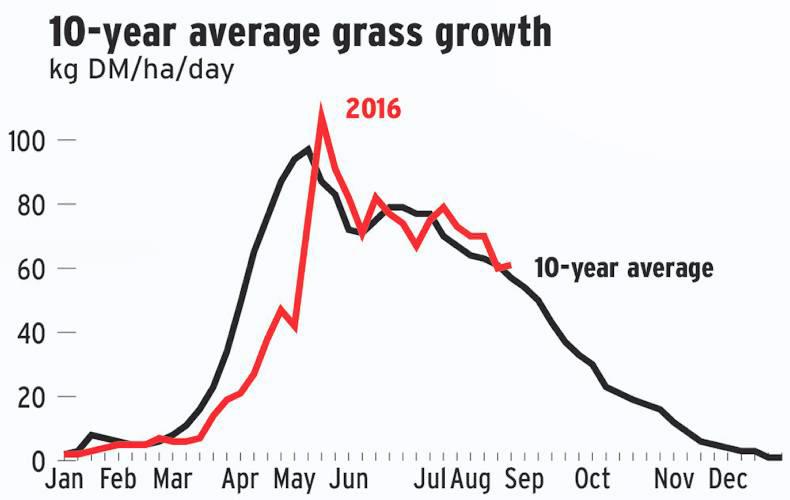
Average grass growth rate last week was 59kgDM/ha/day, which is on a par with the previous week’s figures. As is evident from the 10-year average graph below, compensatory grass growth was the story of 2016.
The season started late with a bang and looked increasingly like it would finish late too, resulting in similar cumulative grass production to a typical year. But, while still ahead of daily herd demand on the vast majority of farms, growth in the last fortnight has dipped significantly. It remains to be seen where 2016 will rank in terms of total grass produced.
Dry farms
Most farmers will not be too concerned about total grass produced in a year, rather the grass in front of them and the underfoot conditions for eating it.
There are unbelievable contrasts across the country this week. Though a lot of rain seems to have fallen over the last fortnight, some pockets around the country experienced very little. In fact, many farmers on more free-draining soil were crying out for some moisture, with some ready to go with round bales and ring feeders to try and stretch out grass.
The rain that fell at the beginning of the week seems to have done the trick for them, though I was talking to a farmer in the Kilkenny area who got very little rain and is going in with bales today.
Those on wetter farms face a different dilemma. Grass growth has been good in the past weeks and the supply is there, but ground conditions are preventing proper utilisation and, in some cases, any utilisation as cattle have been housed. Things appear worst in the in the western half of the country, particularly moving north.
The forecast for the weekend is generally OK, with a small amount of rain to fall on Saturday, but dry days either side. This should help things on the wet farms but do little for those on burnt-up ground.
The closed period is creeping up on us. Growth is dropping off and the response to fertiliser will be too.
Farms should be receiving 27 units of N in the final weeks of August to help build up grass for the winter. At this point, there should be 20 days of grazing on the farm.
Trevor Minion, Co Wicklow
Farming system: Suckler to beef; finishing steers and heifers
Land type: Generally dry soils
We really needed the rain that has come. Drought conditions in recent weeks had left grass growth flat-lining. I was very close to having to put bales out to cattle. I stopped measuring grass on 9 July, at which point daily growth was well back due to ground conditions. We estimate that the farm grew next to nothing for a number of weeks subsequently.
I was glad of the paddock system during the drought period – we would have been in big trouble without it. Paddocks protect your regrowth and keep the grass fresh and stimulated for growth.
I can remember even before we joined the programme, we visited a farm walk on Cathal Crean’s farm and were enlightened. His paddock system was working a treat. We began dividing up our fields as soon as we got home. I have security and peace of mind now to push our stocking rate, because I know what the farm can carry it.
James Kenneally, Co Cork
Farming system: Suckler to beef; finishing bulls, steers and heifers
Land type: Dry, free-draining soil
Grass is plentiful with me. I got lucky in that a drop of rain came just after I’d taken my second cut and spurred growth on. It was beginning to get very dry – ground doesn’t take long to burn up down here. The silage ground coming back into the grazing rotation will help to build grass for the autumn. I’m continuing to follow stock with one bag of CAN post-grazing to keep grass growing too. The last of the bulls were slaughtered this week, at a flat price of €3.90. The sheds are empty now and will remain so until the suckler herd needs housing. Calves got their dose a fortnight ago. We won’t dose them again until housing time and, though it’s less than recommended, I generally have no problems with that regime. Our herd test passed all clear last week which was a great relief. I have also recovered from a broken thumb that had kept me out of action for a month or so – it’s been a good few weeks!
Mark Maxwell, Co Westmeath
Farming system: Suckler to beef; finishing steers and heifers
Land type: Dry, free-draining soil
I have around 20 days of grazing at the moment, which is bang on target. I’m spreading fertiliser after every second rotation and targeting compounds on lower index fields. My slurry is also targeted towards these fields. I start closing up paddocks in the first week in October, so it’s important that I build up enough grass between now and then. Land here is mixed in places, but generally dry. Stock are going quite well. I hope to get autumn 2014 bullocks slaughtered from grass at two years of age. They’ve been on meal since the 21 July, starting off on 4kg, increasing to 8kg for a fortnight pre-finish. The power seems to have been gone from grass here since July. There has been no sunshine and I suspect the energy in grass has dipped as a result. My bullocks needed the meal badly. I’ll aim for a 420kg carcase. Autumn calving is coming along well, with 20 out of 60 calved to date and no issues to report thus far.
David Walsh, Co Tipperary
Avg farm cover (kg DM/ha): 664
Stocking rate (LU/ha): 2.93
Growth rate (kg DM/ha/day): 91
Farm work is quiet enough at present. I’ll weigh my beef heifers this week and see which ones we will pick out to kill from grass. I’ll push on any of my own cattle that are around 520kg. There are about 21 grazing days ahead at present. Growth is good, which is just as well given my high stocking rate. The mixture of heat and moisture is lending itself to good growth conditions. While my farm is quite heavy in places, ground conditions are OK. I don’t think we experienced the rain that some places got. Having said that, things can and do turn quite quickly. I’m following cattle with 25 units of urea after grazing and I have been doing so all year. I’ll stop at the end of August. I don’t want to have too much grass that I can’t eat in the back-end. My weekly measurement will help with the budgeting. I start closing up in the middle of October. I used to eat the farm to the turf in the winter, but now I really see the benefits of spring grass.
Read more
Rain: a blessing to some and a curse to others
Average grass growth rate last week was 59kgDM/ha/day, which is on a par with the previous week’s figures. As is evident from the 10-year average graph below, compensatory grass growth was the story of 2016.
The season started late with a bang and looked increasingly like it would finish late too, resulting in similar cumulative grass production to a typical year. But, while still ahead of daily herd demand on the vast majority of farms, growth in the last fortnight has dipped significantly. It remains to be seen where 2016 will rank in terms of total grass produced.
Dry farms
Most farmers will not be too concerned about total grass produced in a year, rather the grass in front of them and the underfoot conditions for eating it.
There are unbelievable contrasts across the country this week. Though a lot of rain seems to have fallen over the last fortnight, some pockets around the country experienced very little. In fact, many farmers on more free-draining soil were crying out for some moisture, with some ready to go with round bales and ring feeders to try and stretch out grass.
The rain that fell at the beginning of the week seems to have done the trick for them, though I was talking to a farmer in the Kilkenny area who got very little rain and is going in with bales today.
Those on wetter farms face a different dilemma. Grass growth has been good in the past weeks and the supply is there, but ground conditions are preventing proper utilisation and, in some cases, any utilisation as cattle have been housed. Things appear worst in the in the western half of the country, particularly moving north.
The forecast for the weekend is generally OK, with a small amount of rain to fall on Saturday, but dry days either side. This should help things on the wet farms but do little for those on burnt-up ground.
The closed period is creeping up on us. Growth is dropping off and the response to fertiliser will be too.
Farms should be receiving 27 units of N in the final weeks of August to help build up grass for the winter. At this point, there should be 20 days of grazing on the farm.
Trevor Minion, Co Wicklow
Farming system: Suckler to beef; finishing steers and heifers
Land type: Generally dry soils
We really needed the rain that has come. Drought conditions in recent weeks had left grass growth flat-lining. I was very close to having to put bales out to cattle. I stopped measuring grass on 9 July, at which point daily growth was well back due to ground conditions. We estimate that the farm grew next to nothing for a number of weeks subsequently.
I was glad of the paddock system during the drought period – we would have been in big trouble without it. Paddocks protect your regrowth and keep the grass fresh and stimulated for growth.
I can remember even before we joined the programme, we visited a farm walk on Cathal Crean’s farm and were enlightened. His paddock system was working a treat. We began dividing up our fields as soon as we got home. I have security and peace of mind now to push our stocking rate, because I know what the farm can carry it.
James Kenneally, Co Cork
Farming system: Suckler to beef; finishing bulls, steers and heifers
Land type: Dry, free-draining soil
Grass is plentiful with me. I got lucky in that a drop of rain came just after I’d taken my second cut and spurred growth on. It was beginning to get very dry – ground doesn’t take long to burn up down here. The silage ground coming back into the grazing rotation will help to build grass for the autumn. I’m continuing to follow stock with one bag of CAN post-grazing to keep grass growing too. The last of the bulls were slaughtered this week, at a flat price of €3.90. The sheds are empty now and will remain so until the suckler herd needs housing. Calves got their dose a fortnight ago. We won’t dose them again until housing time and, though it’s less than recommended, I generally have no problems with that regime. Our herd test passed all clear last week which was a great relief. I have also recovered from a broken thumb that had kept me out of action for a month or so – it’s been a good few weeks!
Mark Maxwell, Co Westmeath
Farming system: Suckler to beef; finishing steers and heifers
Land type: Dry, free-draining soil
I have around 20 days of grazing at the moment, which is bang on target. I’m spreading fertiliser after every second rotation and targeting compounds on lower index fields. My slurry is also targeted towards these fields. I start closing up paddocks in the first week in October, so it’s important that I build up enough grass between now and then. Land here is mixed in places, but generally dry. Stock are going quite well. I hope to get autumn 2014 bullocks slaughtered from grass at two years of age. They’ve been on meal since the 21 July, starting off on 4kg, increasing to 8kg for a fortnight pre-finish. The power seems to have been gone from grass here since July. There has been no sunshine and I suspect the energy in grass has dipped as a result. My bullocks needed the meal badly. I’ll aim for a 420kg carcase. Autumn calving is coming along well, with 20 out of 60 calved to date and no issues to report thus far.
David Walsh, Co Tipperary
Avg farm cover (kg DM/ha): 664
Stocking rate (LU/ha): 2.93
Growth rate (kg DM/ha/day): 91
Farm work is quiet enough at present. I’ll weigh my beef heifers this week and see which ones we will pick out to kill from grass. I’ll push on any of my own cattle that are around 520kg. There are about 21 grazing days ahead at present. Growth is good, which is just as well given my high stocking rate. The mixture of heat and moisture is lending itself to good growth conditions. While my farm is quite heavy in places, ground conditions are OK. I don’t think we experienced the rain that some places got. Having said that, things can and do turn quite quickly. I’m following cattle with 25 units of urea after grazing and I have been doing so all year. I’ll stop at the end of August. I don’t want to have too much grass that I can’t eat in the back-end. My weekly measurement will help with the budgeting. I start closing up in the middle of October. I used to eat the farm to the turf in the winter, but now I really see the benefits of spring grass.
Read more
Rain: a blessing to some and a curse to others






SHARING OPTIONS