


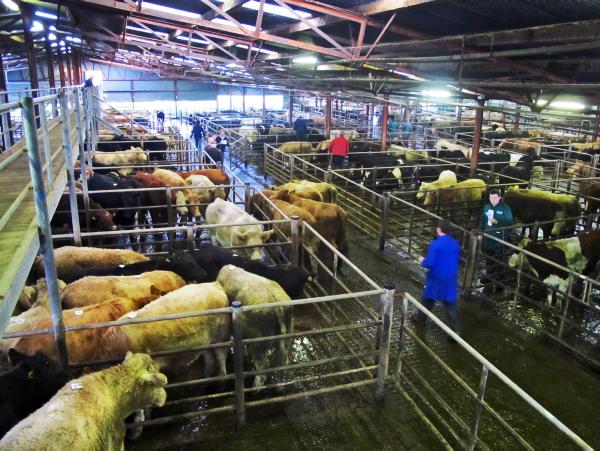
Last week, we looked at how the store cattle prices which were paid in 2015 were marginally higher than the peak of 2012 and 2013. Last year saw the average 550kg steer sell for €1,221, some €27.50/head more than the peak of 2012.
The average 450kg bullock sold for €1,035, up €94/head on 2014 and €54/head on the 2012 peak.
The average 450kg heifer sold for €1,053 on average in 2015, up €94/head on 2014 levels and €58/head on 2012 and 2013 levels.
The record live store prices were not the only feature of 2015.
This week, we have analysed the MartWatch data on weanling sales for 2015. Weanlings too were met with sharp price increases in 2015 due to strong demand.
In several cases, the high store cattle prices forced farmers who normally purchase store cattle to move back to buying weanlings to secure similar numbers with the same budget.
Record weanling bull prices
In 2015, the average 350kg weanling bull sold for €868/head, while the top third made €1,008 for the same weight. Prices increased by about 24c/kg on 2014 levels or €80 to €85/head. Compared to 2012 levels, average prices were up €28/head.
Lighter bulls from 200kg to 300kg were met with a similar trend in prices. The average price paid in 2015 for a 200kg to 300kg bull was €2.71/kg, up from €2.47/kg in 2014. Prices for average-quality types were up by 24c/kg or €60/head.
Bulls from 400kg to 450kg were a strong trade throughout the year, despite 2014 being a difficult year. A favourable beef price resulted in strong demand from specialised finishers.
Bulls from 400kg to 450kg sold for €2.33/kg during the year, up by 22c/kg on 2014 or €100/head. When we look at the top third of bulls in the same weight category, they sold for €2.68/kg in 2015, up by 22c/kg or €100/head on 2014 levels.
Weanling heifer prices surpass bull prices
MartWatch analysis has also shown 2015 to be a record year for weanling heifer prices. As in the case of bulls, strong farmer demand throughout the year had a major impact on live prices.
The average weanling heifer from 200kg to 300kg sold for €2.75/kg in 2015, up by 23c/kg or €58/head on 2014 levels. When compared with 2012, prices were up by 30c/kg or €75/head.
If we look at the top third of heifers in the same weight category, they made €3.14/kg in 2015, up 27c/kg on last year or €68/head. The bottom third of heifers in that weight category were up 38c/kg.
Heavier weanling heifers from 300kg to 400kg saw a strong jump in price in 2015 also. Prices averaged €2.51/kg, up 25c/kg on 2014 levels, or €88/head on a 350kg heifer.
When compared with the peak of 2012, prices in 2015 were 18c/kg or €63/head higher. When we look at the top of the weanling heifer market, the top third of heifers from 300kg to 400kg were up 28c/kg on the previous year’s. This equates to a jump of €98/head on a 350kg heifer in one year.
Differential narrows
Analysis of prices over the past few years for weanlings showed the difference between the top and bottom third of bulls and heifers to have widened year on year in the past few years. However, the high prices paid in 2015 saw an exception to the rule.
In previous years, farmers focused on animal quality and conformation. Seeing the benefits resulting from the QPS grid focused farmers to pay more and more for better-quality types, while at the same time discounting lesser-quality types.
The higher prices paid in 2015 resulted in farmers opting to pay more for lesser types of weanlings compared with better types. As a result, the differential between the top third and bottom third of prices decreased by about 10c to 11c/kg for all categories of weanlings, with the exception of heifers from 300kg to 400kg.
Price increases for the top third of weanlings mirrored that paid for average-quality types. However, the average price paid for the bottom third of weanling bulls and heifers increased by a much larger proportion than that of better-quality types.
Across all weanling types, prices for the bottom third in terms of quality increased by a massive 30c to 39c/kg on 2014 levels.
In contrast, the only store animal category to experience the same trend was store bullocks from 400kg to 500kg. In all other store categories, the price differential remained relatively unchanged.
Price fall in winter
While average prices were up substantially on previous years, similar to store cattle, the last two months of 2015 saw a fall in prices of both weanling bulls and heifers.
Prices of weanlings peaked in February at €2.55/kg on average for bulls and €2.60/kg for heifers from 300kg to 400kg. In September, prices of weanlings rallied once again and reached highs of €2.50/kg to €2.60/kg.
However, in the last two months of the year, prices fell by about 20c to 30c/kg from peak, but have steadied in recent weeks.
High prices – low exports
For most of 2015, live exporters struggled to export cattle due to high live prices in the domestic market.
There were 16,000 head or 16% fewer calves exported in 2015 than in 2014. High calf prices and IBR restrictions in some export markets were the main contributors to the decrease in numbers exported. However, the number of weanling exports in 2015 fell by over 30% or 10,000 head on 2014 levels due mainly to high prices. In late September and November, weanling exports increased due to the bluetongue outbreak in France, but numbers exported fell again in November and December.
Cow throughput increases
2015 saw some changes to the cow trade. The easing of testing requirements for brucellosis in the later part of the year had a positive impact on the number of cows passing through many mart rings, while strong beef prices through most of 2015 kept a firm floor under cull prices, particularly slaughter-fit or short-keep types.
The abolition of quotas saw dairy farmers slower to release cull cows in the autumn. However, despite an influx of culls in many marts, steady demand placed a firm floor under store cow prices.





SHARING OPTIONS