


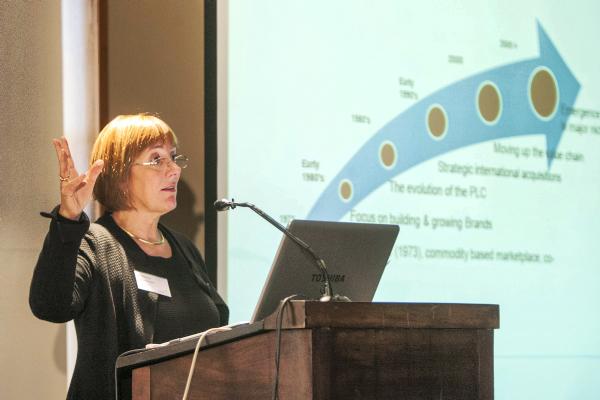
Managing risk in a co-operative business was the topic of the ICOS Conference held in Portlaoise earlier this week.
Risk is a hot topic currently with dairy co-ops planning significant expansion post-2015 and with many marts counting the cost of TLT going into receivership.
Swedish dairy farmer and Arla Foods chairman Ake Hantoft outlined how Arla has managed risk during its huge growth in recent years.
Arla was created in 2000 when the two main co-ops in Sweden and Denmark merged – both saw limited opportunity to grow and improve the return they could generate for farmers in their own countries, and so were open to collaboration.
Arla has since purchased businesses in Canada and the US and has formed partnerships with Chinese dairy companies.
Mergers with co-ops in Germany and the UK in 2011 further increased its supplier base. Today, Arla has 12,000 milk suppliers, employs over 18,000 people across several countries and has a turnover of almost €9bn.
Ake outlined Arla’s goal: “To secure the highest value for our farmers' milk while creating opportunities for growth.”
He explained how mergers delivered on this goal and so the risk of incorporating new co-ops under the Arla umbrella was considered worthwhile.
Joining up with co-ops from different countries meant interpreters were necessary at the main board meetings but this hasn’t hindered the performance of the co-op.
Today, the main co-op board is composed of 15 farmers – six from Denmark, four from Sweden, three from Germany and two from the UK – along with four non-farmer directors.
Milk processors from the different countries are working together under the Arla Co-op model to deliver the best possible milk price to their farmers.
Ake explained that this showed how global the dairy industry has become and commended the foresight of the people involved. He said: “Board members saw past barriers and transformed opportunity into impressive co-op growth.”
Ake made it very clear Arla want more milk and they are targeting outside EU markets for their future products.
He said: “We see a strong potential cheese market in Russia but the majority of growth in markets will be outside the EU. The EU market may become more sophisticated and higher priced but it won’t handle a lot of extra milk. We must be efficient processors and be able to compete at global level.”
Strategy
Chief executive of Enterprise Ireland, Julie Sinnamon, discussed the structure of the Irish dairy industry and strategies that would reduce exposure to risk in the future.
She said: “All dairy farmers will profit from quota removal but how much of the potential will we capture?”
Innovation is one of the key strategies Julie identified that will protect the dairy industry in the future.
She pointed to recent developments such as Kerry’s €100m investment in its innovation centre in Naas and the Food for Health Ireland initiative which is also carrying out research and development work into new products.
Enterprise Ireland have also helped some co-ops to analyse their processing efficiency which has delivered improvements in plant throughput, product quality, and processing costs.
Julie identified increased scale as a definitive risk reducer.
She said: “Increased scale can help cope with supply chain shocks, make it easier to raise capital, attract the most talented people and access the most lucrative markets.
“It’s not about creating the Irish equivalent of Fonterra in New Zealand and bigger is not always better, but as an industry, could we work together and sweat assets a bit more?”
Matt Dempsey, chief executive of the Irish Farmers Journal, echoed this point when he highlighted that it’s easy to be complacent now at a 40c/l milk price but are co-ops putting their futures at risk by sticking with the status quo?
Hedging
Bart Van Belleghem who works for the European Commission in Brussels spoke about the futures market and hedging milk price to reduce risk.
Selling on the futures market to speculators is essentially accepting an agreed price today for milk you will sell in the future. If the market price returns less than this price in the future, the farmer is better off and if the market returns more, the speculator is better off.
Agreeing a fixed price with customers in the future is essentially the same process.
Bart outlined clearly what the purpose of forward selling is.
“The first question to ask is how exposed is your business to a low milk price? If it’s an established business with good cash reserves, then volatility is manageable.
“If it’s a new business not yet performing to its potential and making repayments, then a low milk price could be very dangerous.
“This is where hedging milk price has a part to play – ultimately, you will never beat the market and achieve a higher than average milk price as hedging milk price comes at a cost. But it can reduce the volatility businesses are exposed to which for some is crucial.”
When concluding the conference, Minister Simon Coveney outlined his belief that every co-op should have a milk price fixing scheme for suppliers to insulate those must exposed to risk.
Following on from previous speakers, he echoed that consolidation is a theme equally important as risk management in co-ops: “We need to continue the debate on consolidation. We can see what is happening outside of Ireland and we must compete with that. Our objective for post-quota Ireland should be that every farmer benefits as much as possible – scaling up and working together could be a huge part of that.”
Farmers are in the health business - read more from the ICOS conference here.
Questions and answers from the ICOS conference - read more here


SHARING OPTIONS