


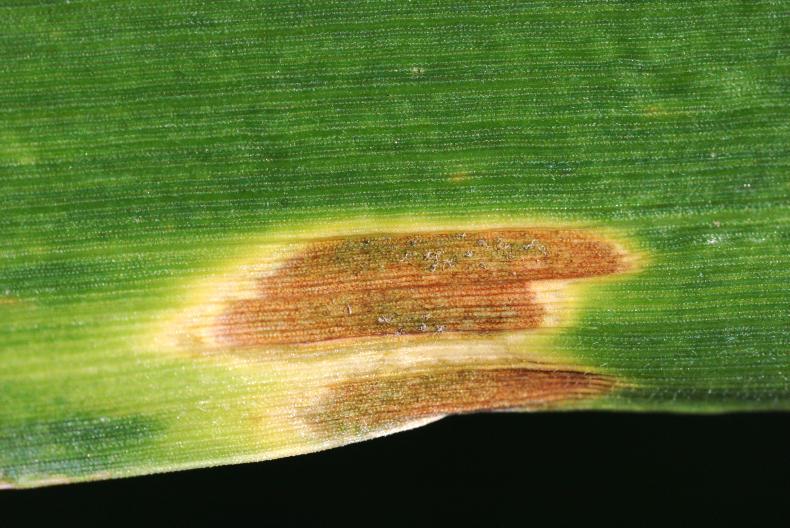
News of this finding can hardly be described as surprising but it does present a grim warning of the risks faced by wheat growers in the years ahead. Teagasc confirmed today that its disease monitoring programme identified these new strains of septoria with reduced sensitivity to SDHI fungicides in 2015.
The early results appear to indicate that the reduced sensitivity is actually full-blown resistance, as one of the two isolates found has withstood 100 times the fungicide concentration that would kill susceptible strains in laboratory tests. However, it is important to state that these insensitive strains are still only present at low frequency in the sites where they were found.
While the Teagasc findings relate to Oak Park and one site in the northeast, it is understood that other screening tests conducted by the main chemical companies have also found reduced sensitivity in at least one other site around the country in an intensive wheat-producing region.
The most resistant isolates were found at Oak Park and these contained the C-H152R mutation. However, the one found in the northeast, which has not yet been identified, seems to be a less severe strain. These resistant isolates have not been previously identified in the Irish septoria population so information on their environmental fitness is still unknown.
Commenting on the worrying findings, Teagasc’s John Spink said: “Further research is ongoing to examine the potential impact of these strains on disease control. And we also plan to conduct intensive nationwide monitoring in early spring.”
While their low frequency suggests that SDHI fungicides will still be critical for successful disease control, these findings emphasise the need to have good resistance strategies in place. Any use of SDHI fungicides must be accompanied by high rates of triazoles, plus a contact active. As frequency of use is a significant factor in the development of resistance, growers should aim to use SDHIs as little as possible, with a single use being preferable. The need for good genetic resistance is firmly back on the table.
Teagasc’s Steven Kildea emphasised the continued and increasing importance of triazoles in the fungicide mix. “They still make a useful contribution to septoria control and remain an integral part of all anti-resistance strategies,” he emphasised.



SHARING OPTIONS