


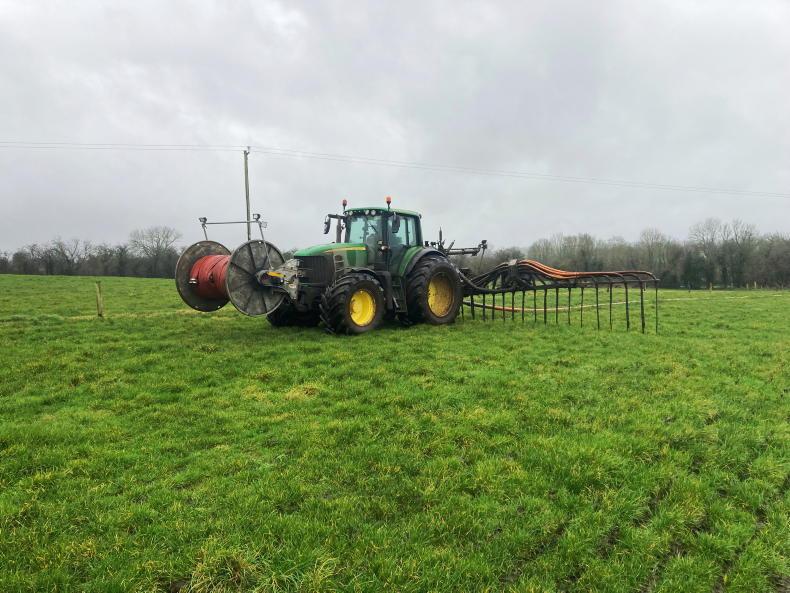
Targeting slurry applications: There are two major issues facing farmers who need to get slurry applied at the moment. The first is ground conditions, and the second is grass covers. While farmers on dry ground have found the opportunity to get some slurry out, some drying is still needed for the majority to travel on land without doing damage or causing compaction.
In many cases, the strong grass growths last autumn and mild winter resulted in higher-than-usual grass covers.
Now is the time to plan your slurry use. Watery slurry can be spread during the first rotation on pasture that will be grazed again in the second rotation as long as there has been a period of 35 to 40 days between slurry application and grazing. It is advisable to only spread slurry on ground with low grass covers of under 900-1,000kg DM/ha (7-8cm). The key advice should be to target slurry application in the spring to reduce fertiliser use. Each 1,000gals of slurry applied in the spring contains about six units of N, five units of P and 30 units of K. Applying 2,500gals/acre can supply up to 15 units N/acre, which will help to get grass growing early.
Creep grazing calves: Drier conditions in recent days have seen ground conditions improve in many areas, but ground continues to be tender on heavy land. If ground conditions allow and if weather is suitable, it may be a good time to start allowing autumn-born calves to creep graze outside from sheds. Not all farmers will have suitable fields adjoining sheds to do so, but where possible it will help boost liveweight gains. Initially, calves should just be turned out for a few hours until they get accustomed to the routine. Turn out initially on dry days only and where there is shelter. When creep grazing during adverse weather conditions, ensure that calves have access to grass or the shed.
Supplementation rates: Cattle that are due to be finished by mid-late March should have been moved on to the intensive finishing diet from the start of this month. Where cattle are on high-concentrate diets, ensure that drinkers are checked and cleaned daily. If water is restricted at any stage, intake will drop and digestive upsets can result, especially at ad-lib levels. Where weanlings and stores will be turned out to grass again in the coming four to six weeks, concentrates should be removed from the diet, or reduced. Where these light cattle are put back out at grass in early spring, they will benefit from compensatory growth at grass, making up the reduced growth in the month pre-turnout. This is an easy way of reducing concentrate input to light stock and saving money. However this does some with a caveat. If the diets fed to weanlings over the winter were low in energy and cattle grew at less than 0.5kg/day, the likelihood of the compensatory growth in the spring making up for the shortfall over the winter is unlikely.



SHARING OPTIONS