


The yield plateau has long been established in both the scientific and traditional practice of farming. The drive towards intensification moulded farmers’ attitudes towards simplicity and specialisation. This led to increased scale, continuous tillage and flat or decreased productivity over time.
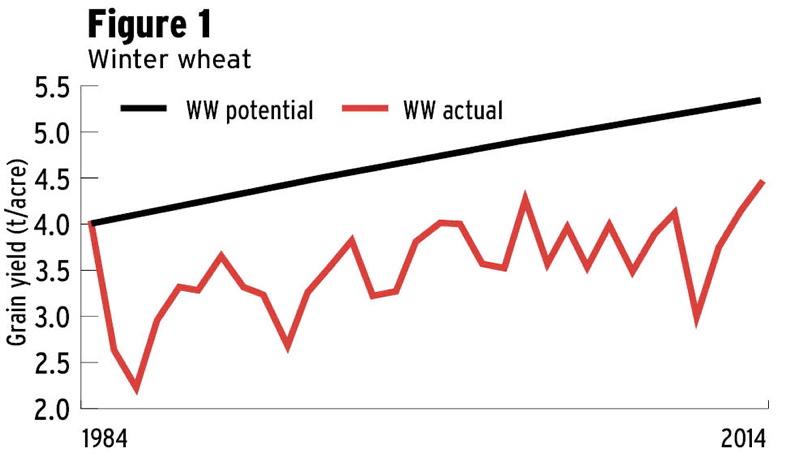
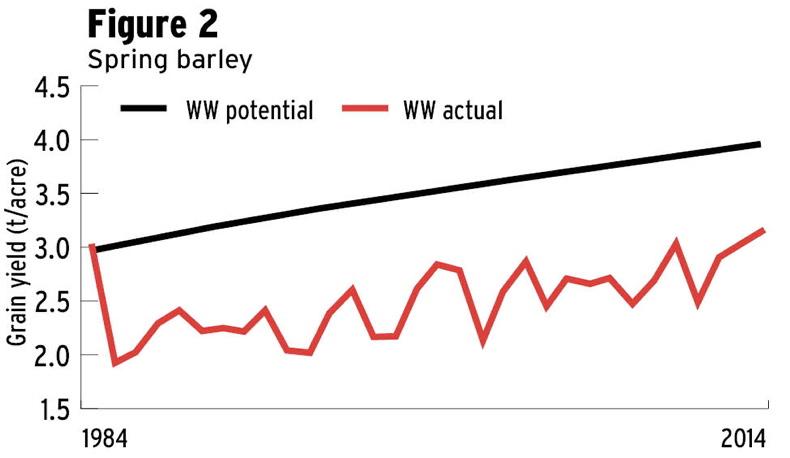
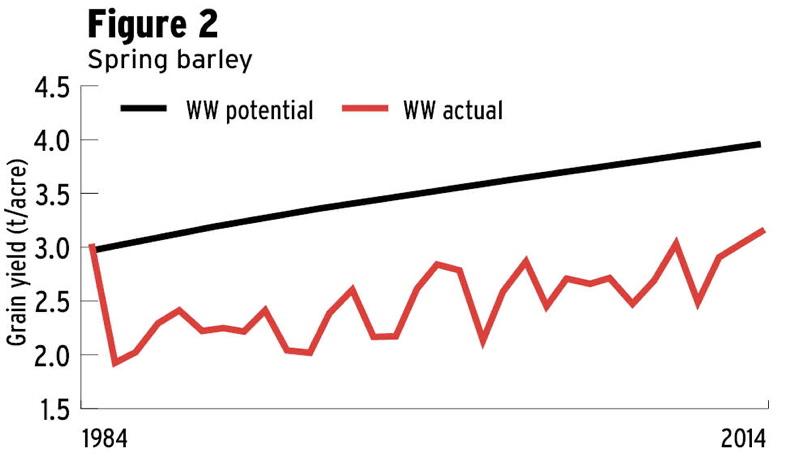
This has become increasingly apparent over the past 15 years as our average winter wheat yields were going backwards and spring barley was just about holding still. Only an exceptional year bucked this trend in our national average yields (see Figures 1 and 2). The gap between potential yield and the actual achievement is clear and indicates that something is missing in our production systems that is holding back progress with yields.
The ever-increasing cost base that lay behind this period of flat yield performance was an additional problem and the two together acted to usurp margins and profit in the sector.
Soil: The three-legged stool
It has long been said that a healthy soil is like a three-legged stool (Figure 3). When all three legs are in place, they give the soil a solid foundation on which to produce big healthy crops. When any one is missing or damaged, yield potential is reduced and the cost of delivering that potential can be increased. A healthy soil needs all three legs functioning.
A healthy soil is a sustainable entity where all three legs are interlinked to help supply all of the requirements for plant growth. An active biological system helps to restructure soil. Well-structured soils can more easily support root and plant growth.
Well-structured soils allow enhanced water and air percolation which enables a healthier plant root system to support higher crop yields. Healthy soils contain more organic matter and humus to help supply more of the crop’s needs at critical times and often have lower need for applied fertilisers. Healthy soils drain better but still hold more moisture for times of need.
A healthy soil is also likely to be more resilient against compression damage because of its naturally spongier texture. This does not mean that it cannot be damaged but it should mean that it will recover more quickly, primarily as a result of the active biological system it contains.
A balanced biological system is also likely to improve the availability of the nutrients in the soil but that does not lessen the need to have soil in a good state of fertility. Soil fertility is not just about the actual amount of nutrient present in the soil – it is much more about the amount that is available for plant growth and when it is available. Two soil characteristics are very important for this process – soil acidity or alkalinity, as measured by pH, and humus content.
Nutrient availability
Lime is the most basic and yet the most critical element of fertility. If soil pH is not close to optimum, then the availability of major nutrients is reduced. The anti-acidity elements in lime reduce the ions which drive acidity and thus prevent them from binding with the important plant nutrients. This helps their availability for plant growth. Lime also helps the activity of the whole biological system by optimising soil pH.
Recent Teagasc work has clearly highlighted the link between soil pH, lime and P availability. A similar outcome is likely with soil humus. Humus is an efficient carrier and delivery system for plant nutrients, making them more available to plant roots. So when humus is generated in the soil, more of the soil nutrient pool will be readily available to plant roots to support growth. Keeping soil organic matter and humus maintained is essential for nutrient availability.
Requirements and off-takes
It is important to remember that years such as 2015 with very high yields will take more nutrients out of fields, which is worth considering when coming back with fertiliser programmes in subsequent years.
Soil testing
Soil testing is another area worthy of debate and possibly a lot more science. Many new variants are being brought to the market by commercial interests and we need to know if these have anything additional to offer, or not. The sampling of soil is another and separate issue.
There is increasing evidence, based on relatively limited experience, that larger fields which have been uniformly managed for a number of decades are now showing quite variable fertility levels.
Understanding the causes of fertility variability is important because they can mean a reduction in potential productivity in some areas and/or a waste of applied nutrient in others. Soil samples taken across fields have hidden situations where soil P levels have varied from 3 mg/litre to over 50 mg/l in the same field which had uniform husbandry for decades. The same variability has been found with regard to pH and lime requirement.
So does this mean that we should consider grid sampling or soil conductivity testing, or is there some better way to unravel this variability? Growers need research to advise on the most appropriate ways to tackle this problem.
Nutrition for crop protection
Another aspect of soil fertility/health that deserves more serious consideration is the potential impact that it can have for crop protection. Growers are very aware of the continuously increasing requirement for chemical use in crop production and this comes with a cost. While fungicides, herbicides and many other inputs leave a return in their own right, when the total production cost is not rewarded with margin, then we must look towards a different model.
There is a growing belief that a more balanced supply of a big range of nutrients is likely to produce a plant that is more resistant or tolerant to a range of problems. We often hear mention of the importance of zinc or manganese in this regard but a healthy soil may be supplying many other substances that help plants fight initial infection, or to cope better in the presence of disease.
Having a fertile soil which can supply nutrients on a gradual basis, especially during the early part of the growing season, may well have a knock-on effect in terms of how a programme might be redesigned. Likewise, biological activity in the soil is itself a series of complex chemical process and who knows what these chemicals are doing, either in a positive or negative context. It is possible that some of these compounds may have a growth promotion effect or even a useful fungicidal effect.
Soil potential sets yield potential
Thirty years ago, we were able to raise more eyebrows with the level of yield reports from individual fields. Thirty years later we are trying to reproduce the yield levels of 30 years ago, despite the significant genetic improvements that have taken place in the interim. The harvest of 2015 rocked our perspective of yield potential and it is time to shift the expectation of what our tillage soils are capable of.
Lack of long-term investment in soil fertility in conacre land brings the viability of this into question in many cases. There are many growers in Ireland who could be better off with less ground if this land could produce the genetic potential of the varieties we plant on a land base with healthier soil.
In conclusion
Our soils are our greatest asset. We cannot grow an acre of crop without an acre and we cannot grow a profitable acre without a good acre. If we want to have a viable future in tillage we must maximise the yield and returns from the acres we grow. Having a healthy soil is not an option in this regard – it is essential.
“If you look after your soil it will look after you.” Think soil – think potential.
To read the full Fertilizer Focus Supplement click here.



SHARING OPTIONS