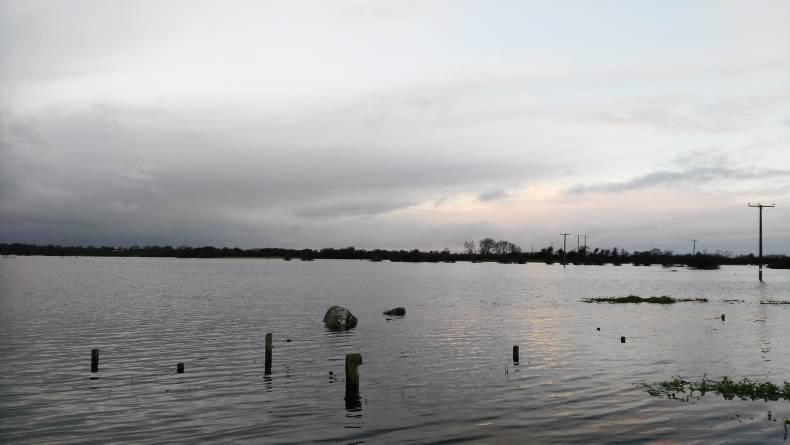
In emergency cases, farmers are being permitted to pump some water out of flooded tanks, the Department has also announced a relaxation of some rules around the movement of animals where the welfare or lives of animals is threatened.
“In line with previous severe weather incidents and insofar as farm inspections are concerned, my Department will take account of the damage caused by flooding and deal sensitively with such inspection cases,” said Minister for Agriculture Simon Coveney.
Matters relating to damage to property (such as fences) or the adverse condition of land due to severe flooding or storm damage will be dealt with using force majeure provisions.
Tim Hyde, Teagasc environmental specialist said; “Farmers faced with flooded farm yards are facing a particularly difficult time. If tanks are flooded it is permitted to pump out water for animal welfare reasons, using sludge pumps. Exporting slurry to other farms is also an option and is allowed until the end of the December. Farmers are also helping their neighbours with fodder where access to their own supplies is restricted due to access.”
Advice on cash flow and financial budgeting for farmers is also available, as they plan over the medium term to cope with the lower incomes in 2015 and the projected income situation into 2016.
Special provisions
In general, there is no restriction on the movement of cattle within the same holding, including on to parcels within the same holding. The movement of animals that are in test from herds which are not restricted due to TB can be effected relatively easily on the basis of a compliance certificate, which can obtained from the DVO, the local mart, the herd PVP (if registered to do so) or printed out by the herdowner.In the case of out of test animals or herds which are restricted due to TB, the movement of such animals or cattle out of these herds is prohibited except where they are going direct to slaughter. Exceptions to the above rules can be made where the welfare or lives of animals is threatened. Every effort must be made to prevent if possible or, if not, to limit the exposure of such animals to other TB susceptible animals.In the case of non-restricted herds, where the animals are at risk, the herdowner should move the animals to higher ground on his/her own farm if this is possible. If this is not possible and the herdowner is unable to get a compliance cert from the DVO or print one out himself/herself, the animals may be moved out of the holding.In the case of TB restricted herds, where the animals are at risk, the herdowner should move the animals to higher ground on his/her own farm if this is possible. If this is not possible and the herdowner is unable to get a movement permit from the DVO, the animals may be moved out of the holding. In these circumstances, the herdowner should notify the DVO as soon as possible after movement.Flooded slurry tanks
In the event of flooding of slurry tanks, the following emergency measures may be put in place:
In emergency cases, farmers will be permitted to pump some water out of flooded tanks, but only for animal welfare reasons. This concession will apply only in those areas that have been severely affected by flooding. Tanks should not be agitated before pumping. Use a sludge pump if possible rather than a vacuum tanker. The suction pipe should be inserted almost to the bottom of the slurry tank so that solids are not removed. Pump out no more than is necessary to alleviate the immediate animal welfare problem. If water is already above the level of the central passageway or the apron, then there is no point in pumping at all, because water will continue to flow into the tank. In these cases, animals will have to be removed from the sheds.The water should not be discharged directly to a watercourse, but on to the driest field available.The Department’s animal welfare helpline is available to take calls relating to animal welfare issues. The helpline is open daily from 9am to 5.45pm, including at the weekend, and can be contacted at:
Call Save: 0761-064408Phone: 01-607 2379Full details of the advice to farmers is available on the Department of Agriculture, Food and the Marine website www.agriculture.gov.ie, from local Department veterinary offices and from Teagasc advisers.
In emergency cases, farmers are being permitted to pump some water out of flooded tanks, the Department has also announced a relaxation of some rules around the movement of animals where the welfare or lives of animals is threatened.
“In line with previous severe weather incidents and insofar as farm inspections are concerned, my Department will take account of the damage caused by flooding and deal sensitively with such inspection cases,” said Minister for Agriculture Simon Coveney.
Matters relating to damage to property (such as fences) or the adverse condition of land due to severe flooding or storm damage will be dealt with using force majeure provisions.
Tim Hyde, Teagasc environmental specialist said; “Farmers faced with flooded farm yards are facing a particularly difficult time. If tanks are flooded it is permitted to pump out water for animal welfare reasons, using sludge pumps. Exporting slurry to other farms is also an option and is allowed until the end of the December. Farmers are also helping their neighbours with fodder where access to their own supplies is restricted due to access.”
Advice on cash flow and financial budgeting for farmers is also available, as they plan over the medium term to cope with the lower incomes in 2015 and the projected income situation into 2016.
Special provisions
In general, there is no restriction on the movement of cattle within the same holding, including on to parcels within the same holding. The movement of animals that are in test from herds which are not restricted due to TB can be effected relatively easily on the basis of a compliance certificate, which can obtained from the DVO, the local mart, the herd PVP (if registered to do so) or printed out by the herdowner.In the case of out of test animals or herds which are restricted due to TB, the movement of such animals or cattle out of these herds is prohibited except where they are going direct to slaughter. Exceptions to the above rules can be made where the welfare or lives of animals is threatened. Every effort must be made to prevent if possible or, if not, to limit the exposure of such animals to other TB susceptible animals.In the case of non-restricted herds, where the animals are at risk, the herdowner should move the animals to higher ground on his/her own farm if this is possible. If this is not possible and the herdowner is unable to get a compliance cert from the DVO or print one out himself/herself, the animals may be moved out of the holding.In the case of TB restricted herds, where the animals are at risk, the herdowner should move the animals to higher ground on his/her own farm if this is possible. If this is not possible and the herdowner is unable to get a movement permit from the DVO, the animals may be moved out of the holding. In these circumstances, the herdowner should notify the DVO as soon as possible after movement.Flooded slurry tanks
In the event of flooding of slurry tanks, the following emergency measures may be put in place:
In emergency cases, farmers will be permitted to pump some water out of flooded tanks, but only for animal welfare reasons. This concession will apply only in those areas that have been severely affected by flooding. Tanks should not be agitated before pumping. Use a sludge pump if possible rather than a vacuum tanker. The suction pipe should be inserted almost to the bottom of the slurry tank so that solids are not removed. Pump out no more than is necessary to alleviate the immediate animal welfare problem. If water is already above the level of the central passageway or the apron, then there is no point in pumping at all, because water will continue to flow into the tank. In these cases, animals will have to be removed from the sheds.The water should not be discharged directly to a watercourse, but on to the driest field available.The Department’s animal welfare helpline is available to take calls relating to animal welfare issues. The helpline is open daily from 9am to 5.45pm, including at the weekend, and can be contacted at:
Call Save: 0761-064408Phone: 01-607 2379Full details of the advice to farmers is available on the Department of Agriculture, Food and the Marine website www.agriculture.gov.ie, from local Department veterinary offices and from Teagasc advisers.






SHARING OPTIONS