



Budget cuts have put pressure on all government departments, not least within the Agri-Food and Biosciences Institute (AFBI) which has reduced staff numbers from 800 to slightly over 600, mainly over the course of the last year.
With the majority of these staff leaving under the civil service-wide voluntary exit scheme, it has been a period of much change and upheaval, with a significant body of expertise effectively all leaving at once.
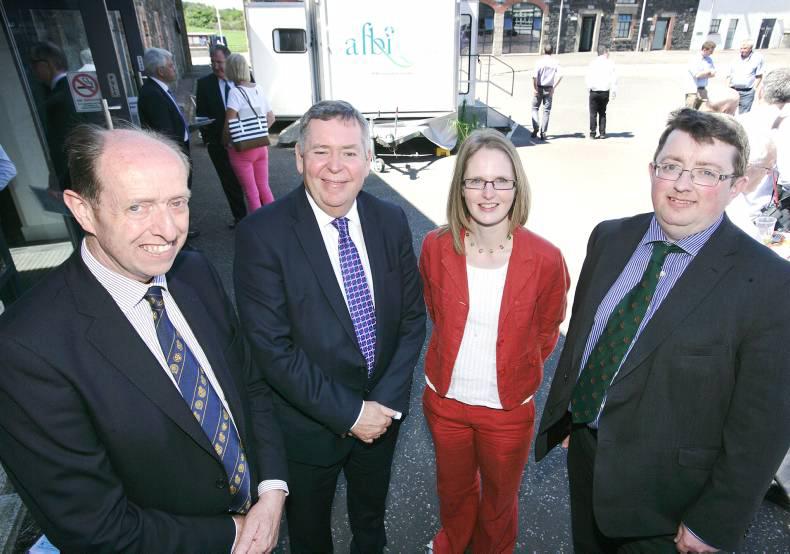
“It has been a very difficult 12 months,” acknowledged the chair of AFBI, Colm McKenna, speaking at an open day held at AFBI Hillsborough last week.
That open day was held to mark 10 years since the creation of AFBI in 2006. Up to that point, most of DARD’s research activity was conducted in-house as part of DARD Science Service. Under that sat a much smaller non-departmental public body (NDPB) in the form of the Agricultural Research Institute at Hillsborough.
However, in 2002, a review for the then Minister of Agriculture, Brid Rogers, conducted by Dr Dan O’Hare, recommended a number of changes to education activity and also research and development work within DARD. Among those changes was that the CAFRE colleges should merge with further education facilities and that all research and advisory work should be put together in a new NDPB.
In the end, CAFRE managed to avoid becoming part of a further education establishment, stayed within DARD, and kept their advisory function.
However, all research activity was lumped together into AFBI, and a new NDBP created, sponsored by DARD. The theory was that AFBI would be free from some of the constraints of being directly part of the civil service.
In reality, it created a separation, which has not been to the long-term benefit of the industry. Education, research and farm advice should all be together, not apart.
Looking ahead, AFBI chair Colm McKenna is adamant that the streamlining of AFBI to meet new budget targets is at an end.
“We believe we have completed the ‘shrink’ piece of our ‘shrink to grow strategy’ to 2020,” he told assembled guests last week. As well as losing staff, some work areas are to end including arable research and the publication of recommended grass lists.
AFBI Crossnacreevy is to close by 2019. Some research areas at AFBI Loughgall have also been cut and there are ongoing discussions with Teagasc about creating an all-island centre for top-fruit and mushroom research at the Loughgall site.
Maintenance
High maintenance and running costs mean AFBI would also like to move their headquarters out of Newforge Lane in Belfast. The preferred site is to relocate to AFBI Hillsborough. A business case is partially developed.
“We are also keen to modernise our other facilities, but not to replicate what is being done at CAFRE,” said McKenna.
With budgets tight, he is keen to develop closer links with CAFRE, which could involve sharing livestock and livestock accommodation in the future. Ten years after research was split off from education and advice, the future seems to point towards re-establishing those broken links.
McIlveen positive towards research
Critical to the future for AFBI will be the attitude of new Agriculture Minister Michelle McIlveen. In a short speech at the start of the open meeting, she emphasised the importance of research and innovation to the wider agri-food industry.
“I am aware that AFBI has been through a challenging period, and there are more challenges in the months and years ahead. But I want AFBI to succeed and flourish,” she said.
New CEO hopes to raise income
On 1 June 2016, Professor Elaine Watson took up the post as the new chief executive of AFBI. Originally from Scotland, her background is in equine medicine and research, and for the last four years she has been based in St Kitts in the Caribbean.
She told industry representatives at the open meeting that she is keen to meet and discuss with stakeholders how the organisation might develop in the future.
Challenge
With public sector finances under pressure, perhaps her greatest challenge will be to increase revenue from commercial sources coming into AFBI. “I am aware of the need to grow commercial income,” she said.
She has also a job of work to do to attract high quality scientists into the organisation given the void that has been left as a result of the voluntary exit scheme.
£3.6m boost to AFBI for new facilities
AFBI is one of a number of agri-food related facilities to benefit from UK government and commercial funding for a new Centre of Innovation and Excellence in Livestock (CIEL). Currently based in York, it will provide a central point for research projects which will then be delivered by various research institutes across the UK including AFBI. Industry partners include Devenish Nutrition, AgriSearch and Dunbia.
In total, AFBI has been allocated £3.6m of funding for new facilities over a four year period that will be invested in dairy, pigs, beef and sheep research. In the dairy sector the funding will focus on the grazing platform with plans to invest in tools to assess herbage quality, eating behaviour and also robotic milking systems in a grazing environment. In pigs, beef and sheep, the upgrade to facilities will mainly relate to measuring individual feed intake.


SHARING OPTIONS