The key driver of efficiency in grass-based systems is achieving a compact calving pattern. It is critical to get as many cows in-calf as quickly as possible after the breeding season begins. This means that high submission rates and good conception rates are essential.
A major factor affecting cow reproductive performance is the interval from calving to mating start date (ie the first day of the programme). This means that a herd’s calving pattern influences subsequent reproductive performance. This is important, because it indicates that letting calving pattern slip in one year has consequences for fertility performance in the following years. A second major factor is cow body condition score (BCS).
How is my breeding season likely to progress?
As a result of the spring forage shortage, cow condition is poor on many farms. This will increase the number of non-cycling cows in the herd, which will reduce submission rates.
If you have been carrying out pre-breeding heat detection, at least 70% of the cows need to have been detected in heat before mating start date. The target three-week submission rate in the first three weeks after mating start date is 90%.
This means that if you plan to breed 100 cows, 90 of them should be bred by 21 days after mating start date.
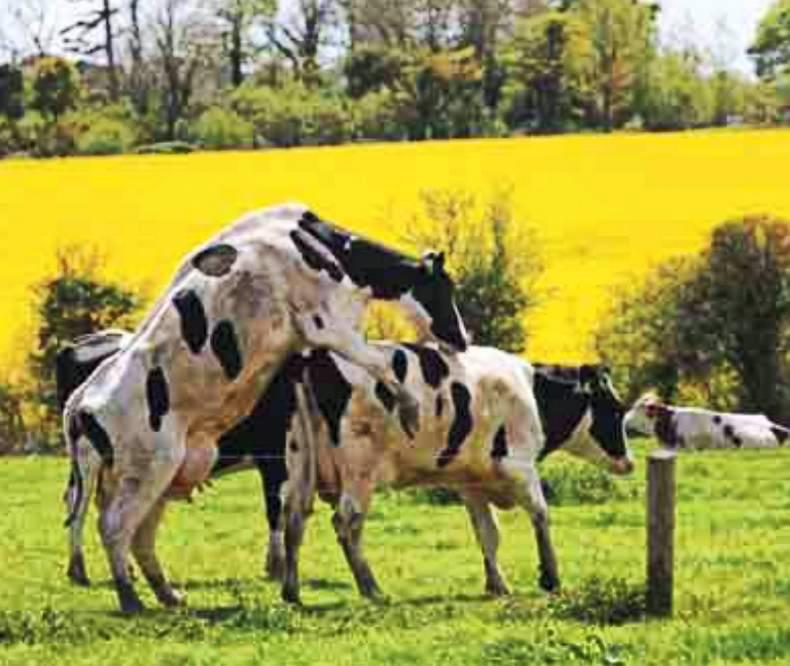
In seasonal calving systems, all cows are eligible for AI if they are observed displaying heat, regardless of days in milk.
As an early check on how submission rate is progressing, count the number of cows bred in the first 10 days. To be on track to achieve 90% submission rate, 43% of the cows should have been bred by 10 days after mating start date.
If your herd is well below this figure, it may be necessary to take early action to prevent a slippage in calving pattern.
What action can I take?
What can I do with non-cycling cows in the herd? Ideally, these cows should be treated to get them bred as soon as possible after mating start date.
Acceptable fertility performance can be achieved with anoestrous cows when they receive fixed-time AI after a synchronisation protocol that includes supplemental progesterone.
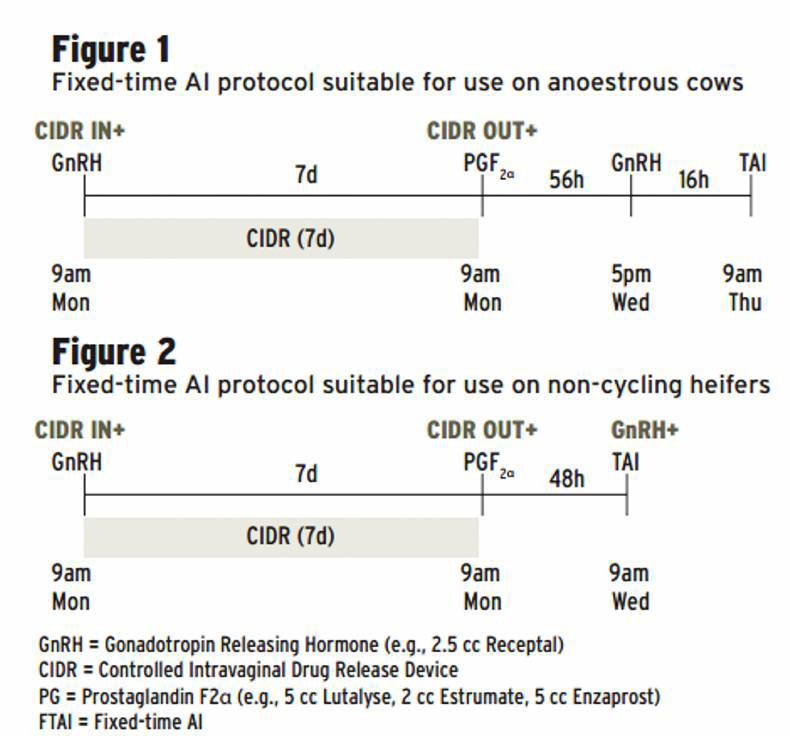
A fixed-time AI protocol is suitable for use on anoestrous cows. Cows should be at least 32 days calved before starting this treatment. A CIDR is inserted for seven days, with an injection of GnRH at the time of CIDR insertion and an injection of PGF2 at the same time as CIDR removal (after morning milking).
Fifty-six hours after CIDR removal, cows are administered a second injection of GnRH (after PM milking) allowing timed AI (TAI) 16 to 20 hours later (after the AM milking).
This fixed-time AI protocol has a number of advantages over conventional oestrus synchronisation.
First, there is no requirement for heat detection, as AI is carried out at a designated time at the end of the sequence of hormone treatments (of course, heat detection will still be necessary to pick up repeat heats in cows that fail to conceive).
Second, increased use of AI is easily facilitated, as you know in advance when the cow will be inseminated.
Third, if used early in the breeding season, it can increase the proportion of cows calving early in the following spring.
Are there additional options?
Increasing energy intake through additional concentrate feeding (up to 6kg to 7kg/cow per day) will allow the cow to more closely meet energy requirements. This will reduce BCS loss and increase the likelihood of a successful response to the hormonal treatment. In severe feed deficits, cow milk energy output can be temporarily reduced by adopting once-a-day milking. It is important to note that cows on once-a-day milking still require high levels of nutrition to prevent major reductions in milk output for the remainder of the lactation.
2013 Breeding season: Synchronisation for heifers
Well-bred heifers, if managed to calve early, have the potential to significantly improve herd calving pattern.
Synchronisation should be utilised as a management tool to maximise the number of heifers that become pregnant as quickly as possible after mating start date.
The most popular and cost-effective synchronisation protocols for heifers involve intramuscular injections of prostaglandin (eg Lutalyse Estrumate, Enzoprost, etc).
Prostaglandin synchronisation protocols work very well for heifers that have started cycling, but will not work in non-cycling heifers. The following protocol works well:
Apply heat detection aids to all heifers, and inseminate following observation of heat during the first six days of the breeding season. Many farmers have identified the “scratch card” (eg Estrotect, ScratchE) or “mount detector” (eg Heat Seeker, Bulling Beacon, CheckMate) heat detection aids as particularly useful for heifers.
All heifers not inseminated in the first six days receive a prostaglandin injection on day six, and are inseminated following heat observation in the next two to four days.
Heifers that failed to come into heat following the first injection of prostaglandin receive a second injection 11 to 14 days later.
The remaining heifers are again inseminated at a standing heat, or receive fixed-time AI at 72 and 96 hours after the second injection.
What about heifers that have not yet commenced cycling?
As a rule, it is not recommended to use hormone treatments to induce cyclicity in excessively light heifers, as they will be too small at calving.
It is important that light heifers receive preferential feeding for the following nine months to allow them to reach target weights and size at first calving. This will require monitoring of weights and weight gain.
A fixed-time AI protocol is suitable for use on non-cycling heifers. A CIDR is inserted for seven days, with an injection of GnRH at the time of CIDR insertion and an injection of PGF2 at the same time as CIDR removal (morning time). Forty-eight hours after CIDR removal, heifers are administered a second injection of GnRH and timed AI (TAI).
Key points
Given spring feed pressures, greater likelihood of non-cycling cows and maiden heifers in upcoming breeding season. Cows calved greater than 32 days which have not been submitted for AI can be treated with hormones and subsequently achieve good conception rates.Maiden heifers should be inseminated to standing heat for the first six days and any heifers not bred should then be injected. Get the basics right: Have a breeding chart on a wall and keep it updated. Keep cows topped up with tail paint. If using hormonal treatment listed here, make sure you follow the rules.
The key driver of efficiency in grass-based systems is achieving a compact calving pattern. It is critical to get as many cows in-calf as quickly as possible after the breeding season begins. This means that high submission rates and good conception rates are essential.
A major factor affecting cow reproductive performance is the interval from calving to mating start date (ie the first day of the programme). This means that a herd’s calving pattern influences subsequent reproductive performance. This is important, because it indicates that letting calving pattern slip in one year has consequences for fertility performance in the following years. A second major factor is cow body condition score (BCS).
How is my breeding season likely to progress?
As a result of the spring forage shortage, cow condition is poor on many farms. This will increase the number of non-cycling cows in the herd, which will reduce submission rates.
If you have been carrying out pre-breeding heat detection, at least 70% of the cows need to have been detected in heat before mating start date. The target three-week submission rate in the first three weeks after mating start date is 90%.
This means that if you plan to breed 100 cows, 90 of them should be bred by 21 days after mating start date.
In seasonal calving systems, all cows are eligible for AI if they are observed displaying heat, regardless of days in milk.
As an early check on how submission rate is progressing, count the number of cows bred in the first 10 days. To be on track to achieve 90% submission rate, 43% of the cows should have been bred by 10 days after mating start date.
If your herd is well below this figure, it may be necessary to take early action to prevent a slippage in calving pattern.
What action can I take?
What can I do with non-cycling cows in the herd? Ideally, these cows should be treated to get them bred as soon as possible after mating start date.
Acceptable fertility performance can be achieved with anoestrous cows when they receive fixed-time AI after a synchronisation protocol that includes supplemental progesterone.
A fixed-time AI protocol is suitable for use on anoestrous cows. Cows should be at least 32 days calved before starting this treatment. A CIDR is inserted for seven days, with an injection of GnRH at the time of CIDR insertion and an injection of PGF2 at the same time as CIDR removal (after morning milking).
Fifty-six hours after CIDR removal, cows are administered a second injection of GnRH (after PM milking) allowing timed AI (TAI) 16 to 20 hours later (after the AM milking).
This fixed-time AI protocol has a number of advantages over conventional oestrus synchronisation.
First, there is no requirement for heat detection, as AI is carried out at a designated time at the end of the sequence of hormone treatments (of course, heat detection will still be necessary to pick up repeat heats in cows that fail to conceive).
Second, increased use of AI is easily facilitated, as you know in advance when the cow will be inseminated.
Third, if used early in the breeding season, it can increase the proportion of cows calving early in the following spring.
Are there additional options?
Increasing energy intake through additional concentrate feeding (up to 6kg to 7kg/cow per day) will allow the cow to more closely meet energy requirements. This will reduce BCS loss and increase the likelihood of a successful response to the hormonal treatment. In severe feed deficits, cow milk energy output can be temporarily reduced by adopting once-a-day milking. It is important to note that cows on once-a-day milking still require high levels of nutrition to prevent major reductions in milk output for the remainder of the lactation.
2013 Breeding season: Synchronisation for heifers
Well-bred heifers, if managed to calve early, have the potential to significantly improve herd calving pattern.
Synchronisation should be utilised as a management tool to maximise the number of heifers that become pregnant as quickly as possible after mating start date.
The most popular and cost-effective synchronisation protocols for heifers involve intramuscular injections of prostaglandin (eg Lutalyse Estrumate, Enzoprost, etc).
Prostaglandin synchronisation protocols work very well for heifers that have started cycling, but will not work in non-cycling heifers. The following protocol works well:
Apply heat detection aids to all heifers, and inseminate following observation of heat during the first six days of the breeding season. Many farmers have identified the “scratch card” (eg Estrotect, ScratchE) or “mount detector” (eg Heat Seeker, Bulling Beacon, CheckMate) heat detection aids as particularly useful for heifers.
All heifers not inseminated in the first six days receive a prostaglandin injection on day six, and are inseminated following heat observation in the next two to four days.
Heifers that failed to come into heat following the first injection of prostaglandin receive a second injection 11 to 14 days later.
The remaining heifers are again inseminated at a standing heat, or receive fixed-time AI at 72 and 96 hours after the second injection.
What about heifers that have not yet commenced cycling?
As a rule, it is not recommended to use hormone treatments to induce cyclicity in excessively light heifers, as they will be too small at calving.
It is important that light heifers receive preferential feeding for the following nine months to allow them to reach target weights and size at first calving. This will require monitoring of weights and weight gain.
A fixed-time AI protocol is suitable for use on non-cycling heifers. A CIDR is inserted for seven days, with an injection of GnRH at the time of CIDR insertion and an injection of PGF2 at the same time as CIDR removal (morning time). Forty-eight hours after CIDR removal, heifers are administered a second injection of GnRH and timed AI (TAI).
Key points
Given spring feed pressures, greater likelihood of non-cycling cows and maiden heifers in upcoming breeding season. Cows calved greater than 32 days which have not been submitted for AI can be treated with hormones and subsequently achieve good conception rates.Maiden heifers should be inseminated to standing heat for the first six days and any heifers not bred should then be injected. Get the basics right: Have a breeding chart on a wall and keep it updated. Keep cows topped up with tail paint. If using hormonal treatment listed here, make sure you follow the rules.






SHARING OPTIONS