


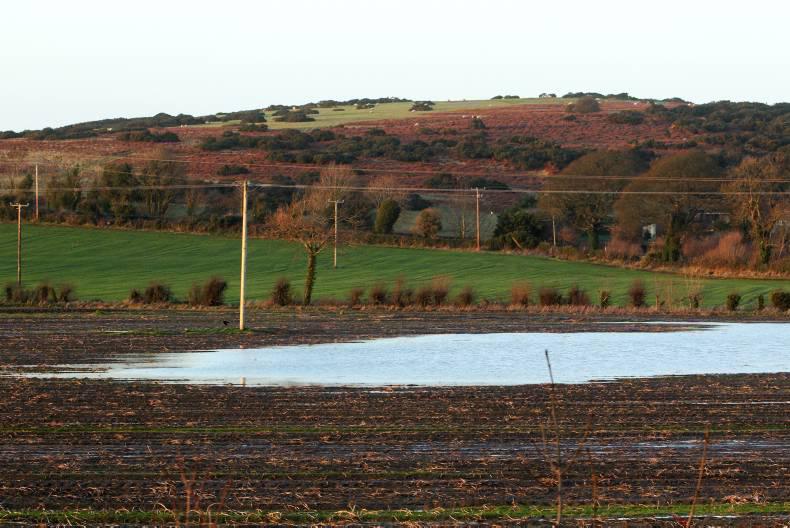
With over 40% of annual rainfall falling in December alone, Teagasc says that the consequences for cereal crops will be felt up to next harvest. Despite higher rainfall in other areas of the country, flooding in fields is evident across the tillage areas. Teagasc advisers have put flooding at 5% to 10% and at this stage and potential damage at less than 5% of the crop area.
Head of crops and energy knowledge transfer Michael Hennessy is advising tillage farmers on how to limit damage.
“There are a number of simple actions growers can take to help alleviate surface flooding. Checking land drains are flowing into drains unimpeded, checking drain outlets are not blocked with debris such as branches and leaves and where possible create a channel to let surface water run into dikes or ditches,” he said.
Michael added that “in order to reduce damage, it is very important to get the surface water to drain away as quickly as possible, so that oxygen can get to the leaves and roots.”
Higher-value crops
The most immediate impact will be felt by farmers with higher-value crops. A small number of farmers also have potatoes in the ground and under water. It will be some time before these crops can be harvested and losses are expected to be high.
Should I have a license to fish in a carrot field? pic.twitter.com/kzxwAo7eXR
— Julian Hughes (@JulianHughesAg) January 7, 2016Teagasc tillage adviser in Cork Ciaran Collins said: “There are substantial amounts of fodder beet in the ground waiting to be harvested. Ground conditions since mid-November halted harvesting and now stocks are running out, creating a fodder gap for farmers and a potential loss of sales for beet growers.”
The majority of the damage has been confined to areas flooded by rivers or low-lying areas. Teagasc adviser in Wexford Ciaran Hickey said that because the major flooding took place beside rivers in areas which were generally not sown to winter cereals, “most crops are reasonably ok.”
Although he added that “damage may not be apparent for some time on headlands or areas of the field with poor soil structure.”
Teagasc also advises that because winter barley is more sensitive to waterlogging than wheat, if it is under water for more than a couple of days, it is likely to be severely impacted.
IFA welcomes Taoiseach's commitment on flooding
Meanwhile, IFA flood project chairman Tom Turley has welcomed Enda Kenny’s commitment that common sense needs to be applied in relation to dredging of rivers to alleviate flooding. Turley also pointed out that the extent of the flood damage done on farms will not be identifiable until the floods have receded. At that time the Government should assess such damage which will include damage to land, crops and property as well as loss of stock.




SHARING OPTIONS