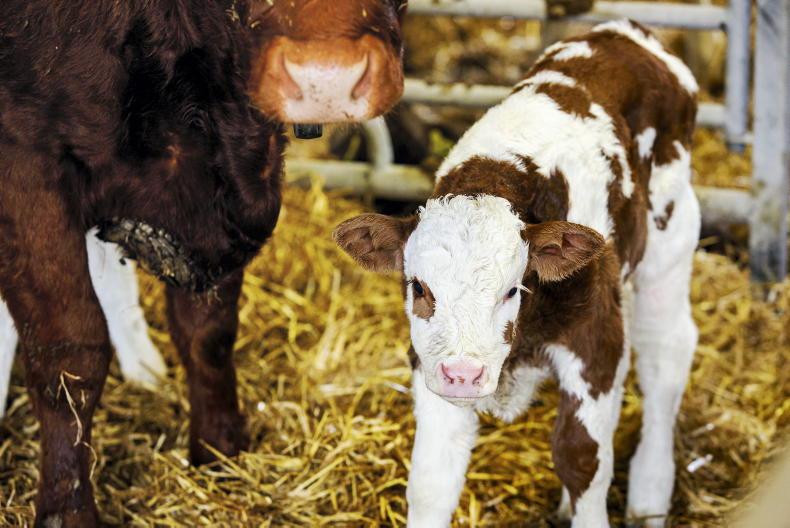
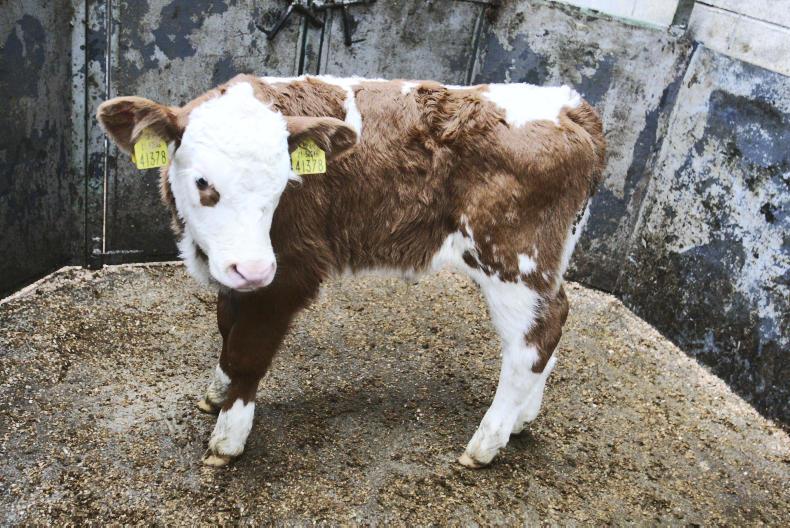
Calf weights: At Tullamore Show last Sunday, we had a demonstration on the Irish Farmers Journal stand with dairy weanling calves. We picked three calves from a commercial herd for the demo – two strong calves and one weaker calf. It was only when we weighed the calves did we realise how far behind the weaker calf was and that the strong calves were actually only just above the target weight. The target weight for all February-born calves expected to calve at 24 months old is to be 32% of their mature liveweight now.
The strong Friesian calf we had at the show weighed 188kg. If her mature liveweight is 550kg then her target weight today is 180kg so she is just above target. The strong crossbred weighed 155kg and her target weight is 150kg. But the light heifer, who was also born in February but didn’t get the same thrive as the others, only weighed 115kg – way behind the 180kg target for her category. When looking at them in a big bunch in the field, you wouldn’t think there was as much of a difference between them. The lesson? The calves should have been split up based on liveweight in May and weighed again four or six weeks later. At this stage, take out the lighter calves and give them preferential treatment – extra meal and don’t ask them to graze out paddocks fully.
Fertilisers: There are just three weeks left to spread fertiliser before the start of the closed period on 15 September. This deadline only relates to chemical nitrogen and phosphorus. Slurry, lime and potash can still be spread after this date. On fertilisers, it’s fairly obvious that a switch has been flicked in some farmers’ heads about the importance of soil fertility to grow grass. All the farms growing high volumes of grass are fixing the soil pH with lime and going out with a big bang of compounds now, spreading again in the spring and drip-feeding phosphorus (P) and potassium (K) over the summer. You should shop around for good deals. There are alternatives to just 18:6:12 and 10:10:20. I was talking to a farmer the other day who was quoted €100/t more for 18:20:0 over superphosphate which is 0:16:0. In my book the 18:20:0 was much better value as he was getting four units of P and 18 units of nitrogen for €100/t. While awkward, it might be cheaper to spread twice with different products rather than go for a convenient, but more expensive compound that has all your requirements in the one bag. Target more of K at this time of year to help prevent luxurious uptake causing milk fevers and grass tetany next spring.
ADVERTISEMENT
Autumn Calvers: As autumn-calving herds gear up for calving, the next couple of months will be tough. Low milk prices coupled with a big workload can cause stress. Ask yourself what you can do now to be more organised. Are the calf sheds ready? Are the slurry tanks emptied? Are you up to date on vaccines and doses? Anything you can do now to reduce the workload when cows start calving should be explored. Calving cows outdoors is a big saving on labour, as is outdoor calf rearing – at least until the weather turns bad.
Register for free to read this story and our free stories.
This content is available to digital subscribers and loyalty code users only. Sign in to your account, use the code or subscribe to get unlimited access.
The reader loyalty code gives you full access to the site from when you enter it until the following Wednesday at 9pm. Find your unique code on the back page of Irish Country Living every week.
CODE ACCEPTED
You have full access to the site until next Wednesday at 9pm.
CODE NOT VALID
Please try again or contact support.
Calf weights: At Tullamore Show last Sunday, we had a demonstration on the Irish Farmers Journal stand with dairy weanling calves. We picked three calves from a commercial herd for the demo – two strong calves and one weaker calf. It was only when we weighed the calves did we realise how far behind the weaker calf was and that the strong calves were actually only just above the target weight. The target weight for all February-born calves expected to calve at 24 months old is to be 32% of their mature liveweight now.
The strong Friesian calf we had at the show weighed 188kg. If her mature liveweight is 550kg then her target weight today is 180kg so she is just above target. The strong crossbred weighed 155kg and her target weight is 150kg. But the light heifer, who was also born in February but didn’t get the same thrive as the others, only weighed 115kg – way behind the 180kg target for her category. When looking at them in a big bunch in the field, you wouldn’t think there was as much of a difference between them. The lesson? The calves should have been split up based on liveweight in May and weighed again four or six weeks later. At this stage, take out the lighter calves and give them preferential treatment – extra meal and don’t ask them to graze out paddocks fully.
Fertilisers: There are just three weeks left to spread fertiliser before the start of the closed period on 15 September. This deadline only relates to chemical nitrogen and phosphorus. Slurry, lime and potash can still be spread after this date. On fertilisers, it’s fairly obvious that a switch has been flicked in some farmers’ heads about the importance of soil fertility to grow grass. All the farms growing high volumes of grass are fixing the soil pH with lime and going out with a big bang of compounds now, spreading again in the spring and drip-feeding phosphorus (P) and potassium (K) over the summer. You should shop around for good deals. There are alternatives to just 18:6:12 and 10:10:20. I was talking to a farmer the other day who was quoted €100/t more for 18:20:0 over superphosphate which is 0:16:0. In my book the 18:20:0 was much better value as he was getting four units of P and 18 units of nitrogen for €100/t. While awkward, it might be cheaper to spread twice with different products rather than go for a convenient, but more expensive compound that has all your requirements in the one bag. Target more of K at this time of year to help prevent luxurious uptake causing milk fevers and grass tetany next spring.
Autumn Calvers: As autumn-calving herds gear up for calving, the next couple of months will be tough. Low milk prices coupled with a big workload can cause stress. Ask yourself what you can do now to be more organised. Are the calf sheds ready? Are the slurry tanks emptied? Are you up to date on vaccines and doses? Anything you can do now to reduce the workload when cows start calving should be explored. Calving cows outdoors is a big saving on labour, as is outdoor calf rearing – at least until the weather turns bad.
If you would like to speak to a member of our team, please call us on 01-4199525.
Link sent to your email address
We have sent an email to your address. Please click on the link in this email to reset your password. If you can't find it in your inbox, please check your spam folder. If you can't find the email, please call us on 01-4199525.
ENTER YOUR LOYALTY CODE:
The reader loyalty code gives you full access to the site from when you enter it until the following Wednesday at 9pm. Find your unique code on the back page of Irish Country Living every week.





SHARING OPTIONS