Farmers are aware of the importance of servicing and maintaining oil levels regularly to ensure that they get maximum performance from their machine. Unfortunately, farmers do not have the same understanding of how ryegrass actually grows. As a result, they are not as familiar with the key management practices required to ensure they get maximum performance from their grass sward. In this article, we outline in simple terms how the engine in the ryegrass plant operates.
Similar to shamrock
You should think of ryegrass as being a bit like the shamrock. Both plants can only support the growth of three leaves at one time. When a fourth leaf starts to merge out of the top of the plant, the leaf at the bottom starts to die away. The rate at which the plant produces a new leaf will obviously depend on the time of year and growth rates. For example, in early spring a new leaf is produced every 30 to 40 days and therefore you need a long grazing rotation. However, during peak growing periods in May and June, a new leaf is produced every seven to eight days, requiring a grazing rotation in the region of days. The variation in the rate at which the plant produces a new leaf is the reason why you need to carry out a grass budget on a weekly basis. The aim of the grass budget is to simply match your rotation length to the time taken for the plant to grow three leaves.

Grass budgeting
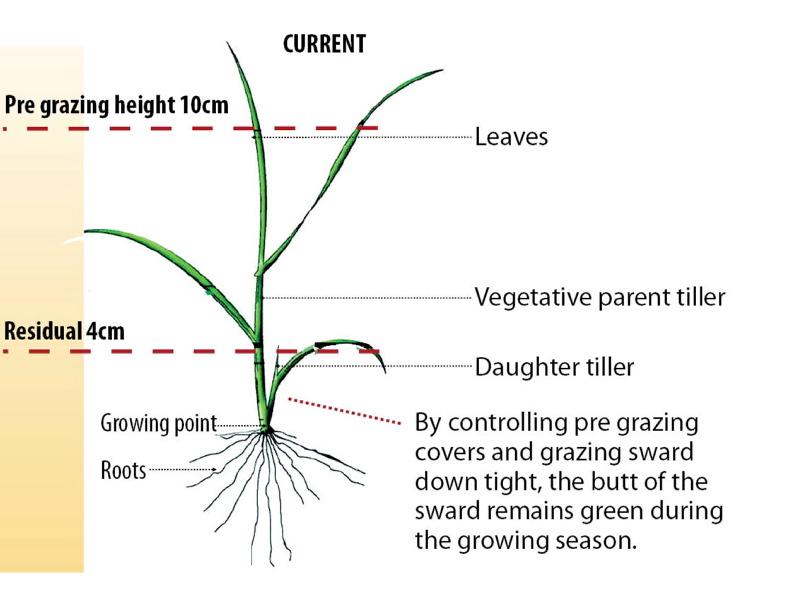
The inability of the ryegrass plant to support the growth of more than three leaves at any one time is the reason why you need to monitor growth rates and control pre-grazing covers throughout the grazing season. Figure 1 shows the stage at which ryegrass should be grazed. If the plant is allowed to continue to grow past this stage (above 10cm to 12cm), then a fourth leaf will appear out of the top. However, the bottom leaf will start to die away. It is these dead leaves that prevent swards from being grazed down tight (sward height of 3.5cm to 4cm). As a result, a butt of white dead grass accumulates at the bottom of the sward. This not only delays regrowth rates but also grass quality.
White butt slows regrowth
To understand the importance of grazing management, it is essential that we understand the re-growth cycle of the ryegrass plant. Firstly, it is important to realise that ryegrass is designed to survive continuous grazing. When the plant is grazed out, the first thing it has to do is get enough energy to grow the first leaf. This happens quickly where the butt of the grazed out sward is still green and free from dead leaves. The green leaf quickly traps the energy from the sun and along with energy reserves stored in the crown of the plant regrowth kicks in quickly.
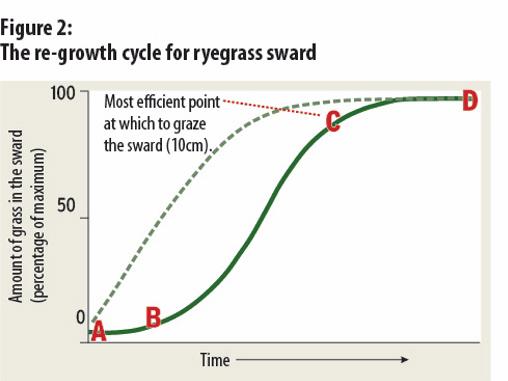
However, where a butt of dead white grass has been allowed to accumulate at the bottom of the sward, the plant has to rely solely on reserves of energy stored in the crown to produce the first green leaf. The establishment of this green leaf can delay sward regrowth rates by 10 to 14 days. This is shown in Figure 2.
The letter 'B' denotes the stage at which regrowth starts when the butt of the sward is green and free from dead white grass. As you can see, growth rates kick in right away. However, point 'A' is the starting point for a sward that has not been grazed out properly and the butt of the sward is white.
The lag phase between A and B reflects the time taken for the energy reserves in the crown to grow the first green leaf. This is the reason why silage swards that contain no green leaves after harvest are so slow to green up. They are relying solely on energy reserves in the crown to grow the first green leaf.
When the first green leaf has been established (point B, Figure 2), the plant quickly draws energy from the sun and then starts to grow the second leaf.
When the second leaf is established, growth is rapid as you have two leaves drawing in energy. The third leaf quickly appears and surplus energy is transferred back to the crown of the plant and stored for when the sward is grazed out.
Keeping growth in top gear
Figure 2 also shows the importance of grazing paddocks out after the third leaf has formed. From point C onwards the increase in the amount of grass in the paddock remains steady as the rate of growth is offset by the level of decay at the butt of the sward. Remember, the perennial ryegrass plant can only support three leaves. The secret to keeping growth high throughout the year is to keep the grass in your paddocks between points B and C.
Point B denotes the stage at which regrowth kicks in when a paddock is grazed down to 4cm and the butt of the sward is still green. At point C, a sward height of 12cm, you move in and graze the sward back down to 3.5cm to 4cm and the cycle starts over again. By doing this, you avoid the lag phase between points A and B and the lag phase between C and D. By not letting paddocks get too strong and slip into between points C and D, you will also ensure that the butt of the sward remains green when the paddock is grazed out.
If you start letting paddocks move above point C before grazing, a butt of dead white grass will quickly form at the bottom of the sward. This in turn will see regrowth starting at point A, with the plant depending solely on the energy reserves in the crown to get growth going again.
Do not tighten up the rotation
The growth cycle of the ryegrass plant highlights the importance of not being tempted to tighten up the rotation when grass supplies are tight. If you move in and graze paddocks when only two leaves are established, the plant will not have had sufficient time to replenish energy reserves in the crown. This will significantly reduce subsequent regrowth rates and therefore tighten grass supplies further.
White butt prevents tillering
Unlike your weed grasses, rye can also reproduce by tillering. Figure 1 shows the daughter tiller sprouting at the bottom of the sward. However, the daughter tiller will only appear where light is allowed to penetrate the butt.
This is one of the reasons why you need to continuously graze swards down tight to at least 3.5cm to 4cm. Not controlling pre-grazing covers and allowing a white butt of dead and unpalatable grass to accumulate at the bottom of the sward makes it almost impossible to graze swards out and let light penetrate the bottom.
It is especially important to ensure that swards are grazed down tight in the spring when daughter tillers are at their peak.
As each tiller only lasts three to six months, you need to ensure that new tillers are continuously being produced. This is the reason why grass growth rates and quality decline in the second half of the grazing season in swards that were not grazed down tight in the spring.
Seed head reduces growth rate
Producing the seed head takes a lot of energy out of the plant, energy that would have otherwise been used for leaf growth. Therefore, if you allow ryegrass to go to seed you are effectively reducing annual growth rates by up to 50%. Again, grazing swards down tight in the spring and early summer will ensure the seed head is continuously being grazed in the early stages of development. When the seed head is eaten, this will encourage the crown of the plant to produce more tillers and therefore increase sward density. A knock-on benefit of this will be that you will also be grazing out the seed head of the weed grasses. As their only means of reproduction is by going to seed, many of the weed grasses will naturally die out of swards that are grazed tight during the spring.
More grass less fertiliser
Growing more grass does not mean spreading more fertiliser. By understanding how the ryegrass plant works, beef and sheep farmers have the opportunity to increase annual pasture growth by at least 50% to 60%. While most farms spreading 200kg of N per hectare are growing 8-10t/DM/ ha per year, there is the potential to increase this up to 16-18/t/DM/ha without spreading any additional fertiliser. This is effectively increasing output on some farms by 100%. It all comes back to understanding the regrowth cycle of the ry grass plant and ensuring the plant does not go to seed. How you ensure this happens is by keeping your sward between points B and C (Figure 2) during the first half of the grazing season – grazing down to between 3.5cm and 4cm and not allowing pre-grazing covers to exceed 10cm to 12cm.
More grass more gain
By controlling pre- and post-grazing covers, you will also significantly improve grass quality and ultimately animal performance. When that first leaf emerges from the plant, it is equivalent in feed value to the best concentrate ration on the market. However, if you let your pre-grazing covers exceed 10cm to 12cm and allow that leaf to decay, its feed value at the point of grazing has been reduced.
Key points
The perennial ryegrass plant can only support three leaves. When the fourth leaves starts to emerge, the primary leaf at the butt of the sward starts to die away.It is these dead leaves that cause the butt of the sward to turn white.This white butt delays regrowth rates as there is not green material in the sward to pull energy out of the sun and give growth a kickstart. The plant has to rely on energy reserves stored in the crown alone.Where swards are grazed down tight during the summer and pre-grazing covers are restricted to 10cm to 12cm, then the butt of the sward will remain green when grazed out. This will speed up regrowth rates and increase annual production.By grazing swards down tight during the spring, you will quickly remove the seed head from the plant. This will encourage the crown of the plant to produce more tillers and therefore improve sward quality and density.By control pre-grazing heights and ensuring paddocks are grazed down tight throughout the spring, there is the potential to increase annual growth by up to 100% without the need for additional fertiliser.This article is an excerpt from 'Grazing Guide' which was published as a joint venture between the Irish Farmers Journal and Teagasc.
Read more
Grazing guide: The best use of autumn grass
Farmers are aware of the importance of servicing and maintaining oil levels regularly to ensure that they get maximum performance from their machine. Unfortunately, farmers do not have the same understanding of how ryegrass actually grows. As a result, they are not as familiar with the key management practices required to ensure they get maximum performance from their grass sward. In this article, we outline in simple terms how the engine in the ryegrass plant operates.
Similar to shamrock
You should think of ryegrass as being a bit like the shamrock. Both plants can only support the growth of three leaves at one time. When a fourth leaf starts to merge out of the top of the plant, the leaf at the bottom starts to die away. The rate at which the plant produces a new leaf will obviously depend on the time of year and growth rates. For example, in early spring a new leaf is produced every 30 to 40 days and therefore you need a long grazing rotation. However, during peak growing periods in May and June, a new leaf is produced every seven to eight days, requiring a grazing rotation in the region of days. The variation in the rate at which the plant produces a new leaf is the reason why you need to carry out a grass budget on a weekly basis. The aim of the grass budget is to simply match your rotation length to the time taken for the plant to grow three leaves.
Grass budgeting
The inability of the ryegrass plant to support the growth of more than three leaves at any one time is the reason why you need to monitor growth rates and control pre-grazing covers throughout the grazing season. Figure 1 shows the stage at which ryegrass should be grazed. If the plant is allowed to continue to grow past this stage (above 10cm to 12cm), then a fourth leaf will appear out of the top. However, the bottom leaf will start to die away. It is these dead leaves that prevent swards from being grazed down tight (sward height of 3.5cm to 4cm). As a result, a butt of white dead grass accumulates at the bottom of the sward. This not only delays regrowth rates but also grass quality.
White butt slows regrowth
To understand the importance of grazing management, it is essential that we understand the re-growth cycle of the ryegrass plant. Firstly, it is important to realise that ryegrass is designed to survive continuous grazing. When the plant is grazed out, the first thing it has to do is get enough energy to grow the first leaf. This happens quickly where the butt of the grazed out sward is still green and free from dead leaves. The green leaf quickly traps the energy from the sun and along with energy reserves stored in the crown of the plant regrowth kicks in quickly.
However, where a butt of dead white grass has been allowed to accumulate at the bottom of the sward, the plant has to rely solely on reserves of energy stored in the crown to produce the first green leaf. The establishment of this green leaf can delay sward regrowth rates by 10 to 14 days. This is shown in Figure 2.
The letter 'B' denotes the stage at which regrowth starts when the butt of the sward is green and free from dead white grass. As you can see, growth rates kick in right away. However, point 'A' is the starting point for a sward that has not been grazed out properly and the butt of the sward is white.
The lag phase between A and B reflects the time taken for the energy reserves in the crown to grow the first green leaf. This is the reason why silage swards that contain no green leaves after harvest are so slow to green up. They are relying solely on energy reserves in the crown to grow the first green leaf.
When the first green leaf has been established (point B, Figure 2), the plant quickly draws energy from the sun and then starts to grow the second leaf.
When the second leaf is established, growth is rapid as you have two leaves drawing in energy. The third leaf quickly appears and surplus energy is transferred back to the crown of the plant and stored for when the sward is grazed out.
Keeping growth in top gear
Figure 2 also shows the importance of grazing paddocks out after the third leaf has formed. From point C onwards the increase in the amount of grass in the paddock remains steady as the rate of growth is offset by the level of decay at the butt of the sward. Remember, the perennial ryegrass plant can only support three leaves. The secret to keeping growth high throughout the year is to keep the grass in your paddocks between points B and C.
Point B denotes the stage at which regrowth kicks in when a paddock is grazed down to 4cm and the butt of the sward is still green. At point C, a sward height of 12cm, you move in and graze the sward back down to 3.5cm to 4cm and the cycle starts over again. By doing this, you avoid the lag phase between points A and B and the lag phase between C and D. By not letting paddocks get too strong and slip into between points C and D, you will also ensure that the butt of the sward remains green when the paddock is grazed out.
If you start letting paddocks move above point C before grazing, a butt of dead white grass will quickly form at the bottom of the sward. This in turn will see regrowth starting at point A, with the plant depending solely on the energy reserves in the crown to get growth going again.
Do not tighten up the rotation
The growth cycle of the ryegrass plant highlights the importance of not being tempted to tighten up the rotation when grass supplies are tight. If you move in and graze paddocks when only two leaves are established, the plant will not have had sufficient time to replenish energy reserves in the crown. This will significantly reduce subsequent regrowth rates and therefore tighten grass supplies further.
White butt prevents tillering
Unlike your weed grasses, rye can also reproduce by tillering. Figure 1 shows the daughter tiller sprouting at the bottom of the sward. However, the daughter tiller will only appear where light is allowed to penetrate the butt.
This is one of the reasons why you need to continuously graze swards down tight to at least 3.5cm to 4cm. Not controlling pre-grazing covers and allowing a white butt of dead and unpalatable grass to accumulate at the bottom of the sward makes it almost impossible to graze swards out and let light penetrate the bottom.
It is especially important to ensure that swards are grazed down tight in the spring when daughter tillers are at their peak.
As each tiller only lasts three to six months, you need to ensure that new tillers are continuously being produced. This is the reason why grass growth rates and quality decline in the second half of the grazing season in swards that were not grazed down tight in the spring.
Seed head reduces growth rate
Producing the seed head takes a lot of energy out of the plant, energy that would have otherwise been used for leaf growth. Therefore, if you allow ryegrass to go to seed you are effectively reducing annual growth rates by up to 50%. Again, grazing swards down tight in the spring and early summer will ensure the seed head is continuously being grazed in the early stages of development. When the seed head is eaten, this will encourage the crown of the plant to produce more tillers and therefore increase sward density. A knock-on benefit of this will be that you will also be grazing out the seed head of the weed grasses. As their only means of reproduction is by going to seed, many of the weed grasses will naturally die out of swards that are grazed tight during the spring.
More grass less fertiliser
Growing more grass does not mean spreading more fertiliser. By understanding how the ryegrass plant works, beef and sheep farmers have the opportunity to increase annual pasture growth by at least 50% to 60%. While most farms spreading 200kg of N per hectare are growing 8-10t/DM/ ha per year, there is the potential to increase this up to 16-18/t/DM/ha without spreading any additional fertiliser. This is effectively increasing output on some farms by 100%. It all comes back to understanding the regrowth cycle of the ry grass plant and ensuring the plant does not go to seed. How you ensure this happens is by keeping your sward between points B and C (Figure 2) during the first half of the grazing season – grazing down to between 3.5cm and 4cm and not allowing pre-grazing covers to exceed 10cm to 12cm.
More grass more gain
By controlling pre- and post-grazing covers, you will also significantly improve grass quality and ultimately animal performance. When that first leaf emerges from the plant, it is equivalent in feed value to the best concentrate ration on the market. However, if you let your pre-grazing covers exceed 10cm to 12cm and allow that leaf to decay, its feed value at the point of grazing has been reduced.
Key points
The perennial ryegrass plant can only support three leaves. When the fourth leaves starts to emerge, the primary leaf at the butt of the sward starts to die away.It is these dead leaves that cause the butt of the sward to turn white.This white butt delays regrowth rates as there is not green material in the sward to pull energy out of the sun and give growth a kickstart. The plant has to rely on energy reserves stored in the crown alone.Where swards are grazed down tight during the summer and pre-grazing covers are restricted to 10cm to 12cm, then the butt of the sward will remain green when grazed out. This will speed up regrowth rates and increase annual production.By grazing swards down tight during the spring, you will quickly remove the seed head from the plant. This will encourage the crown of the plant to produce more tillers and therefore improve sward quality and density.By control pre-grazing heights and ensuring paddocks are grazed down tight throughout the spring, there is the potential to increase annual growth by up to 100% without the need for additional fertiliser.This article is an excerpt from 'Grazing Guide' which was published as a joint venture between the Irish Farmers Journal and Teagasc.
Read more
Grazing guide: The best use of autumn grass







SHARING OPTIONS