


“Rain, rain, go away, come again another day” – it might be a children’s nursery rhyme, but it chimes with the sentiments being expressed around here over the past month. We had two inches in one night again last week.
We had a great start to our spring work in March. Freezing conditions over winter left our ground in as mellow a condition as I have ever seen it. We opted for no-till as much as possible this spring as the ground was so loose and soft to begin with. Normally we only get to do this on about 25% of our acres.
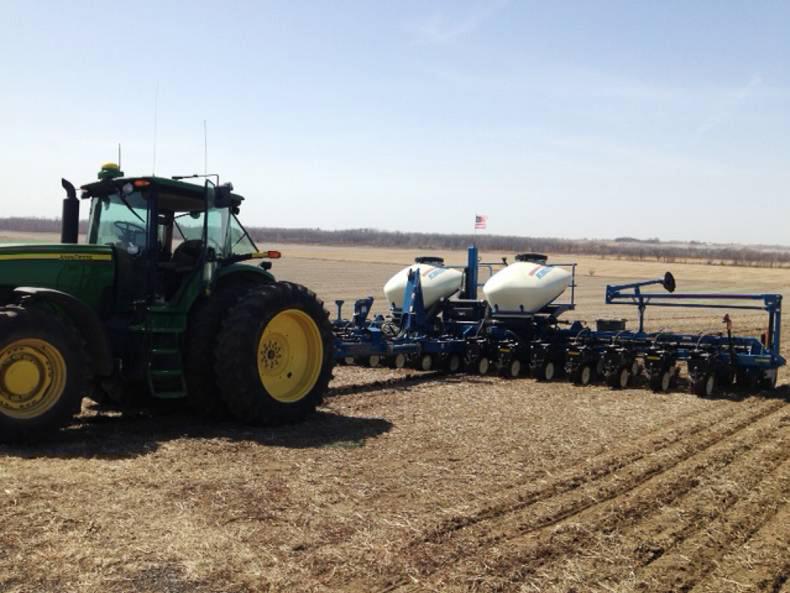
Corn planting was almost completed in these good conditions but then the rain came. We have no soyabeans planted yet this year, while this time last year all planting was completed. So the planters sit and wait and we do other things while waiting on dry weather to return. Our problem is that the rest of the country has progressed well with planting, so prices have continued to quietly slide lower.
It’s going to be another interesting year for sure ... greetings from Missouri!
So this spring is giving us additional challenges. We have been through such springs before but they usually translate to reduced yields. If this happens in conjunction with the lower prices we are seeing currently, this might be a breakeven year in farming.
Input costs
Input prices are higher again this year but fuel is down to around $2.25/US gallon (€0.55/litre) for farm diesel and $2.65/US gallon (€0.64/litre) for road fuel, so that helps. And since we decided to switch to more no-till this spring anyway, our fuel usage has dropped significantly. This helps to offset the higher input costs as our two biggest tillage tractors use 22-25 gallon (83-95 litres) per hour.
Crop care products have increased by their usual annual 2-6%. Fertiliser is also up on last year, but the level of increase depends very much on the products one is using. Fertilisers such as 11:52:0 Phosphate (11% N and 22.6% P), 0:0:60 Potash (50% K) and NH3 anhydrous (82% N) are all up about 10%.
Seed price is up for both corn and beans. The traited beans (mostly Roundup Ready and Liberty Link) range from $45 to $70 per 140,000 seed unit. It may interest you to know that soyabean seed used to be sold in 50lb units but since Monsanto introduced Roundup Ready beans in 1996, their licence agreements forced everyone to switch to a 140,000 unit instead of the traditional 50lb unit.
I personally resisted this change at our seed plant. However, the new GM genetics appear to have given bigger beans over the last few years and so the new seed units became more accepted as 140,000 seeds made more sense.
We plant between 155,000 and 175,000 seeds per acre and our average population is about 165,000. So for us a 140,000 bag plants 0.8 to 0.89 of an acre and we budget 1.25 bags per acre for purchases and seed production. So our seed production plant will now have bags of bean seed weighing from 38lb to 64lb per bag and they will all contain 140,000 seeds/bag.
Seed corn cost
There is an interesting debate taking place about seed corn, given the current low commodity prices. Growers are questioning the benefits of all the new GM traits, given that they all cost more and add to production cost.
Some seed corn is now costing close to $400 per bag (€367) and a bag contains 80,000 seeds. We drill between 25,000 and 31,500 seeds per acre on our farms so a bag will do 2.5 to 3.2 acres. We can buy good genetics without all these traits for $150 per bag (€138). So many farmers are now questioning the economics of this cost and asking if they really need all of the traits that are being promoted?
Spacing
Another debate taking place on our own farm relates to row spacing and plant population for corn. My brother (Mike) endorsed the idea of 10in rows and ultra-high populations last year.
One seed company here in the US is promoting ultra-high populations. If you use a 45ft planter and guarantee to purchase 1,200 bags of seed over a three-year period, the company will cost-share the planter and provide two-thirds of the cost so the farmer only has to come up with one-third of the cost of a new planter.
The problem is that you have to buy seed from that company for three years. And for a 60ft planter you need to commit 1,600 bags over three years. They promote populations of 45,000 to 55,000 seeds per acre, while on our most productive land we normally plant only 31,000 seeds per acre. So you increase your seed cost significantly on this one.
Another issue is that their breeding material (parent) uses determinate ears. So if growing conditions are less than perfect, ie hot and dry, and the ears are set on the crop, it could have lower yield than flex genetics.
That breeder also wants growers to apply extra nitrogen (somewhere between 40-60lb of product per acre), in addition to the anhydrous ammonia (approximately 140 units/acre) applied at sowing. So the cost goes up even more. They claim increased yields more than cover the extra costs to make it worthwhile.
I am not sure at this point. Last year I had some 30in rows that yielded 15 bushel/acre more than the two 10in test fields. This year Mike is planting all of his acres in 10in rows but the rest of our family is sticking to the proven 30in spacing. Time will tell on this one.
We also have another test going with corn. My two sons are working with a retail company called Big Cob (got to love that name) and they have gone the other way on seed populations. They are trying low population (18,000 to 24,000 seeds/acre) corn with full flex hybrids on several acres.
A full flex hybrid is supposedly bred to be able to respond better to weather conditions.
If things are good, the plant will adjust ear size up to provide higher potential but if the weather is tough, the ears will be smaller. Some companies promote flex hybrids but no one is really talking about full flex hybrids except the Big Cob company.
This idea is new to our farm but other farmers who tried it last year had great yields. So I am confident that the cost saving on seed, plus the ability of the plant to flex or adjust the ear size as conditions are better, will be successful and is likely to be more economical in the long run.
Time will tell on this one too. But as farmers we have to continuously study our own operations to judge what is best and what valid improvements we need to make to keep up with the changing times.
On the soyabean side, we are putting out more test plots and test strips. We are a little tired of everyone telling us they have the best genetics, or to treat, or to use our traits, or whatever.
So we are now doing a lot more research on our own farms instead of relying on sales people. When we control the whole process, plus the yield measuring ourselves, we will learn the good and bad of each.
Economics
Most of us farmers are confused about the future. Low prices are no fun for anyone. We knew a period of low prices would return but many younger farmers have never seen this environment of breakeven crops (or worse) and they are discouraged for sure. Some are accepting it and adapting as best they can.
We older farmers have been through this before and we are not enjoying it either but experience has taught us that low prices could last a while.
My dad, who is 76, has seen it a couple times and he just rolls along with it. He still plays a very active part in the farm and claims that it just takes him a little longer to do a job than he would like.
However, all three generations on this family farm are optimistic and we will survive the current downturn.
The dollar
I have never experienced the dollar being this strong so it is somewhat new to me in terms of planning a reaction. When we were farming in Brazil we watched the exchange rate between the dollar and the real and reacted as best we could.
At these rates our dollar is making our commodities a little pricey and less competitive in the world market. That said, one would think that our imported inputs would be cheaper and not higher as a consequence. Those of you using euro have a little economic advantage on us right now.
Interest rates
This is a positive at this time if you are borrowing. We just bought a nice neighbouring farm and the interest rate offered to us was 4.35% over 20 years; if you could handle 15 years, this dropped to 3.75%.
But remember that these rates only apply for 65% of value so you have to come up with 35% cash or value to make it work.
In the 1980 farm crisis I watched interest rates go to 18% and all of the problems of high interest and low commodity prices were not fun when I first got married and started farming. At least interest is reasonable this time.
On the flip side, if you are a pensioner or have money in savings at a bank, they are only offering 0.001% on interest. And with inflation at 3.5%, your savings are going backwards fast – not good.
We have no idea when interest rates will rise again – the Feds want to raise them but the economy is not good enough yet.
Land
Land sales have slowed down and prices have eased a bit. I would guess that poor ground has dropped about 10% more than prime ground, as is usual.
Rents
As high-priced rental contracts expire, tenants are attempting to get prices lowered for new agreements. Some have succeeded while others have not. I have noticed more landlords seeking new renters than usual. Some landlords were not willing to lower their rents so the tenants moved on and let the farm go to someone else.
As usual, good landlord-tenant relationships are working things out. But most still like cash rents versus crop share. On the farms we rent out to other farmers we utilise cash rents but they have been set at a price that is fair to all, in the good and now bad times, so nothing has changed for us on that side.
Government
We are still in the process of adjusting to the new five-year farm bill. So far we have had to make three trips in to our local office for different sign-up parts.
We still have to go in by June to report all acres planted – nothing like four trips to the FSA office (our Farm Service Agency), just to meet government programme requirements, to test everyone’s patience.
The new programme is complex and not really worth much in terms of value to most farmers. It does put a little support under tough times, but all of us would rather take our income from the market rather than some programme from government. So let’s hope prices increase and we return to better times.
From here on
We hope to be back in the fields in June. We did very little field work in May but we still hope to finish soon. You can only spend so long tinkering in the workshop while it is raining and mowing the yard twice a week is not really much therapy for a farmer who likes the smell of fresh dirt.


SHARING OPTIONS