


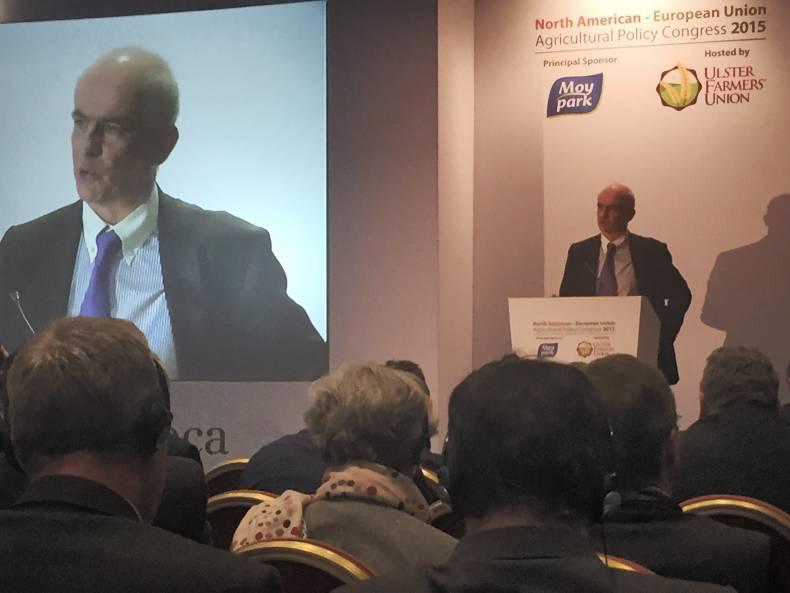


“Working together works” were the words of UFU president Ian Marshall in the closing session of the 37th North American-EU (NAEU) Agricultural Policy Congress at Templepatrick County Antrim on Friday. The two-day conference was hosted by the Ulster Farmers Union and this was the first time the event was held on the island of Ireland.
Delegates from farmer representative organisations across Europe and North America were welcomed by UFU president Ian Marshall and as well as the conference itself delegates had the opportunity to visit local farms to experience what exactly the family farm structure was like. The recurring theme of the congress was the need for farmer cooperation across the world with many admitting surprise at finding farmers everywhere shared so many problems and challenges. These ranged from dealing with weather, bureaucracy, regulation, price volatility, and cost of farm inputs.
The final day of the biennial event focused on opportunities and examples of cooperation within the agricultural sector.
President and CEO of Farmers of North America James Mann detailed how his company set up partnerships and business alliances between farmers to give them more bargaining power with high cost farm inputs as well as to create efficiencies in the distribution systems of these products.
Using fertiliser as an example, Mann said that Farmers of North America were working to get farmers to invest in a production facility for themselves. This was to lower the cost of fertiliser to levels closer to the cost of producing it. He said that some fertiliser companies in Canada have profits close to 50% of sales.
“We need to create competition or become involved in markets that make excess profits by finding ways to reduce the cost of production to make farming more profitable,” he said.
President of Cogeca, the umbrella organisation of European farmer co-operatives, Christian Pees said that by organising farmer co-operatives together, farmers could be become players in the industry at a global level.
Technology
Clive Blacker from UK Department of Trade and Investment said that he was convinced that farming was on the edge of technological boom with the availability and sharing of data being the driver of this.
“Data in its own right does not have a value, it is how we manage it and what we do to it that adds value,” he said.
Maria Dzelzkaleja, vice president of European farm organisation Copa, said that by using data and precision agriculture technologies farmers would save money as well as contribute to environmental benefits such as reduction of greenhouse gas emissions and water pollution.
She said that the role of farm advisory services and demonstration farms was imperative to educating farmers on how to use data from their farms and new technologies for the benefit of themselves and other farmers.
Further reports will follow in next week’s Irish Farmers Journal.





SHARING OPTIONS