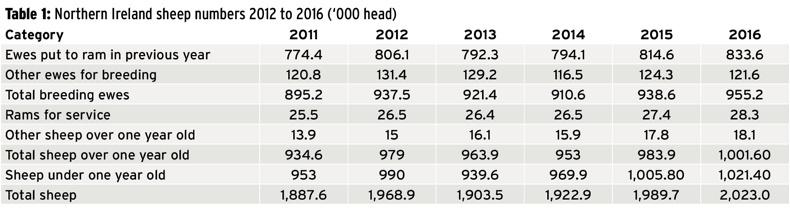
The recently released results of the June 2016 Northern Ireland Agricultural Census, collated by Department of Agriculture, Environment and Rural Affairs, shows sheep numbers at their highest level since 2007. As shown in Table 1, breeding ewe numbers maintained their upward momentum after falling to a 20-year low of 876,000 in 2010 and temporarily reducing in 2014.
The category of ewes put to the ram in the previous year increased 2% or 19,300 to 833,600 head. The number of other ewes on farm for breeding (dry hoggets) eased slightly from 124,300 in 2015 to 121,600, giving a net increase in total ewe numbers of 16,600 to reach 955,200 head.
The number of rams for service has also risen in line with an increase in ewe numbers and stood at 28,300 in June 2016, an increase of 900 head on 2015 levels.
As expected, a higher number of ewes put to the ram is generating higher lamb numbers. The number of sheep under one year old on farms last June increased from 1,005,800 in 2015 to 1,021,400 in 2016 – a lift of 15,600. This follows an increase of 35,900 from 2014 to 2015 with the total number of sheep on farms in June 2016 passing 2m for the first time since 2007.
Slaughter performance
Extra lambs in the system has also boosted the number of sheep available for slaughter in northern plants or export for direct slaughter to southern plants. The latter remains an important route to market for in the region of 40% of sheep traded of NI farms, as shown in the article on page 40, with 330,541 sheep exported south in 2015, 369,186 in 2014 and a massive 454,203 head in 2014.
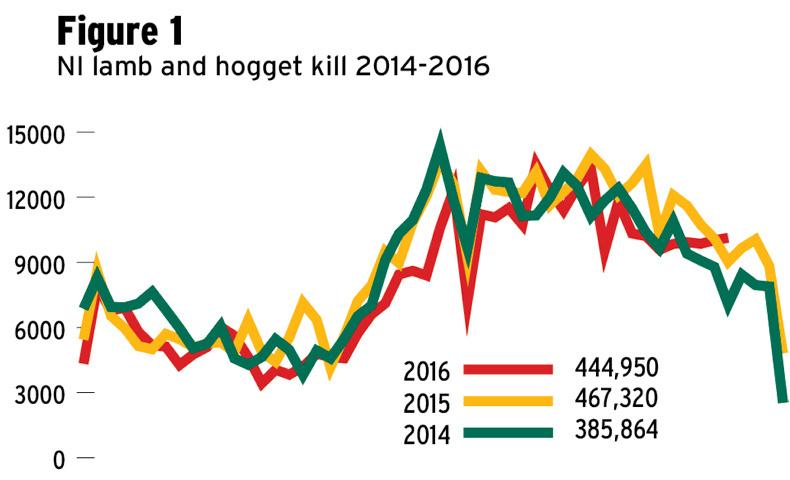
Figure 1 shows the NI lamb and hogget kill for the period 2014 to 2016. The kill for the year to date, at 385,864, is running behind the corresponding period in 2015 of 433,961 head.
The difference can be directly attributed to higher exports south, with a favourable exchange rate for southern buyers and tight lamb supplies adding a stronger source of competition into the trade for live lambs.

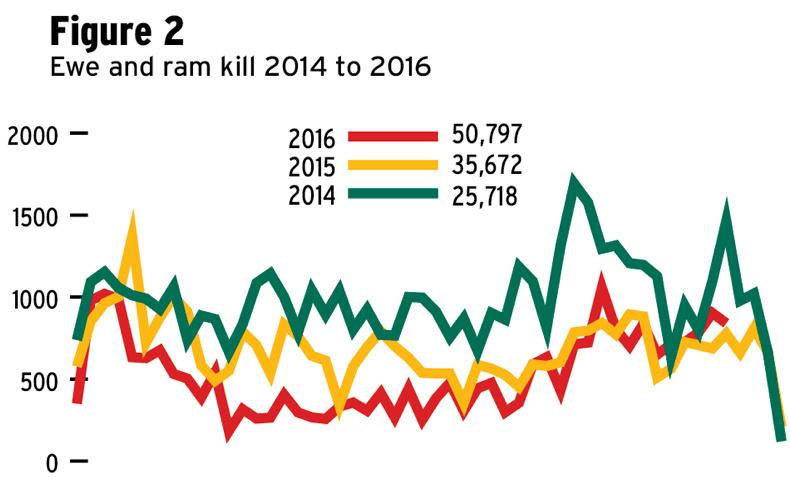
Figure 2 shows the weekly kill of ewes and rams for the same period. The number of ewes and rams processed in northern plants is in contrast to the south, where the ewe and ram kill has increased sharply. For the year to date, there were 25,718 ewes and rams slaughtered, well behind 33,325 during the same period in 2015 and 48,009 in 2014.


Read more
Counting the sheep supply for 2016/2017
Welsh sheep flock continues to expand
The recently released results of the June 2016 Northern Ireland Agricultural Census, collated by Department of Agriculture, Environment and Rural Affairs, shows sheep numbers at their highest level since 2007. As shown in Table 1, breeding ewe numbers maintained their upward momentum after falling to a 20-year low of 876,000 in 2010 and temporarily reducing in 2014.
The category of ewes put to the ram in the previous year increased 2% or 19,300 to 833,600 head. The number of other ewes on farm for breeding (dry hoggets) eased slightly from 124,300 in 2015 to 121,600, giving a net increase in total ewe numbers of 16,600 to reach 955,200 head.
The number of rams for service has also risen in line with an increase in ewe numbers and stood at 28,300 in June 2016, an increase of 900 head on 2015 levels.
As expected, a higher number of ewes put to the ram is generating higher lamb numbers. The number of sheep under one year old on farms last June increased from 1,005,800 in 2015 to 1,021,400 in 2016 – a lift of 15,600. This follows an increase of 35,900 from 2014 to 2015 with the total number of sheep on farms in June 2016 passing 2m for the first time since 2007.
Slaughter performance
Extra lambs in the system has also boosted the number of sheep available for slaughter in northern plants or export for direct slaughter to southern plants. The latter remains an important route to market for in the region of 40% of sheep traded of NI farms, as shown in the article on page 40, with 330,541 sheep exported south in 2015, 369,186 in 2014 and a massive 454,203 head in 2014.
Figure 1 shows the NI lamb and hogget kill for the period 2014 to 2016. The kill for the year to date, at 385,864, is running behind the corresponding period in 2015 of 433,961 head.
The difference can be directly attributed to higher exports south, with a favourable exchange rate for southern buyers and tight lamb supplies adding a stronger source of competition into the trade for live lambs.
Figure 2 shows the weekly kill of ewes and rams for the same period. The number of ewes and rams processed in northern plants is in contrast to the south, where the ewe and ram kill has increased sharply. For the year to date, there were 25,718 ewes and rams slaughtered, well behind 33,325 during the same period in 2015 and 48,009 in 2014.
Read more
Counting the sheep supply for 2016/2017
Welsh sheep flock continues to expand





SHARING OPTIONS