Over the last 45 years, the application of lime as a major soil nutrient has declined more than two-fold, resulting in Irish soils now being majorly deficient in lime. In the 1970s and early 1980s, there was an average of 1.7m tonnes of lime applied annually. Over the last 30 years, we have applied an average of 800,000t of lime annually (less than half).
In Ireland, our soils naturally have a requirement for lime to control soil acidity generated by our high annual rainfall. For example, from the east to the west coast we get in the region of 40in to 60in of rain each year. Rainfall is the biggest driver of soil acidity and reducing the production power of our soils. The accumulated reduction in lime applications over the last 30 years has resulted in a large percentage of soils with low pH levels. Irish soils are some of the most productive in the world in terms of either grass and grain production due to our wet climate, but if we continue to ignore lime – a key component of soil fertility – we are slowly eroding away our competitive advantage.
Soil acidity is a major limitation to the productivity of our soils as it reduces the availability of major soil nutrients (N, P and K) and the uptake and efficiency of applied nutrients in manures or fertilisers. In grassland swards, it will reduce the persistency of productive ryegrasses and clovers. Some counties, for example Kildare and Offaly, have a higher percentage of soils above pH 6.5. This is due to the underlying parent material which is limestone. Naturally high soil pH levels (>pH 7.0) or fields that are over-limed will result in reduced availability of both major (especially P) and minor nutrients (especially Mn). Only apply lime based on a recent soil test report.
Effect of lime on soil fertility
and grass production
Research from Johnstown Castle demonstrates the importance of lime in relation to soil P availability and the improved efficiency from applied P fertiliser.
Figure 1 shows the change in soil test P levels when lime is applied by unlocking stored soil P (blue bar) and increasing the efficiency of freshly applied fertiliser P (green bar) compared with applying high quantities of P fertiliser alone (red bar). This clearly shows that soil pH optimisation is the first step to consider when setting out to build up soil P levels.
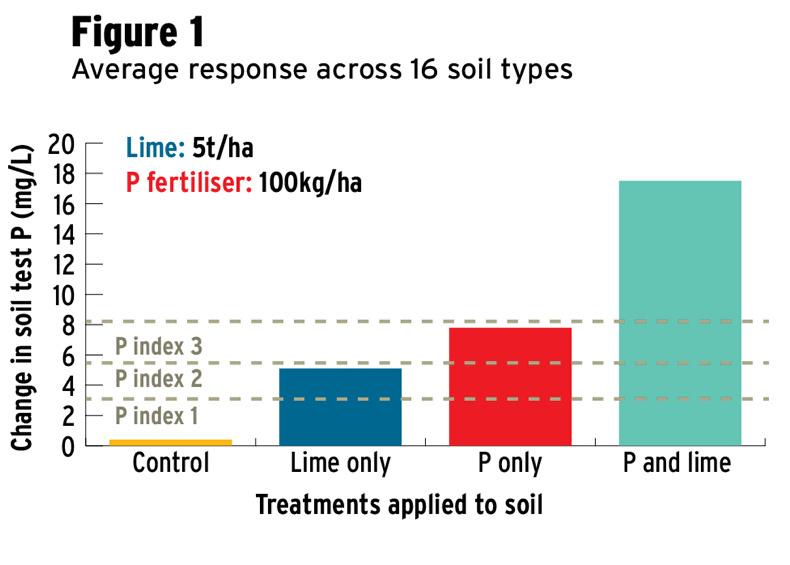
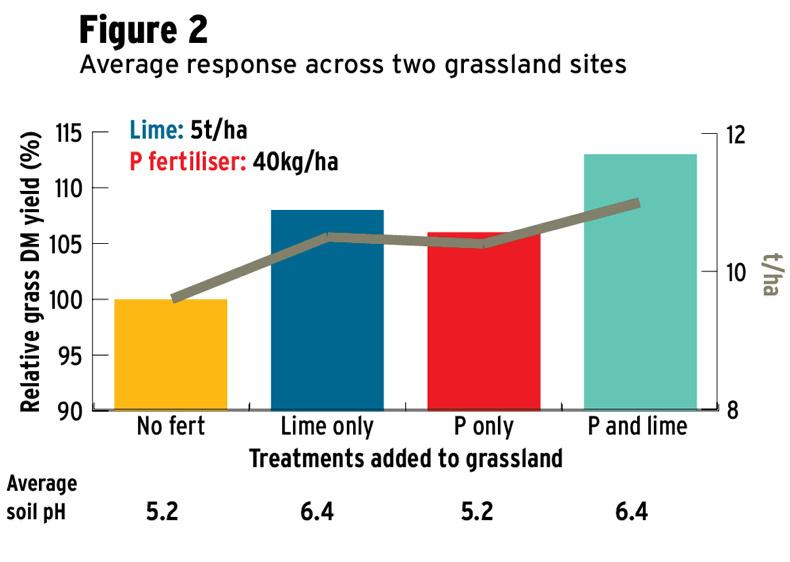
Figure 2 shows the grass yield response to lime and P fertiliser in grassland. The application of 5t/ha ground limestone (blue bar) produced approximately 1t DM/ha additional grass and had similar grass yields compared with the application of 40 kg/ha P fertiliser alone (red bar). However, the addition of lime + P fertiliser in combination (green bar) produced the largest grass yield response (1.5t/ha more grass than the control). These results show how effective lime is at increasing the availability of both stored soil P (from previous fertiliser and manure applications) and freshly applied fertiliser P.
Return on investment in lime
As with any business, achieving a positive return on investment is critical when using inputs. When the pH of grassland soils are maintained close to the optimum range, increased grass production of at least 1.0t DM/ha/year can be achieved. In addition to P and K release from the soil, N supply worth up to €75 may also be achieved, boosting spring growth in particular. If this extra grass production is utilised by the grazing livestock, it has the potential to reduce farm feed bills by at least €180/ha year. One tonne of additional grass production each year over a typical five-year liming period (5 t/ha lime applied) represents a 7:1 (grass €180/t: lime €25/t) return on investment in lime, not including the potential for reducing fertiliser costs into the future.
Management tips when applying lime to grassland
Apply lime based on the soil test report. Where lime recommendations exceed 7.5t/ha, it is best to split the total application rate and apply up to 7.5t/ha initially and the remainder in year three.Do not over-lime soils as it will reduce the availability of both major and minor nutrients.Ground limestone is the most cost-effective source of lime. Ground limestone will start to work once it is applied and is washed into the soil. The finer fractions of the ground limestone will adjust soil pH upwards to target soil pH over the shorter term (pH increases should begin within three months) while the coarser components will maintain this pH adjustment over the longer term (12- to 36-month period).Use magnesium limestone where soil magnesium (Mg) levels are low to replenish soil Mg reserves.Maintaining soil pH will result in increased release of soil N from organic matter up to a value of €75/ha/year. This N release usually occurs in spring and contributes to better early season growth, facilitating earlier stock turnout.On heavier and organic soils, there is often hesitance to applying lime for fear of softening the sod or increased poaching (due to the rapid breakdown of soil organic matter). On these soils, it is best to apply lower application rates of lime (<5t/ha) on a more regular basis to control soil acidity to avoid “softening the soil".Wait seven days after applying urea or slurry before applying lime.Leave three months between applying lime first and following with urea/slurry application.Leave at least three months between liming and silage harvest.On grassland soils with high molybdenum (Mo) levels, increasing soil pH above 6.2 can lead to increased Mo levels in the herbage. High intakes of Mo in ruminant animals can lead to an increased risk of copper deficiency. It is therefore recommended to maintain soil pH at 6.2 on these soils or consider supplementing animals with copper.Granulated limes are a finely ground limestone (<0.1mm), aiding the reaction with soil acidity to increase soil pH in the shorter term. Recent research shows that these products (usually used at much lower application rates than ground limestone) are more suitable for maintaining soil pH (ie where soil pH is close to the target).Apply lime as recommended on the soil test report.Release of soil nitrogen (N) for early grass growth (up 80kg N/ha/year).Increase the availability of soil phosphorus (P) and potassium (K).Grow an extra 1t to 1.5t grass dry matter per hectare annually.Every €100 investment in lime = €700 in extra grass production. Read more
Special focus: spring planning and soil fertility
Over the last 45 years, the application of lime as a major soil nutrient has declined more than two-fold, resulting in Irish soils now being majorly deficient in lime. In the 1970s and early 1980s, there was an average of 1.7m tonnes of lime applied annually. Over the last 30 years, we have applied an average of 800,000t of lime annually (less than half).
In Ireland, our soils naturally have a requirement for lime to control soil acidity generated by our high annual rainfall. For example, from the east to the west coast we get in the region of 40in to 60in of rain each year. Rainfall is the biggest driver of soil acidity and reducing the production power of our soils. The accumulated reduction in lime applications over the last 30 years has resulted in a large percentage of soils with low pH levels. Irish soils are some of the most productive in the world in terms of either grass and grain production due to our wet climate, but if we continue to ignore lime – a key component of soil fertility – we are slowly eroding away our competitive advantage.
Soil acidity is a major limitation to the productivity of our soils as it reduces the availability of major soil nutrients (N, P and K) and the uptake and efficiency of applied nutrients in manures or fertilisers. In grassland swards, it will reduce the persistency of productive ryegrasses and clovers. Some counties, for example Kildare and Offaly, have a higher percentage of soils above pH 6.5. This is due to the underlying parent material which is limestone. Naturally high soil pH levels (>pH 7.0) or fields that are over-limed will result in reduced availability of both major (especially P) and minor nutrients (especially Mn). Only apply lime based on a recent soil test report.
Effect of lime on soil fertility
and grass production
Research from Johnstown Castle demonstrates the importance of lime in relation to soil P availability and the improved efficiency from applied P fertiliser.
Figure 1 shows the change in soil test P levels when lime is applied by unlocking stored soil P (blue bar) and increasing the efficiency of freshly applied fertiliser P (green bar) compared with applying high quantities of P fertiliser alone (red bar). This clearly shows that soil pH optimisation is the first step to consider when setting out to build up soil P levels.
Figure 2 shows the grass yield response to lime and P fertiliser in grassland. The application of 5t/ha ground limestone (blue bar) produced approximately 1t DM/ha additional grass and had similar grass yields compared with the application of 40 kg/ha P fertiliser alone (red bar). However, the addition of lime + P fertiliser in combination (green bar) produced the largest grass yield response (1.5t/ha more grass than the control). These results show how effective lime is at increasing the availability of both stored soil P (from previous fertiliser and manure applications) and freshly applied fertiliser P.
Return on investment in lime
As with any business, achieving a positive return on investment is critical when using inputs. When the pH of grassland soils are maintained close to the optimum range, increased grass production of at least 1.0t DM/ha/year can be achieved. In addition to P and K release from the soil, N supply worth up to €75 may also be achieved, boosting spring growth in particular. If this extra grass production is utilised by the grazing livestock, it has the potential to reduce farm feed bills by at least €180/ha year. One tonne of additional grass production each year over a typical five-year liming period (5 t/ha lime applied) represents a 7:1 (grass €180/t: lime €25/t) return on investment in lime, not including the potential for reducing fertiliser costs into the future.
Management tips when applying lime to grassland
Apply lime based on the soil test report. Where lime recommendations exceed 7.5t/ha, it is best to split the total application rate and apply up to 7.5t/ha initially and the remainder in year three.Do not over-lime soils as it will reduce the availability of both major and minor nutrients.Ground limestone is the most cost-effective source of lime. Ground limestone will start to work once it is applied and is washed into the soil. The finer fractions of the ground limestone will adjust soil pH upwards to target soil pH over the shorter term (pH increases should begin within three months) while the coarser components will maintain this pH adjustment over the longer term (12- to 36-month period).Use magnesium limestone where soil magnesium (Mg) levels are low to replenish soil Mg reserves.Maintaining soil pH will result in increased release of soil N from organic matter up to a value of €75/ha/year. This N release usually occurs in spring and contributes to better early season growth, facilitating earlier stock turnout.On heavier and organic soils, there is often hesitance to applying lime for fear of softening the sod or increased poaching (due to the rapid breakdown of soil organic matter). On these soils, it is best to apply lower application rates of lime (<5t/ha) on a more regular basis to control soil acidity to avoid “softening the soil".Wait seven days after applying urea or slurry before applying lime.Leave three months between applying lime first and following with urea/slurry application.Leave at least three months between liming and silage harvest.On grassland soils with high molybdenum (Mo) levels, increasing soil pH above 6.2 can lead to increased Mo levels in the herbage. High intakes of Mo in ruminant animals can lead to an increased risk of copper deficiency. It is therefore recommended to maintain soil pH at 6.2 on these soils or consider supplementing animals with copper.Granulated limes are a finely ground limestone (<0.1mm), aiding the reaction with soil acidity to increase soil pH in the shorter term. Recent research shows that these products (usually used at much lower application rates than ground limestone) are more suitable for maintaining soil pH (ie where soil pH is close to the target).Apply lime as recommended on the soil test report.Release of soil nitrogen (N) for early grass growth (up 80kg N/ha/year).Increase the availability of soil phosphorus (P) and potassium (K).Grow an extra 1t to 1.5t grass dry matter per hectare annually.Every €100 investment in lime = €700 in extra grass production. Read more
Special focus: spring planning and soil fertility







SHARING OPTIONS