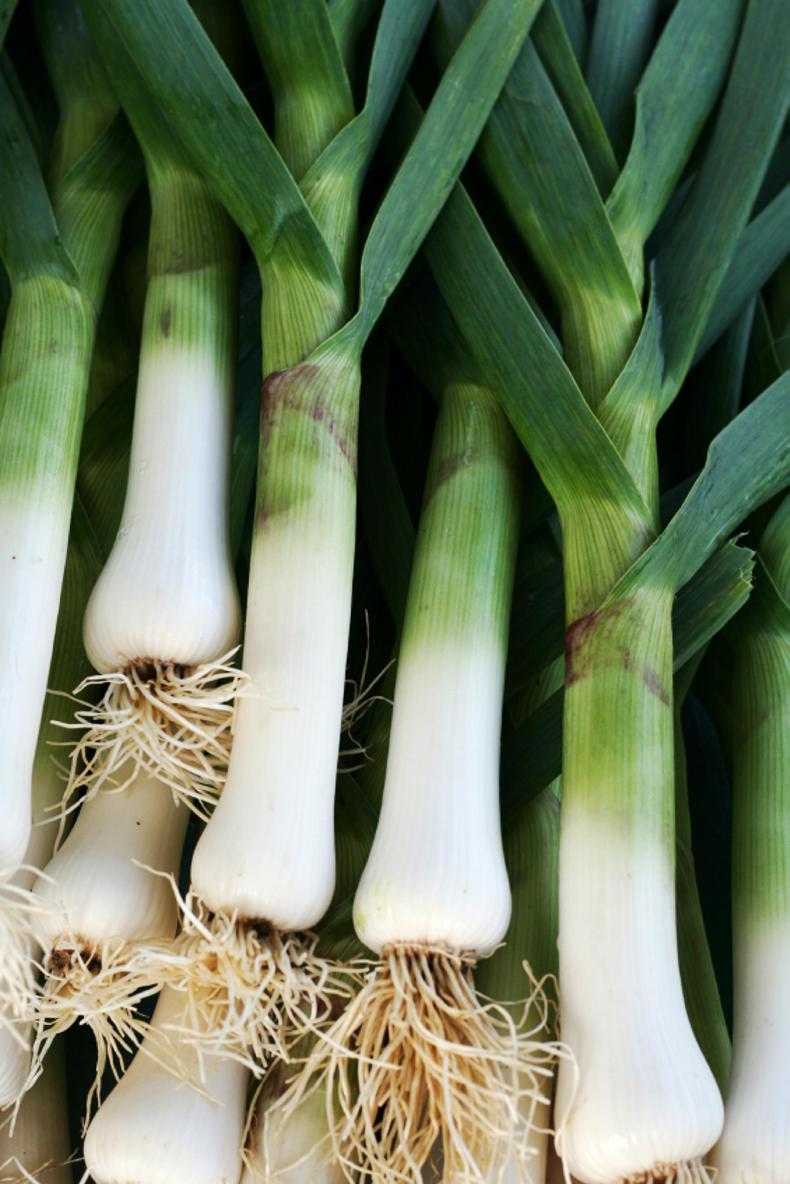
Now that my vegetable patch is really starting to wind down for the winter months, there are just five fresh vegetables left in the ground holding the fort: parsnips, carrots, celeriac, kale and leeks. There’s a fine crop of leeks this year in the garden. While there are still so many other wonderful vegetables (such as celeriac, carrots, pumpkin, squash, etc) to eat from the veg patch and the larder, we try to hold off until post-Christmas to start delving into the leeks. In fact, the St Stephen’s Day stalwart of turkey and leek pie is normally the first outing for them (a whopping 2kg of them in fact).
Leeks often don’t grab the health headlines the way their allium cousins (garlic and onions) do, but they contain most of the same flavonoids and nutrients. Just 100g of leeks contain over half of your daily vitamin K requirements, 30% of vitamin A and high levels of vitamins B and C, iron and folate. There is a traditional, and rather unlikely in my view, link between a strong voice and the consumption of leeks – with the Roman emperor Nero supposedly eating them daily to make his voice stronger. It was the Romans in fact who are credited with introducing leeks to these parts, and they did well here since they are unaffected by winter cold.
They were so popular across the Irish sea that they became the national emblem of Wales and the national soup of Scotland.
Just 100g of leeks contain over half of your daily vitamin K requirements, 30% of vitamin A and high levels of vitamins B and C, iron and folate.
Leeks are quite easy to grow and you can get a decent amount of them in a relatively small space. I sow mine in module trays before transplanting them to the veg patch outside, about two months later. Though a tiny black seed, they are very reliable to grow. I just pop one or two seeds in each module at 1cm deep and within a fortnight they will germinate and quickly develop into a long, often straggly seedling.
If two little seedlings grow in each module, you have a decision to make when planting out. If you plant them in the same hole you will get two smaller leeks growing together. If you take them apart and plant them in two separate holes, you will get two larger leeks growing apart. It’s really up to you. I generally sow one decent batch of them some time in March/April and start eating them in December.
The Basics – Puddling In
The traditional process of planting leeks is somewhat of a palaver called “puddling in”. You make a 6in hole with a dibber, drop the leek in and then fill the hole gently with water. Do not backfill with soil – over the coming weeks it will fill itself.
I’ve heard Klaus Laitenberger in a talk, wondering why we would put the poor little seedlings through such nonsense and stress. He advocates planting them as you would any seedling. Make a hole, pop in the seedling and backfill with soil. Job done. Again, I’ve tried both methods and haven’t noticed any difference, so I think his way is probably easier.
Leave 15cm between plants and 30cm between rows. Keep the leek bed well weeded. Leeks have to be earthed up during the growing season – this process encourages the bleaching or whitening of the stem. If you don’t earth up you will be left with leeks which are predominantly green with just a small amount of edible white stem. Earth up twice during the season.
When harvesting, don’t try and pull the leek out of the soil by the top as you would a carrot – their roots are surprisingly fibrous and strong – use a fork. Winter varieties can stay in the ground until needed, although in a very harsh winter you might need to use them up – constant freezing and thawing will eventually turn them to mush. CL
Read more
GIY: there is always a cost to cheap food down the line
GIY: Rewards to be reaped in the veg patch
Now that my vegetable patch is really starting to wind down for the winter months, there are just five fresh vegetables left in the ground holding the fort: parsnips, carrots, celeriac, kale and leeks. There’s a fine crop of leeks this year in the garden. While there are still so many other wonderful vegetables (such as celeriac, carrots, pumpkin, squash, etc) to eat from the veg patch and the larder, we try to hold off until post-Christmas to start delving into the leeks. In fact, the St Stephen’s Day stalwart of turkey and leek pie is normally the first outing for them (a whopping 2kg of them in fact).
Leeks often don’t grab the health headlines the way their allium cousins (garlic and onions) do, but they contain most of the same flavonoids and nutrients. Just 100g of leeks contain over half of your daily vitamin K requirements, 30% of vitamin A and high levels of vitamins B and C, iron and folate. There is a traditional, and rather unlikely in my view, link between a strong voice and the consumption of leeks – with the Roman emperor Nero supposedly eating them daily to make his voice stronger. It was the Romans in fact who are credited with introducing leeks to these parts, and they did well here since they are unaffected by winter cold.
They were so popular across the Irish sea that they became the national emblem of Wales and the national soup of Scotland.
Just 100g of leeks contain over half of your daily vitamin K requirements, 30% of vitamin A and high levels of vitamins B and C, iron and folate.
Leeks are quite easy to grow and you can get a decent amount of them in a relatively small space. I sow mine in module trays before transplanting them to the veg patch outside, about two months later. Though a tiny black seed, they are very reliable to grow. I just pop one or two seeds in each module at 1cm deep and within a fortnight they will germinate and quickly develop into a long, often straggly seedling.
If two little seedlings grow in each module, you have a decision to make when planting out. If you plant them in the same hole you will get two smaller leeks growing together. If you take them apart and plant them in two separate holes, you will get two larger leeks growing apart. It’s really up to you. I generally sow one decent batch of them some time in March/April and start eating them in December.
The Basics – Puddling In
The traditional process of planting leeks is somewhat of a palaver called “puddling in”. You make a 6in hole with a dibber, drop the leek in and then fill the hole gently with water. Do not backfill with soil – over the coming weeks it will fill itself.
I’ve heard Klaus Laitenberger in a talk, wondering why we would put the poor little seedlings through such nonsense and stress. He advocates planting them as you would any seedling. Make a hole, pop in the seedling and backfill with soil. Job done. Again, I’ve tried both methods and haven’t noticed any difference, so I think his way is probably easier.
Leave 15cm between plants and 30cm between rows. Keep the leek bed well weeded. Leeks have to be earthed up during the growing season – this process encourages the bleaching or whitening of the stem. If you don’t earth up you will be left with leeks which are predominantly green with just a small amount of edible white stem. Earth up twice during the season.
When harvesting, don’t try and pull the leek out of the soil by the top as you would a carrot – their roots are surprisingly fibrous and strong – use a fork. Winter varieties can stay in the ground until needed, although in a very harsh winter you might need to use them up – constant freezing and thawing will eventually turn them to mush. CL
Read more
GIY: there is always a cost to cheap food down the line
GIY: Rewards to be reaped in the veg patch






SHARING OPTIONS