



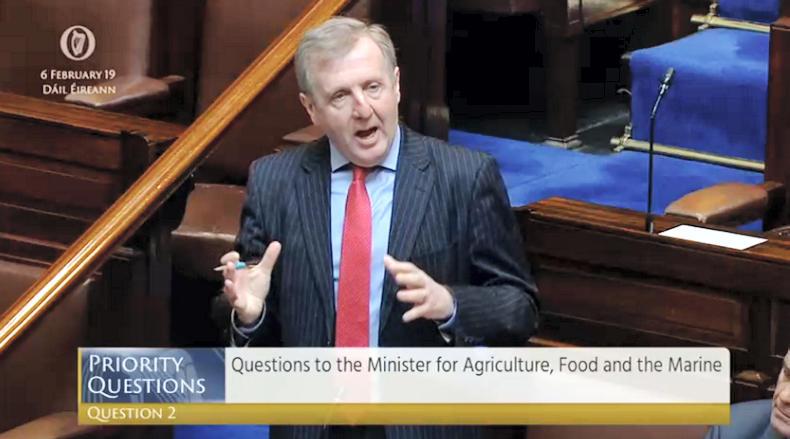
Minister Creed will be proposing legislation to reduce the time period for notification of imports subject to sanitary and phytosanitary (SPS) checks to 24 hours for imports using roll-on roll-off ferries.
He told the Dáil on Wednesday this week that much of the work in his Department to prepare for Brexit has been orientated towards border staffing and IT requirements.
An aid package for farmers cannot be implemented until “we know what type of Brexit we are dealing with”.
However, he assured the Dáil that “we won’t be found wanting when it comes to supporting the sector”.
There is no part of the Withdrawal of the UK from the EU (Consequential Provisions) Bill that refers to the Department of Agriculture.
EU policies
“This is because my Department largely implements EU policies such as the CAP and CFP and any legislative changes required will be made at EU level,” Minister Creed said.
The estimated cost of potential tariffs for the sector as a whole is €1.7bn, based on Irish agri-food exports to the United Kingdom of €4.8bn in 2016.
At meetings with the European Commission, he said that a range of measures to mitigate the effect of a no-deal Brexit on farmers were discussed. These included:
Ongoing work by the Department of Agriculture is focusing on three key areas, namely infrastructure, staffing and information technology, and in three key locations, that is Dublin Port, Rosslare Port and Dublin Airport.
“The delivery timelines in the event of a disorderly Brexit are extremely challenging, but officials are working with the greatest urgency to ensure the necessary requirements are in place by 29 March,” Minister Creed said.
He also told Lisa Chambers, in response to a Parliamentary Question, that the Department will deploy in the region of 230 staff resources as part of its Brexit Response. This number will comprise new recruits, redeployed staff and people on temporary contracts. Dublin Port will be staffed on a 24/7 basis. Rosslare ports will operate on the basis of two shifts per day, based on ferry activity. All of these resource levels will be kept under review and will be adjusted in light of developments up to and post-29 March 2019.




SHARING OPTIONS