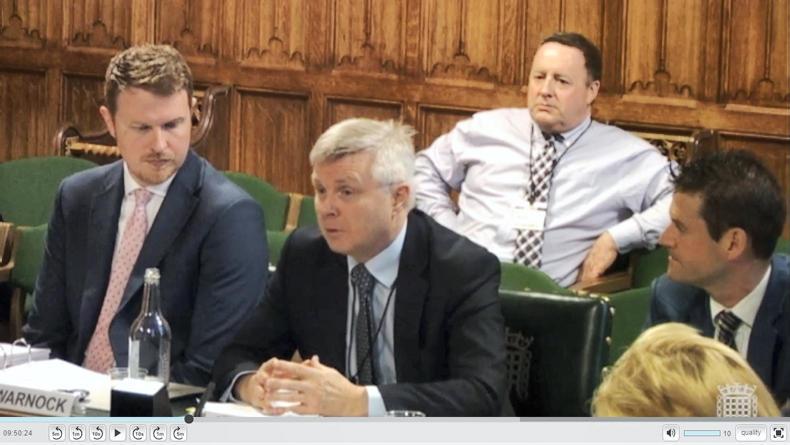
Senior officials from the Department for the Economy (DfE) defended their decision to cut Renewable Heat Incentive (RHI) tariffs during a sitting of the NI Affairs Committee in Westminster on Wednesday.
Their key argument remains that RHI tariffs were reduced to bring the annual rate of return that boiler owners receive on investments down to the rate approved by the European Commission under state aid rules in 2012, which was 12%.
George Peretz QC told MPs that it is unclear whether the European Commission in 2012 granted approval for the actual RHI tariffs rates on their own
However, the exact details of what EU state aid approval was granted for, and therefore DfE’s argument for cutting tariffs, was called into question at the committee the previous day by legal experts.
George Peretz QC told MPs that it is unclear whether the European Commission in 2012 granted approval for the actual RHI tariffs rates on their own, or for an RHI scheme which delivers a 12% rate of return at any tariff level.
“Ultimately, the answer to the question ‘what did the Commission exactly approve?’ is not a matter for the Commission, it is a matter for the courts,” he said.
On Wednesday, DfE officials maintained that from the outset the European Commission was clear that it had given state aid approval for a scheme that delivers a 12% rate of return, which then gave DfE grounds to cut tariffs when it emerged that payment rates were too high.
Inquiry
MPs on the NI Affairs Committee are currently conducting an inquiry into RHI cuts that were part of legislation which passed through Westminster in April 2019.
One option being discussed is introducing a hardship scheme for RHI claimants that have experienced financial difficulties due to tariff cuts.
When you look at the scheme as a whole, the average participant spent £38,000 on a boiler, would have already received £55,000 from the tax payer and will receive another £35,000
However, it is something that DfE permanent secretary Noel Lavery did not appear too enthusiastic about during the evidence session on Wednesday.
“When you look at the scheme as a whole, the average participant spent £38,000 on a boiler, would have already received £55,000 from the tax payer and will receive another £35,000 [in future RHI payments],” Lavery said.
“You shouldn’t have got into financial difficulty from the operation of the RHI scheme,” he added.
Lavery did acknowledge that some RHI businesses are under pressure, but suggested that it was because loans were taken out to fund biomass boilers, and RHI payments were partially used for broader business expansion.
DfE officials also argued that biomass is a cheaper form of heating in NI when compared with the alternatives of kerosene and LPG. In addition, RHI payments are still available when using biomass.
However, officials gave a commitment to MPs to set up an independent unit within DfE to examine individual cases of financial hardship among RHI claimants.
Differences
During the briefing, MPs also raised questions about significantly higher incentives for renewable heat generation in both Britain and the Republic of Ireland (ROI), compared with NI.
Differences in biomass fuel costs, capital costs of boilers and the cost of the most common alternative fossil fuels in each region could lead to differences in calculating tariff rates
Richard Rodgers from DfE maintained that for standard 99kW boilers, which are most common in NI, the schemes in Britain and ROI both deliver annual payments of around £5,000, compared with £2,000 in NI. He said that differences in biomass fuel costs, capital costs of boilers and the cost of the most common alternative fossil fuels in each region could lead to differences in calculating tariff rates.
Some MPs on the committee suggested that the European Commission should be notified under state aid rules that the higher tariffs in ROI leaves NI businesses at a competitive disadvantage. However, Rodgers pointed out that calculations for the ROI scheme indicate that participants will receive a rate of return of 8% per annum, and there is also provision within the scheme to retrospectively adjust tariffs.
Read more
Growers query Moy Park commitment
Moy Park won’t bail out RHI scheme
Senior officials from the Department for the Economy (DfE) defended their decision to cut Renewable Heat Incentive (RHI) tariffs during a sitting of the NI Affairs Committee in Westminster on Wednesday.
Their key argument remains that RHI tariffs were reduced to bring the annual rate of return that boiler owners receive on investments down to the rate approved by the European Commission under state aid rules in 2012, which was 12%.
George Peretz QC told MPs that it is unclear whether the European Commission in 2012 granted approval for the actual RHI tariffs rates on their own
However, the exact details of what EU state aid approval was granted for, and therefore DfE’s argument for cutting tariffs, was called into question at the committee the previous day by legal experts.
George Peretz QC told MPs that it is unclear whether the European Commission in 2012 granted approval for the actual RHI tariffs rates on their own, or for an RHI scheme which delivers a 12% rate of return at any tariff level.
“Ultimately, the answer to the question ‘what did the Commission exactly approve?’ is not a matter for the Commission, it is a matter for the courts,” he said.
On Wednesday, DfE officials maintained that from the outset the European Commission was clear that it had given state aid approval for a scheme that delivers a 12% rate of return, which then gave DfE grounds to cut tariffs when it emerged that payment rates were too high.
Inquiry
MPs on the NI Affairs Committee are currently conducting an inquiry into RHI cuts that were part of legislation which passed through Westminster in April 2019.
One option being discussed is introducing a hardship scheme for RHI claimants that have experienced financial difficulties due to tariff cuts.
When you look at the scheme as a whole, the average participant spent £38,000 on a boiler, would have already received £55,000 from the tax payer and will receive another £35,000
However, it is something that DfE permanent secretary Noel Lavery did not appear too enthusiastic about during the evidence session on Wednesday.
“When you look at the scheme as a whole, the average participant spent £38,000 on a boiler, would have already received £55,000 from the tax payer and will receive another £35,000 [in future RHI payments],” Lavery said.
“You shouldn’t have got into financial difficulty from the operation of the RHI scheme,” he added.
Lavery did acknowledge that some RHI businesses are under pressure, but suggested that it was because loans were taken out to fund biomass boilers, and RHI payments were partially used for broader business expansion.
DfE officials also argued that biomass is a cheaper form of heating in NI when compared with the alternatives of kerosene and LPG. In addition, RHI payments are still available when using biomass.
However, officials gave a commitment to MPs to set up an independent unit within DfE to examine individual cases of financial hardship among RHI claimants.
Differences
During the briefing, MPs also raised questions about significantly higher incentives for renewable heat generation in both Britain and the Republic of Ireland (ROI), compared with NI.
Differences in biomass fuel costs, capital costs of boilers and the cost of the most common alternative fossil fuels in each region could lead to differences in calculating tariff rates
Richard Rodgers from DfE maintained that for standard 99kW boilers, which are most common in NI, the schemes in Britain and ROI both deliver annual payments of around £5,000, compared with £2,000 in NI. He said that differences in biomass fuel costs, capital costs of boilers and the cost of the most common alternative fossil fuels in each region could lead to differences in calculating tariff rates.
Some MPs on the committee suggested that the European Commission should be notified under state aid rules that the higher tariffs in ROI leaves NI businesses at a competitive disadvantage. However, Rodgers pointed out that calculations for the ROI scheme indicate that participants will receive a rate of return of 8% per annum, and there is also provision within the scheme to retrospectively adjust tariffs.
Read more
Growers query Moy Park commitment
Moy Park won’t bail out RHI scheme
SHARING OPTIONS