



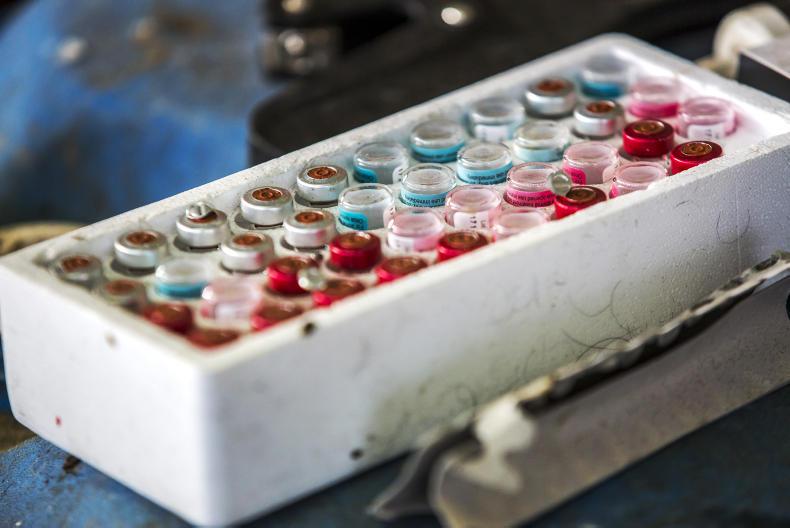
A number of farmers expressed frustration over the TB testing process at a recent Irish Cattle and Sheep Farmers Association (ICSA) meeting in Monaghan.
Senior Department vet Eoin Ryan attended the meeting on Thursday 10 May and attempted to answer a number of points of concern raised by farmers.
What is the difference between the skin and blood test?
Ryan said that the skin test picks up eight out of 10 animals with TB.
When an animal appears as a reactor, there is a 99.96% chance it has TB. The chance of a false positive is one in every 5,000 cattle.
The blood test detects nine out of every 10 animals with TB and it can detect animals at an earlier stage.
However, it is not used on a widespread basis, as there is a much higher chance of a false positive.
If used for testing the national herd, there would be 280,000 false positives every year.
When is the blood test used?
Ryan explained that the blood test was used in high-risk herds.
These are herds who had a breakdown as a result of reactors appearing in a skin test.
The blood test would detect other animals which are not in as advanced a stage of TB infection.
An animal tested negative to a skin test but had lesions in the factory, why?
Ryan explained that this could be for two reasons.
Firstly, the tests used were not guaranteed to detect all TB positive animals. He said this was why eradicating TB was so difficult.
The other reason was because TB targets and destroys an animal's an immune system.
Ryan said some animals were so far into TB infection that they do not have a response to the skin test, as the immune system was not functioning.
An animal reacted to a skin test but showed no lesions in the factory. Was it a false positive?
Ryan said there was a lot of confusion around this issue.
He explained that only 15% of animals detected by the blood test had lesions in the factory, while this figure rose to 30% for skin test reactors.
He said no lesions did not mean a false positive, as lesions only appeared on animals in an advanced stage of TB infection.
Lesions were rotting flesh and animals who had them were often the ones who spread the disease.
Why do I have to wait 60 days between tests?
Ryan said testing an animal again too quickly meant the test would not pick up infection due to the time it takes TB to develop.
He assured farmers it was not because the Department was too busy, but rather because there would be no response to a test if it occurred too frequently.



SHARING OPTIONS