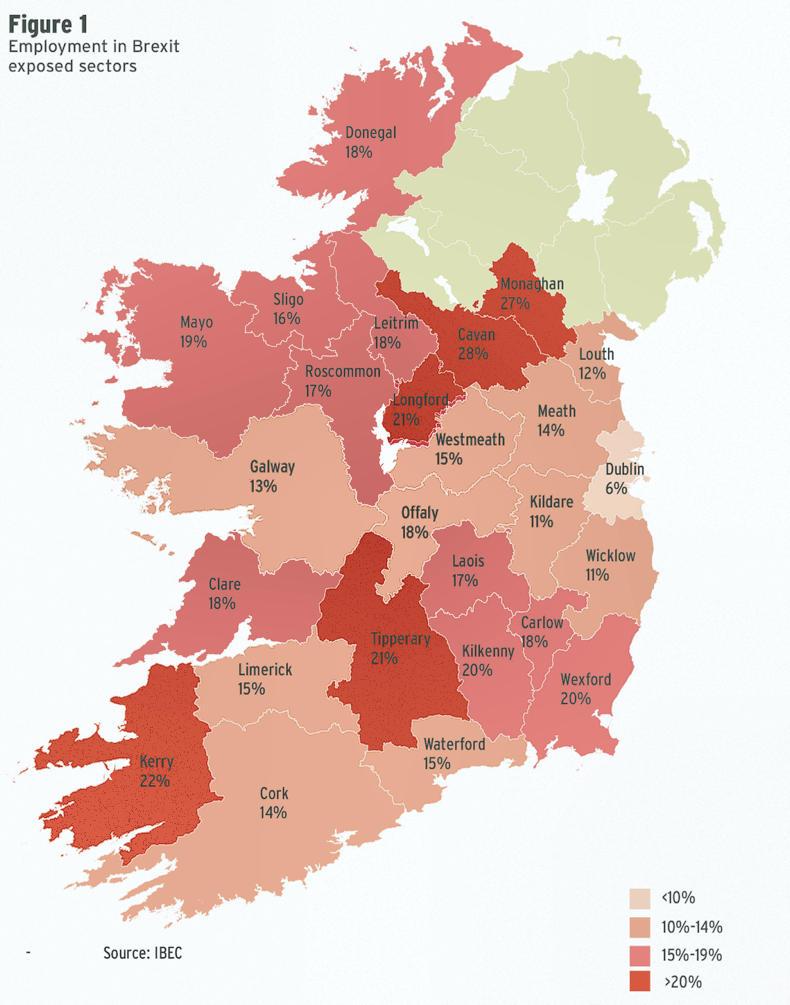
As reported in this week's Irish Farmers Journal, a study of the sectors most at risk from the worst-case Brexit scenario shows nearly one in seven jobs are on the line. How many are in your county?
Combining data from existing ESRI forecasts on the export losses from a hard Brexit scenario and the 2016 census recording people’s place and sector of work, IBEC warned this week that rural regions were most at risk of rising unemployment. The Irish Farmers Journal has obtained county-by-county data confirming this rural-urban divide.
In all counties, the size of the agri-food sector is the main contributor to risk exposure. This is especially true in Cavan and Monaghan, the two counties most exposed, where employment in agriculture and food represents around 18% of all jobs. The large numbers of milk and meat-processing plants involved in intense trading with both Northern Ireland and Britain in border counties puts many jobs there on the frontline of Brexit.
ADVERTISEMENT
The hard Brexit scenario modelled by IBEC would see trade with the UK hit by WTO tariffs, other barriers, such as administrative delays, and a 10% fall in the value of sterling. The business lobby group said this week that this would also result in an annual drop in farmgate revenue of €3,000 per farm.
This content is available to digital subscribers and loyalty code users only. Sign in to your account, use the code or subscribe to get unlimited access.
The reader loyalty code gives you full access to the site from when you enter it until the following Wednesday at 9pm. Find your unique code on the back page of Irish Country Living every week.
CODE ACCEPTED
You have full access to the site until next Wednesday at 9pm.
CODE NOT VALID
Please try again or contact support.
Combining data from existing ESRI forecasts on the export losses from a hard Brexit scenario and the 2016 census recording people’s place and sector of work, IBEC warned this week that rural regions were most at risk of rising unemployment. The Irish Farmers Journal has obtained county-by-county data confirming this rural-urban divide.
In all counties, the size of the agri-food sector is the main contributor to risk exposure. This is especially true in Cavan and Monaghan, the two counties most exposed, where employment in agriculture and food represents around 18% of all jobs. The large numbers of milk and meat-processing plants involved in intense trading with both Northern Ireland and Britain in border counties puts many jobs there on the frontline of Brexit.
The hard Brexit scenario modelled by IBEC would see trade with the UK hit by WTO tariffs, other barriers, such as administrative delays, and a 10% fall in the value of sterling. The business lobby group said this week that this would also result in an annual drop in farmgate revenue of €3,000 per farm.
If you would like to speak to a member of our team, please call us on 01-4199525.
Link sent to your email address
We have sent an email to your address. Please click on the link in this email to reset your password. If you can't find it in your inbox, please check your spam folder. If you can't find the email, please call us on 01-4199525.
ENTER YOUR LOYALTY CODE:
The reader loyalty code gives you full access to the site from when you enter it until the following Wednesday at 9pm. Find your unique code on the back page of Irish Country Living every week.








SHARING OPTIONS