


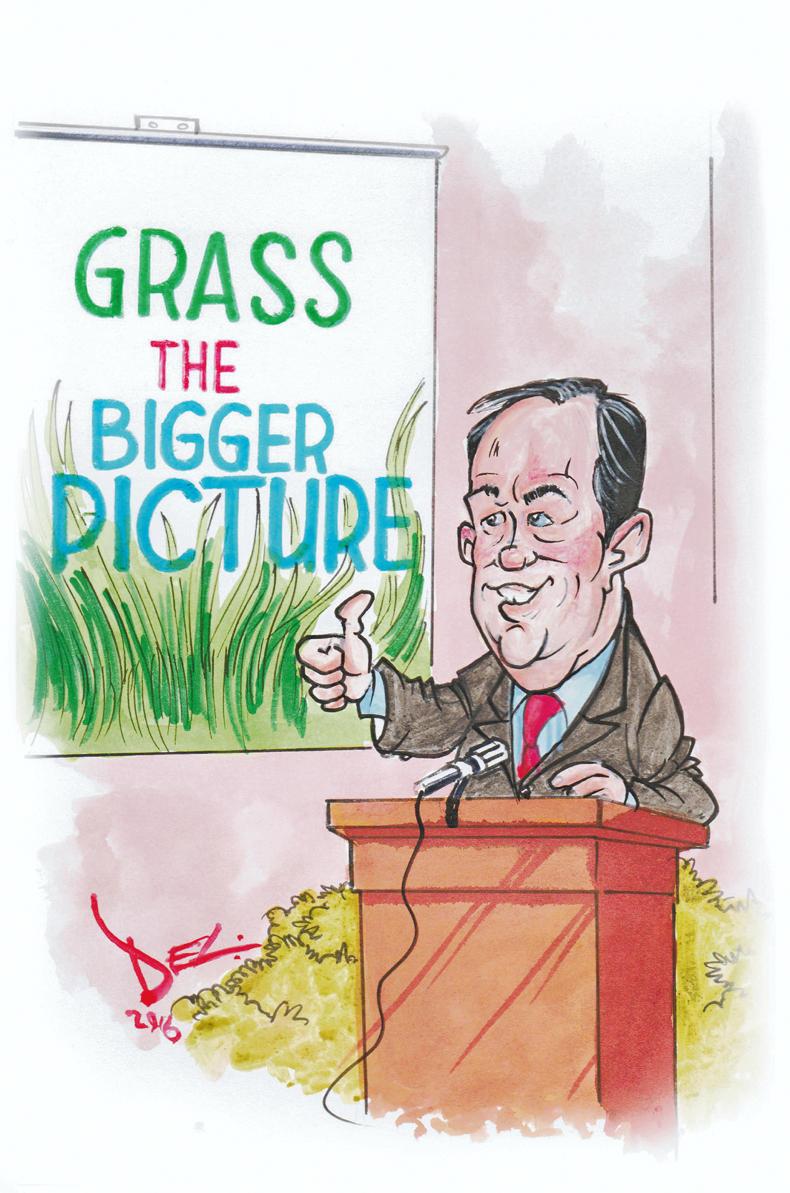
As a teacher, I strive for ways to stimulate students, to pique their interest to participate. You win some, you lose some and you always know and worry about the ones who seem to be lost or just afraid of change.
On a higher plane of adult learning, the basic task is the same but you have to engage your audience by your knowledge, persuasion and your passion for the subject. It is stimulating to be on the receiving end of such a lecture, coupled with information that is seriously researched and tested, with the added bonus of foresight.
I speak of Teagasc’s head of Animal and Grassland Research and Innovation, Dr Pat Dillon, who addressed a packed Rochestown Park Hotel at the recent dairy conference.
He outlined the factors influencing world dairy markets and, consequently, what influenced the disastrous milk price that farmers were receiving throughout the year.
He explained the supply correction that has happened world-wide to cause the milk price to begin to recover. More importantly, this address was a reinforcement of the findings coming from the researchers in Moorepark over many years now.
The competitive advantage for Irish dairy farmers is our pasture-based, low-input system, with the right type of cow, high EBI and the focus on controlling the budget, especially managing cashflow inside the farm gate. It continues to work in a volatile milk price situation.
He pointed out the key indicators that should be highlighted on a dairy farm. For many farmers, it was a valuable, mental box-ticking exercise akin to an annual exam.
According to the national farm survey data, efficiency has increased and the cost of milk production has decreased. There is plenty of scope for increased profits to come from increasing the milk solids produced per cow and per hectare.
Dairy farmers have also increased the grass utilisation on their farms. Dr Dillon outlined a three-tonne/hectare variation between the top 20% and the bottom 20% of dairy farms that are measuring grass.
“If you’re not measuring grass now, where are you as a dairy farmer?” he asked.
It was like being back in the classroom and being asked for the most recent assignment. If we want to improve, we must follow the advice of the experts. It is researched and tested for our benefit and that of the future of the dairy industry.
Dr Dillon said that dairy farmers who registered the highest profit per hectare had fed less concentrate per cow, had higher stocking rates, higher grass utilisation per hectare and higher milking production.
NEW DIRECTION
A few days after the Teagasc dairy conference, we were having breakfast. I was watching the clock to leave for school. I wasn’t ready for a discussion. As I poured a cup of tea, Tim asked me what particular message I took from the conference. I always get nervous when he asks me a question like that because I know that he’s looking for a specific answer. I could feel his anticipation. He made it worse by adding: “There was one big message throughout the day that was different from before! I’m wondering did you pick up on it.”
I paused to think and the answer was there imprinted on my mind: “Pat Dillon’s wheels!”
“Exactly,” Tim said – and the discussion was opened.
The message was to get all the mechanics of a good dairy operation working on the farm and, in turn, in the wider industry. Our new focus must be on increasing our competitiveness. We will do this through innovation. To explain this, Dr Dillon used the analogy of a car and its wheels.
The big wheel in the centre represented innovation. Fitted into its cogs were four other wheels. They represented high EBI and a slightly smaller cow, increased grass utilisation, a sustainable production system, and a highly skilled workforce.
When Dr Dillon pressed the magic button for the graphics, the four wheels began to turn, causing the big wheel of innovation to move forward. It was a clever way of reinforcing the message already delivered.
At home we agreed between us that the new message to dairy farmers is that we are managing dairy businesses rather than family farms, but we must still make sure all the basic wheels are greased and running smoothly. We will have to adjust our thinking in order to be part of the big wheel of innovation, to increase the competitiveness of the dairy farms we manage and the overall dairy industry.
The conference provided much food for thought in several areas. Another new focus was on health and wellbeing. An important point raised is to maintain our exercise during the quiet period so as not to pile on extra pounds. I will return to this topic again.
MERRY CHRISTMAS
And so we can continue to talk grass and farming over the Christmas break. We will hone our plans for spring 2017 and look forward with enthusiasm to the year ahead.
I wish all my readers a very happy Christmas and I thank you all for your continued support and various interactions with me during 2016. I hope that you will have your loved ones around the kitchen table at some time over the festive season.
This is a lucky year for us in that we will have Julie, D, Philip and Colm at home for Christmas. We will have two extras this year – dad will be with us, as will our new son-in-law David. It is hard to imagine that it is almost a year since Julie and David’s wedding. Time flies when you put energy into living life to the full. Have a very peaceful and happy Christmas.


SHARING OPTIONS