


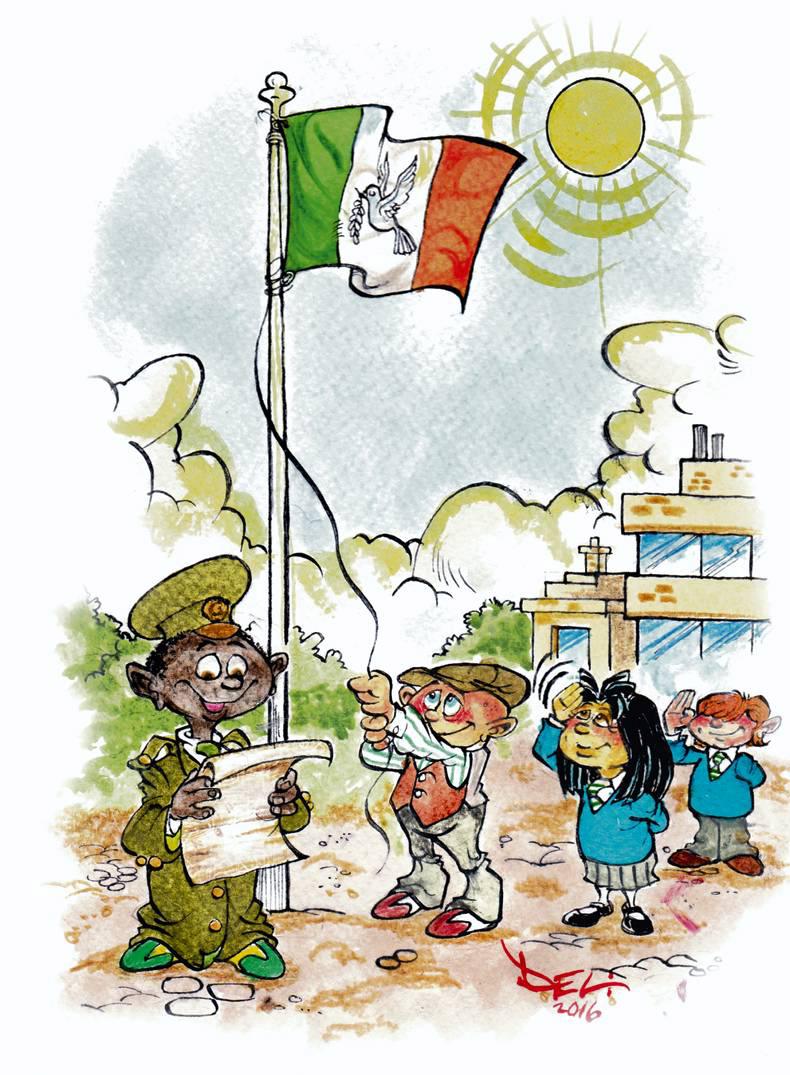
School was a special day on Tuesday 15 March 2016, because it was the 100-year anniversary of the Proclamation. To celebrate 100 years of the Irish Republic, the Defence Forces, Óglaigh na hÉireann, were commissioned by the Government to deliver a National flag to all of the primary schools in the country.
It was an excellent idea to familiarise young pupils with Irish history and to foster respect for our National flag. There are very specific guidelines about how the flag is used. It must be flown higher than any other flags. The rules are all available on the Department of An Taoiseach website and make very interesting reading.
On Tuesday, all primary schools were celebrating proclamation day and have been getting to know the names of the signatories to the Proclamation in preparation for this day.
The names of Clarke, MacDiarmada, MacDonagh, Pearse, Ceannt, Connolly and Plunkett have all been resurrected in our minds. My own favourite is Padraig Pearse, although I take issue with his sentiments in his poem called The Mother.
It was drilled into me by my own mother for a competition when I was 10. Then I hated it. Now I’m proud to know it. I wonder, though, how any mother could not regret the sacrifice of her two sons for the sake of the rebellion.
I think Pearse was probably consoling himself that his mother would understand. The last few lines of The Mother are:
We suffer in their coming and their going;
tho’ I grudge them not, I weary, weary
Of the long sorrow – And yet I have my joy:
My sons were faithful, and they fought.
Proclamation
As I turned into our own school road on Tuesday morning, there was a sight to behold. There was a huge crowd in the playground of Scóil Barra. This primary school is directly opposite our school. The school community was out in force and in colourful attire.
The location of our school, a special school, for pupils with a moderate intellectual disability, was specifically chosen so that there could be integration opportunities between both schools.
This was one morning when the reality of that Department of Education and Science plan was visible for all to see. Two teachers were leaving our school and crossing the road with their classes in tow.
The pupils were allowed to abandon their school uniforms for the day. They could come to school dressed in green.
The new flag pole was erected in the grounds of Scóil Barra and the Irish Flag was being hoisted. A girl’s voice could be heard over the public address system, reading the Scóil Barra proclamation.
Many schools took the opportunity to focus pupils’ minds on the kind of Ireland they would like to see in the future by drafting their own proclamation. I’ve no doubt that this exercise will awaken in some the desire to get involved in politics or even the Defence Forces when it comes to choosing a career.
A visit from the army
In early December, we had a visit from two personnel of the Irish Defence Forces. There was an officer and a senior non commissioned officer (NCO). They came to the school on the appointed day and presented the school with an Irish flag and a copy of the Proclamation.
The proclamation was read by one of the soldiers. It is a difficult document to understand for the pupils in our school. However, it is evident that the essence of the document is celebrated in our school, where all pupils are cherished equally.
More importantly, it was a reason for celebration, just like a birthday. Believe me, the pupils in our school understand birthdays. We have a school calendar that is made each year by the senior class. The faces of the children that have birthdays in a particular month mark that month. It is consulted regularly.
Since the visit of the soldiers, the teachers have been planning how we could best celebrate the hoisting of the flag and recognise Proclamation Day.
Between them, the staff came up with marching like soldiers, standing to attention, facing the flag and saluting the flag. The preparation also included listening to Irish music, learning the National Anthem and drawing and painting the Irish Flag.
In the cookery kitchen, we prepared lots of biscuits and, with the help of students and special needs assistants, iced them in combinations of green, white and orange. It’s lovely to see a school community come together with one aim. We had a very special day.
1916 attire
On another note, my sister Ben had arrived the evening before to augment Jack and Kate’s costumes. Cloghroe school had decided to take a step back in time, and the pupils were asked to come in dressed in 1916 attire.
Jack wanted to be a volunteer and wanted the real uniform. He was loath to accept that army uniforms cannot be loaned or used like that. Kate wanted to be a nurse. Her’s was easy. She had an old black dress, one of my big white aprons and a nurse’s cap. I opened up my big drama case of costumes collected over the years. We found the perfect cap for Jack and wool pants. Ben had already sourced a suitable shirt.
He wasn’t having the pants. He was sure men wore better things in 1916. I then produced braces, and he was happy that they would set off his school pants perfectly. Both children went away happy.
It has been a good exercise for schools and families to focus on commemorating the Easter Rising of 1916. It will also serve to bring meaning to the rest of the celebrations over the Easter period.


SHARING OPTIONS