


I was beguiled by words from an early age, especially the words that name places. My dad would regale us with stories of our grandfather, who hailed from Spellickanee, and of meeting up with his friends down Annabolica Lane, places that hardly sound real.
Growing up on the Cooley Peninsula, home to the saga of the Brown Bull, I was fascinated by the mythology remembered in local names, like Queen Maeve’s Gap, Dundalk (Dún Dealgan) and Ardee (Ath Fhirdia). This fascination followed me when I fell into a career in book publishing, and found myself editing a series of Irish walking guides. Who wouldn’t pause for thought when faced with Lough Eekenohoolikeaghaun?
Much as a hot summer can reveal the outline of millennia old ring forts, place names can hold the secrets of our past. There’s endless entertainment to be found in peeling back the layers of a name and digging into the histories and the myths behind it.
Every field in the country can tell a story; every place name has memories woven into it. Sometimes it’s a practical, does-exactly-what-it-says-on the-tin kind of name – ‘the sea lake’, Lough Atalia/Loch an tSáile – and sometimes it denotes possession – Tory, Túr Rí, ‘the tower of the king’ – while some names commemorate an event from centuries ago: Priest’s Leap/Léim an tSagairt, which remembers the heroic escape of a priest from his pursuers.
Some took a bit of effort to track down, like the aforementioned Annabolica, which resides primarily now in folklore. It appears as Anabologe on the 1820s six-inch Ordnance Survey map of Ireland. If I were to hazard a guess at its origin, I’d say Áth na Bológ, ‘the ford of the bullock’. It is in Cooley, after all.
You can’t help but be struck by the sheer peculiarity of some of our place names. Some sound cosy and welcoming, some vaguely threatening and some you just have to smile at. Many are anglicisations – in other words, the original Irish names written in English roughly following the pronunciation. Cill Ciarán becomes Kilkieran, for example, and Trá Bán becomes Trabane. But the actual meanings – ‘the church of Ciaran’, ‘white strand’ – become garbled along the way. Others are an English name superimposed on a place, where the original Irish name bears little to no resemblance but has, thankfully, been retained. (Who outside of ‘the nook of the tanner’ – Cúil an tSúdaire – would recognise Portarlington?)
The Celtic gods and goddesses are remembered in the names of rivers and lakes, and in the name of the country itself (‘Éire’ is named after a goddess of the Tuatha Dé Danann). There’s ambiguity about the origins of many place names but, as a nation, we’re well used to a bit of opacity: look no farther than GAA scoring and proportional representation.
Names and places
Ballynana, Co Kerry: This one sounds like a warm hug. The original Irish name for this county Kerry townland may have been Baile na nAchadh, ‘the townland of the field’, or Baile na nÁith, ‘the townland of the kilns’.
Brickeens, Co Mayo: It may sound like a pile of little bricks, but Na Broicíní means ‘badger warren’.
Bunnyconnellan, Co Mayo: From the Irish Muine Chonalláin, which means ‘Conlon’s thicket’. There may or may not be rabbits hereabouts.
Eden, Co Leitrim: Who’d have thought we’d find paradise in Co Leitrim? And yet there is it, bordered by the upper reaches of the River Shannon before it enters Lough Allen. In Irish, it’s An tÉadan, meaning ‘brow’ or ‘forehead’, so there’s a hill. You’ll find other Edens in counties Antrim, Derry, Donegal, Mayo, Meath, Roscommon and Tyrone, and an Eden Island in Monaghan.
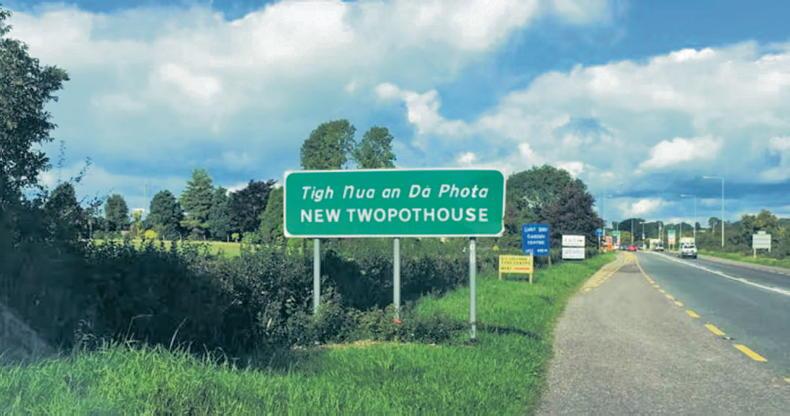
New Twopothouse, Co Cork: Tigh Nua an Dá Phota. Back in the 1700s, there was a coaching inn between Mallow and Buttevant called the Two-Pot House Inn (named for the two beer kegs, or pots, kept by the front door). In the 1800s, a new road was built between Cork and Limerick – now the N20 – and it had need of a coaching stop, too, of course. To differentiate it from the original one, it was called New Twopothouse.
Kilfeakle, Co Tipperary: This has to be one of the oddest! Cill Fhiacal is ‘the church of the tooth’. One possible origin story is that no less a luminary than St Patrick himself lost a tooth here. The tooth was kept as a relic in the altar stone of the church, now ruined.
Ballymacquiff North, Co Galway: From Baile Mhic Dhuibh Thuaidh, this is ‘the northern townland of MacDuff’. Who was, no doubt, fantastically well-coiffed.
Cummeenanimma, Co Kerry: Sounds like how you’d say ‘come in a minute’ after getting local anaesthetic at the dentist’s, but it’s actually from coimín an ime – coimín means the ‘little glen’ but the rest is uncertain, possibly ‘the little glen of the butter’.
Clash: In Irish An Chlais means ‘a ravine or trench’. Not a place you’d like to clash with an enemy. You’ll find a Clash in Cork, Laois, Tipperary and Kerry.
Spellickanee, Co Louth: This sounds like the sort of fiddledy idledy name old Hollywood might have conjured up for the atrocious Finian’s Rainbow. However, unlike Glocca Morra, Spellickanee is a real place and can be found on the map.
Nestled in the Cooley Mountains, you’ll find Speilg an Fhiaigh, ‘the raven’s rock’. Given the area’s connection with Cúchulainn, it’s not a stretch to imagine that the particular raven was an incarnation of the Morrigan. There’s birdlife aplenty in the hills, and the glens echo with their caws.
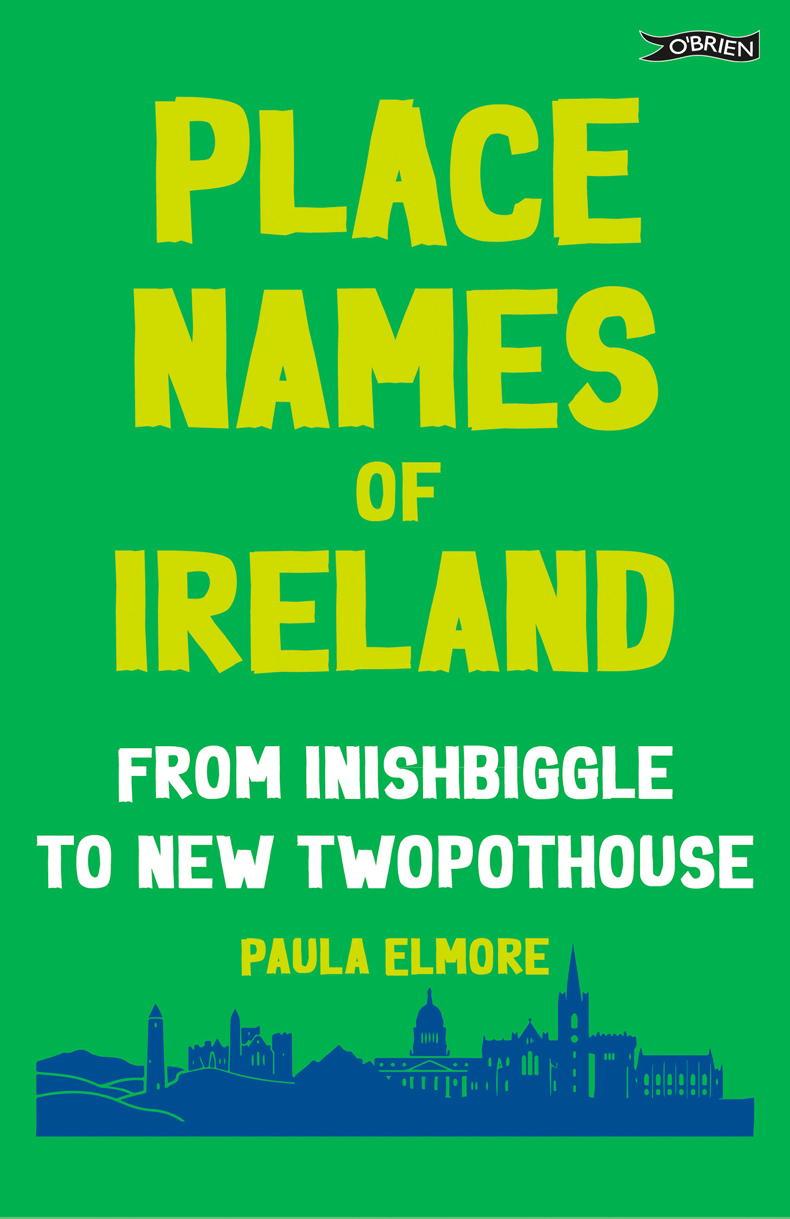
This extract is from Place Names of Ireland - From Inishbiggle to New Twopothouse by Paula Elmore. Published by The O’Brien Press, €11.99.

