



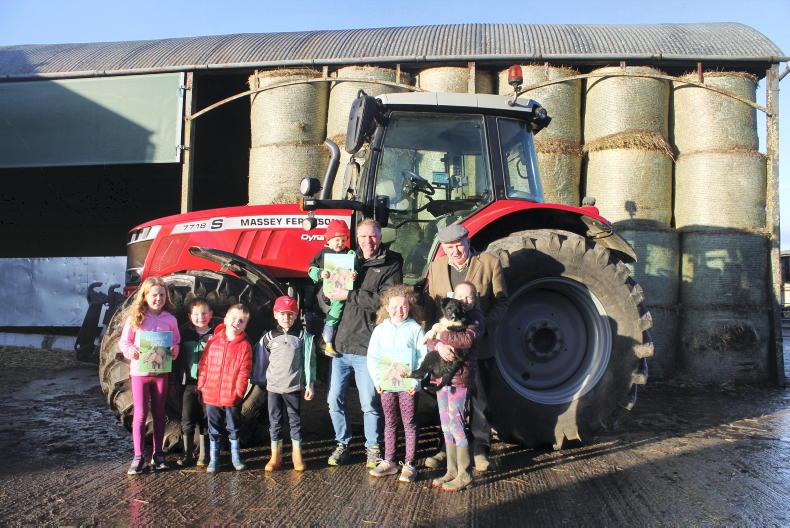
A couple of years ago, Brendan McDonald was asked by his friend’s child to tell her a story.
Hailing from a beef and sheep farm in Co Laois, he decided to incorporate some of his farming background into it.
So, he told her of cows and calves, sheep and lambs. Then, he added an elephant into the mix.
Then I was thinking, well that’s just a nice story of diversity and inclusion
“Her reaction to an elephant on the farm was just so incredulous. She was like, ‘How can there be an elephant on the farm?’ I was like, ‘I know, it’s mad, isn’t it?’ The idea for the children’s book stemmed from there,” Brendan recalls.
“I could see the kids’ reactions to something totally outside the norm being on the farm.
“Then I was thinking, well that’s just a nice story of diversity and inclusion.
“That something different can be accepted into any area, farm, business or part of life really. That somebody who’s different or finds themself in a different scenario can make friends out of it and can be accepted by the wider community.”
Over the last few years, Brendan would often be reading a bedtime story to his nieces and nephews and the thought would occur to him – ‘How hard can writing a children’s book be? I might give it a go’.
Children’s storybooks are usually 24-28 pages long and under 500 words. Not much space to develop characters and a story
So, he enrolled in an online creative writing course with Curtis Brown Creative in the UK, titled ‘How to write a children’s book’.
Upon starting this, Brendan found out there was actually plenty to writing a children’s book. Children’s storybooks are usually 24-28 pages long and under 500 words. Not much space to develop characters and a story, so every page and word counts. Brendan also used a rhyming style, and of course, your language has to be suitable.
A lot of the language Brendan might use in his day job, which probably couldn’t be further away from a children’s storybook author, had to be left behind.
A qualified solicitor, he started working for IDA’s property division in Athlone in 2012. The first big deal he worked on was the Glanbia plant in Belview, Kilkenny.
He then moved to Galway to work in business development for the west of Ireland, coming away from the legal end of things.
Since then, he has moved back near home, to take up the role of regional business development manager for the southeast.
He now lives in Carlow, just 15 minutes from the home farm, which is being farmed by his brother Paul, who played football for Laois.
Self-publishing
Like many when the first lockdown hit last year, Brendan decided to take his children’s storybook project off the long finger and started writing Elephant on the Farm.
He decided to self-publish the book, which turned out to be an interesting and informative journey.
I was in the lucky position that I had a few bob set aside from lockdown
“The journey of self-publishing was always very interesting to me,” Brendan explains.
“It was a personal challenge almost, to see could I do it. To see could I learn enough about it to do it. I was in the lucky position that I had a few bob set aside from lockdown – like everyone else, I didn’t go on any holidays or anything like that, because self-publishing is quite expensive.”
Firstly, Brendan had to find an illustrator to work with, so he got in touch with Illustrators Ireland. After getting a slight wake-up call about the cost of professional illustrators, Brendan found Martin Beckett through a mutual acquaintance, Alma Jordan of AgriKids. Martin had also illustrated her books.
Brendan says he learned a lot about the proportion and positioning of the characters
Martin and Brendan worked together on what the characters would look like.
Brendan says he learned a lot about the proportion and positioning of the characters, as well as getting the book print ready. Wanting to create a totally Irish product, Brendan got the book printed in Modern Printers in Kilkenny.
Just before Christmas, Brendan received his books.
“When I opened the first box, even the smell of the newly printed book was just unbelievable.
“There was a real sense of pride that I was able to create this in lockdown and bring it to fruition.
“Because I’d have lofty ideas at times and maybe the execution of them mightn’t come to full fruition, but the main thing was to set this goal and get to the point where I had the physical book.
We’re so grateful as a family to Crumlin, so I wanted to give something back
“It moved on from the sense of pride and happiness to, ‘OK I now have all these books I have to sell and how do I do that?’ And that’s the journey I’ve been on for the last number of weeks.”
Brendan is selling the books from his website, www.bedtimestory.ie, and it’s also in 25 bookstores, many of whose doors are closed at present. He had hoped to get into more, but lockdown scuppered his plans. Despite the challenges, he is nearly ready to do a second print run.
In addition, 20% of the profit is going to Crumlin Children’s Hospital, as Brendan’s nephew Tommy spent a bit of time there a couple of years ago.
“As we say, they fixed him. We’re so grateful as a family to Crumlin, so I wanted to give something back. It’s not going to raise millions or anything, but it certainly helps raise awareness as well.”
So, with his self-publishing journey complete, what’s Brendan’s next goal? The Sheep Who Couldn’t Sleep, book number two!



SHARING OPTIONS