


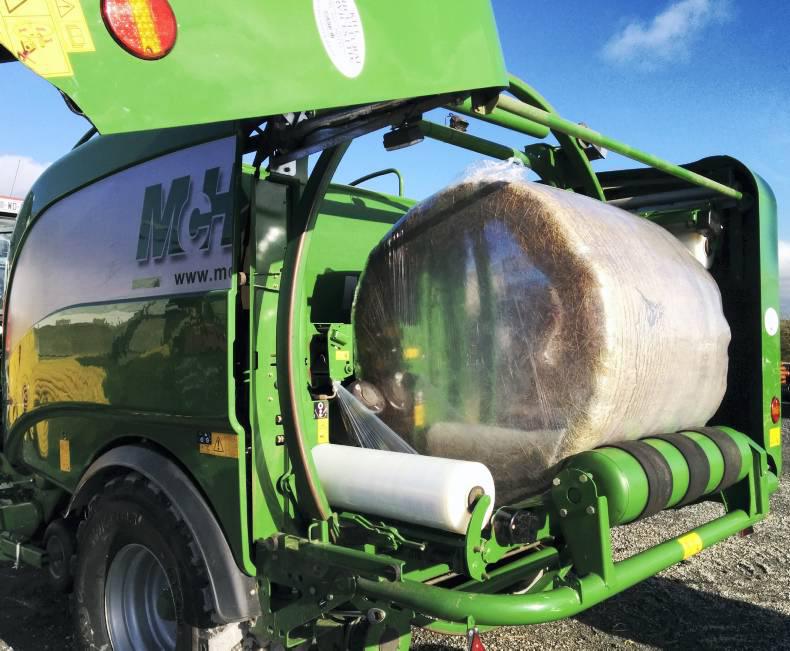
Coveris Flexibles Austria GmbH has developed a transparent silage wrap product, called Agristretch Crystal. This patented product is claimed to offer equivalent silage quality to that of coloured films and can be applied by all makes of bale wrappers.
Coveris has more than 25 years of experience in manufacturing agricultural stretch films. It has also supplied customer-branded silage wrap film in Ireland for 23 years. Coveris estimates that its plastic film is used to wrap around 18 million bales worldwide.
The idea for Agristretch Crystal was born following meetings with farmers and contractors at the 2011 Agritechnica show in Germany. These farmers were discussing the issue of using, selling and buying bales and how they could not tell the quality of the silage inside the black, green and white film before opening.
This was followed by two years of development work and on-the-field trials. Coveris worked closely with a large Austrian contractor to test the product.
In early 2012, the first film was made and tested. For the first cut of 2013, further trials were carried out where half of the bales were wrapped in the Crystal film, with the other half wrapped in an established agricultural stretch film.
In late 2013, the bales were opened and the silage was tested at LFZ Raumberg-Gumpenstein, which is one of Europe’s leading independent research centres for the testing of agricultural products. The tests looked at the quality of the silage, the fermentation losses and the microbiology and aerobic stability of the silage.
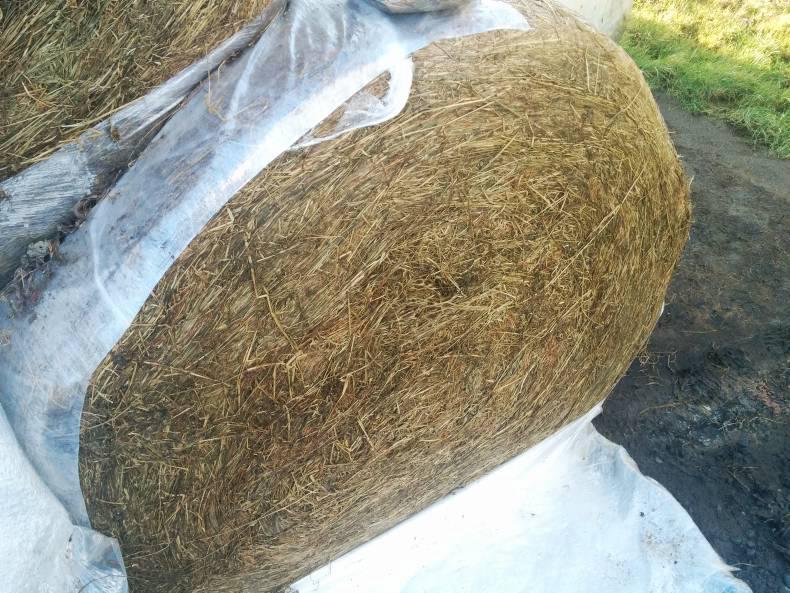
The results confirmed that the silage wrapped in the Crystal film was of the same high quality as that of the silage wrapped in the established coloured brand. Coveris claims that the main benefits of Crystal film include that it fits into the landscape in terms of colour and that farmers can easily recognise preservation and mould problems through the transparent film.
Performance
Donal Corrigan, area sales manager for Coveris in Ireland, is really pleased with how the transparent film has performed. Having travelled to a lot of demonstrations and contractors in 2014, Donal believes that the uptake of the new concept of clear film on bales has been very positive.
Last year, Donal monitored the silage making progress with the Crystal film very closely. The reasons for this were to observe how the film performed with Irish wrapping and bale handling equipment and to receive feedback on the product’s performance for preservation and bird damage in silage bales.
Donal found that no adjustments were made to any of the machines used to wrap bales. These included machines made by McHale, Tanco, Kuhn, Gowell, and Orkle. Donal added that, according to farmers and contractors, the application of the film on to the bale worked well, and the normal application was six layers of film on the bale. The transparency of the film was not lost even at 10 layers, according to Donal.
What was observed on the Crystal film was a reduced incidence of bird strikes on the bales compared with coloured bales in the same stack. To understand better why this was happening, Donal spoke with a Teagasc adviser who was involved with a previous trial regarding plastic film colour and bird attacks on bales.
During that trial, a bird expert monitored the movement of the birds. They found that it was mostly young birds that attacked the bales, and it was reward related. During that trial, eight different colours of plastic were used. Initial observations showed that the clear and red film attracted less attention from birds than black and green film.
The association of black bin liners filled with food triggers the attack on bales by birds. The learning process for the bird to realise it has grass inside and is of no benefit takes time. Donal believes that the clear film allows birds to see what is inside the bale and they lose interest in the contents as they don’t eat grass. The results of this work, while very encouraging, could not be verified as it is only one trial. A series of investigations is needed to give conclusive results.
The Crystal film also allows farmers, contactors and anyone buying or selling baled silage to look at exactly what the silage is like inside and see if any mould has developed. This simplifies trading, especially where high-value stock is involved. Donal tested the silage quality in bales wrapped with Crystal film and competitors’ film and found no significant difference between them in the laboratory analysis at Hillsborough.
In summary, the Crystal film is performing well in Ireland. Around 230,000 bales were wrapped in five countries last year with no problems with machines, quality or birds.
Donal Corrigan can be contacted on 0044-777 578 0703. The new Crystal film is available in Homeland stories, selected Glanbia Agri stores and through Balepak Net & Plastic. The Crystal film can be seen running on the Coveris Facebook and YouTube pages.


SHARING OPTIONS