



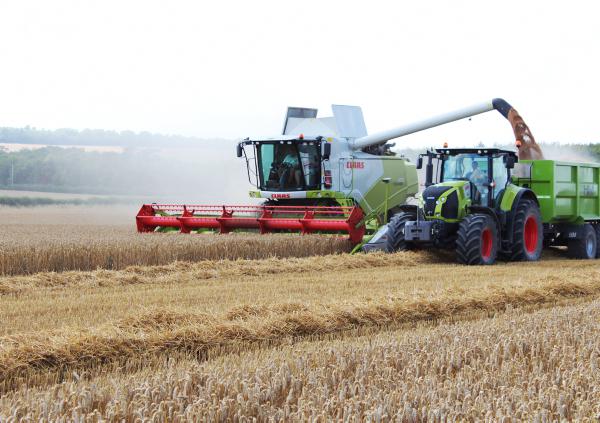
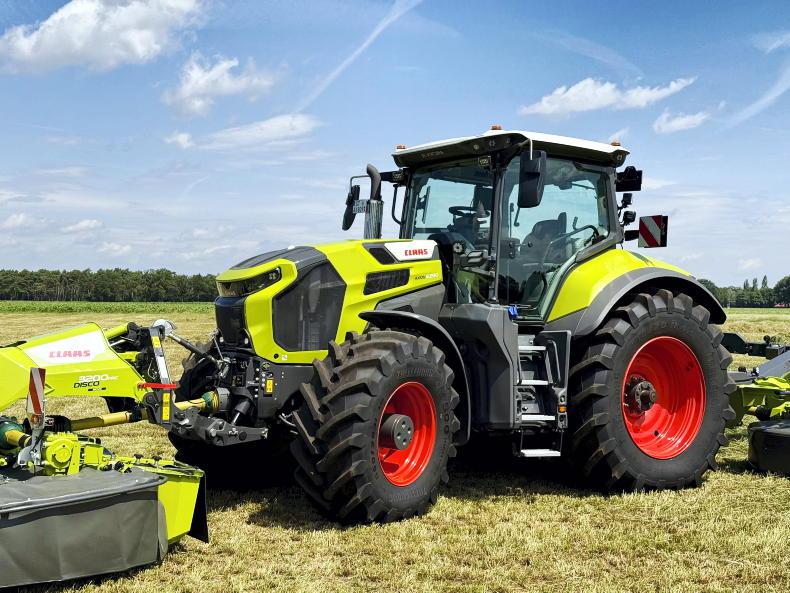
Visitors to the Claas stand at this year’s National Ploughing Championships will be some of the first in Europe to see the recently introduced 2015 Claas Tucano combine. Also on display will be the award-winning Axion 800 series tractor, which is the current tractor of the year and has power outputs ranging from 215hp to 264hp.
Axion 800
With 50/50 front/rear weight distribution, the Axion 800 has a ‘‘wasp waist’’ front-axle design for an increased steering angle and manoeuvrability. It has a more spacious four-pillar cab design, which is fully suspended and is mounted further forward for greater visibility.
The Axion 800 range consists of four models, with Cis and Cebis variants. Powered by a Fiat Power Train (FPT) engine with power outputs from 200hp up to 270hp, it meets the latest Stage IV (Tier 4F) exhaust emissions regulations.
The tractor is built around a fully integral frame that incorporates a self-supporting crankcase and embedded sump. Claas says this design allows a high-capacity front linkage to be fitted without any additional bracing, so maintaining maximum manoeuvrability as there are no side brackets.
The company says that the new cab improves visibility and comfort.
It benefits from a newly developed four-point mechanical cab suspension system and it features a single-piece windscreen.
The cab is mounted forward of the rear axle, which Claas says increases comfort and enhances visibility over wide implements.
There is the option of three different suspension seats, including one with automatic ventilation, plus front and rear linkage vibration damping and the Proactiv front-axle suspension.
The Axion 800 is available with a Hexactiv transmission; Claas claims that DLG tests have shown this to offer high levels of power transfer to the driving wheels and PTO, resulting in increased output and a corresponding reduction in fuel consumption.
Alternatively, the Axion 800 is available with a variable Cmatic transmission or a Cmatic CVT transmission, using a ZF Terramatic transmission.
Claas says that its Tucano combine range, originally launched for the 2008 harvest, has proved popular with smaller to medium-sized arable farmers and contractors who want a high-capacity combine but without all of the additional sophistication of the Lexion range.
Claas says that one of the reasons the Tucano has stood out in the medium-sized sector is the use of its proven APS threshing system and, more recently, its APS hybrid system. This, it says, helps ensure that high outputs can be maintained, even in difficult threshing conditions.
The new Tucano is available in three ranges with a total of six models. Topping the lineup will be the new Tucano 570, which is fitted with an APS Hybrid threshing system.
The four-model Tucano 400 range uses the APS system in combination with straw walkers, while the Tucano 320 has just a single conventional drum and straw walkers.
From the outside, the most notable difference is the appearance of the new Tucano range. It features a top-pivot type unloading auger to provide an increase in loading height. This new auger has increased the grain discharge speed by about 30%.
Power comes from a Tier 4-compatible Mercedes-Benz SCR engine, using fresh air drawn in through a rotating radiator screen with active pre-separation. For difficult or hilly conditions, a new four-wheel drive axle is available, which uses two central hydrostatic motors integrated into the axle. Claas claims that this provides 30% more traction.
On the Tucano 400 and 570 models, the APS threshing system accelerates and subjects the crop to a high centrifugal force, so that 30% of the easily threshed grains are removed in the pre-concave. This leaves the main drum and concave to handle the harder-to-thresh grains.
Claas says that both the accelerator and main drum (and, also, the impellor on the Tucano 570) are synchronously driven, so that the crop maintains an even flow and speed to avoid damaging the straw.
On all the new Tucano models, the concaves are adjusted using the firm Cebis in-cab control system, incorporating a hydraulic overload device. The concave is hydraulically pre-tensioned and opens as the pressure increases, after which it returns automatically to the set working gap.
Unlike the previous Tucano 470 which just had six preset rotor speeds, the rotor speed on the new Tucano 570 can be infinitely adjusted over a speed range from 480rpm to 920rpm, which is set using Cebis and is adjusted separately to the APS rotational speed.
According to Claas, this gives the operator greater control over grain separation and straw quality, especially if the straw is to be baled. The Roto Plus rotor also features mechanical flap adjustment. Using a lever on the left side of the combine, the first and second concaves can now be closed independently of each other.
As crop conditions change, the operator has the option to close either the first or both of the concaves, so that throughput can be better maintained. This means that, in damp conditions, the large separation area can be better used to achieve improved separation of harder to remove grains, or in very dry conditions, both concaves can be fully opened for maximum throughput.
Other new functions within Cebis include automatic crop settings, with default settings for over 35 crops. All of the main operating and cutterbar functions are controlled using either a multifunction joystick control or the new Cmotion ground speed control lever.
Engine change for new Arion 400 range
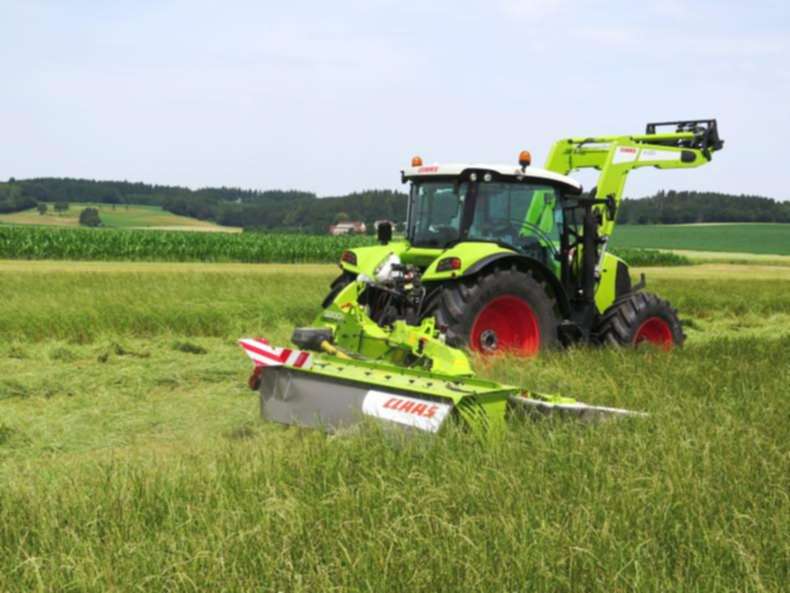
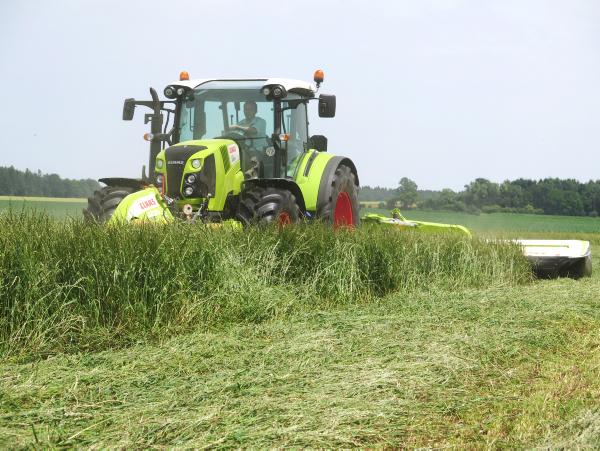
Claas has redeveloped the Arion 400 tractor range with additional models and power from 90hp to 140hp across six models, compared with three in the past. While the tractor may not be present for Ploughing 2014, the Claas team will have information for 2015 orders.
Claas is now using a 4.5-litre FTP four-cylinder engine in all of its tractors, rather than three-cylinder engines used by some of the competition at this power level. This engine replaces a John Deere engine and meets Tier 4 emissions regulations.
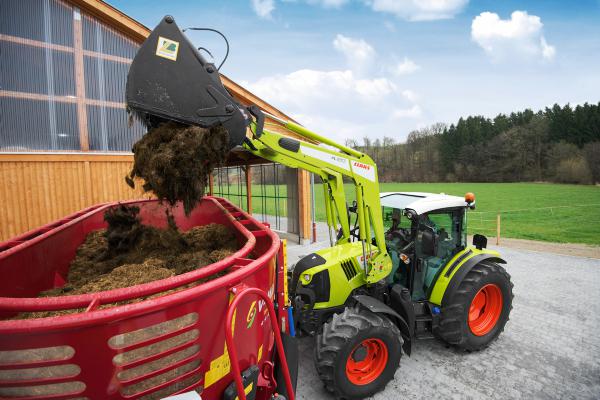
There is a new cab option, with a one-piece windscreen that is joined to the roof pane without a crossbeam, similar to the Fendt 700 series. This gives the operator an impressive 90o field of vision over a front loader.
The wasp-waist design of the bonnet on the new Arion 400 models allows a tight turning lock for maximum manoeuvrability. It also provides space above the front axle for radiator assembly.
The new Arion is built around a solid cast frame with integral oil sump. Where the Arion is to be used with a front loader, the brackets can be bolted directly on to the engine frame and transmission. A front linkage is available that is mounted to the front chassis, which Claas claims gives better stability and ease of access for servicing.
Proactive front-axle suspension is also available as an option for models over 90hp. This has a steering lock of 55o and, when activated, provides independent suspension with automatic height control.
There are two PTO options available on the Arion 400, 540/540 ECO and 540/540 ECO/1000. Speeds are selected using buttons on the B pillar. There is an automatic PTO function that will turn the PTO on and off, according to the height of the rear linkage. The maximum lift capacity at the ball ends is 4.5t on the Arion 410/420 and 5.75t on the Arion 430-460.


SHARING OPTIONS