



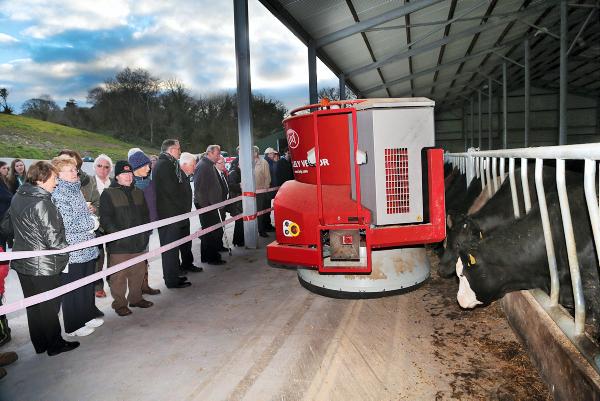
Farming is evolving like every industry in the world. Change happens, and this may have many benefits in the years to follow. So just how advanced has the job of putting feed into animals become?
There are many manufacturers of fully automated robotic controlled systems. Lely seems to be the company that is making the biggest impact on Irish farms. The robotic milking machine has made its debut on many dairy farms.
Robotic feeding, on the other hand, is working on just one farm in Ireland at the moment. According to Lely Ireland, there is more interest coming, and the company expects further sales of the Lely vector feeding system.
How does it work?
The Lely vector feeding system is completely automated from start to finish.
The farmyard needs to be built around it. Unfortunately, it will not stop traffic and cross the road for you. The unit will consist of the Lely kitchen, which is supplied with all the feed ingredients. All the forage and concentrates are placed in designated areas in the kitchen.
The robotic feed arm can travel to each preset area and take the exact amount required for the mix. The robotic diet feeder enters the kitchen and is loaded. The exact amount of concentrates and forage is discharged into the robotic mixer and feeder.
The robot makes its way to the animal sheds on preset pathways. The machine mixes on the way to each passage on the farm. Lely claims that it is very efficient, using low amounts of energy compared with a conventional diet feeder and tractor operation.
Lely also says the benefit of this system is that feeding can be allocated at any time of the day or night. This could possibly increase performance. The labour requirement for feeding is dramatically reduced, according to Lely.
An automated silage pusher known as the Juno is also available from Lely. This machine will work on most farms without much or any modification, Lely claims.
Keenan PACE
If this is just too much of a leap of faith for you, Keenan is offering the inTouch and PACE system as standard on all new feeders. This can be retro-fitted on older machines. This technology is cloud-based, where information is sent directly from the Keenan feeder to the cloud. This information can be accessed at any time by the nutritional team at Keenan. The farmer can be contacted directly by phone if required or via email if there are amendments needed to the feeding system.
Keenan claims that inconsistency in the mixing method is the biggest variable on farms. Cathal Gibbons at Keenan said: “Two Keenan diet feeders with the exact same material can have completely different results due to either under- or over-processing the material. This will have a huge impact on the returns in the milk tank.”
This system, according to Brian Rohan, a dairy farmer in Laois, can pinpoint differences in feeding quality over the weeks, and then look at what happened in the diet feeder that day to cause the problem.
If the tractor using the diet feeder has an electric PTO switch, the pace system can disengage the PTO to ensure the correct mixing time. To retro-fit this system will add roughly €3,658 plus VAT, which includes the first year’s interactive service for free. Eighty-seven per cent of new customers are renewing their subscription for the interactive cloud-based service, according to Keenan.
What is the cloud?
In Ireland, a cloud is associated with imminent bad weather and panic. A cloud in the world of information technology is far more beneficial. In the simplest terms, cloud computing means storing and accessing data and programs over the internet instead of your computer’s hard drive. This application has great potential for storing, gathering and analysing information.


SHARING OPTIONS