Body condition scoring of dairy cows is the assessment of body fat reserves. This can be done easily and quickly by handling cows passing through a crush.
The first area to look at is the ribs. A cow with a BCS 2 will have all ribs individually visible with tight skin covering the ribs and very little fat cover. A cow with a BCS 3 will have covered ribs. However, the last two ribs can be seen and felt. A cow with a BCS 4 will have fully covered ribs with a thick covering of a jelly-like fat.
The second area to inspect is the loin and short ribs. A cow with a BCS 2 will have sharp, readily visible short ribs and an empty loin. A cow with a BCS 3 will have smooth and well covered short ribs. However, it may be possible to see the tips of the short ribs. A cow with a BCS 4 will have fully filled loin and covered short ribs which cannot be felt individually.
The third area to inspect is the pin area. A cow with a BCS 2 will have a skintight cavity under the pins. A cow with a BCS 3 will not have prominent pins, and the area will be covered. A cow with a BCS 4 will have its pins submerged in fat.
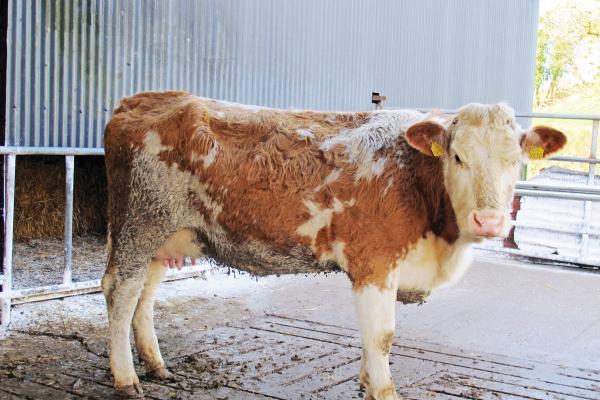
There are three main areas on a cow’s body to handle when assessing body condition score (BCS), see pictures one to three. During lactation, most dairy cows will range from a BCS 2/4 of two to four. BCS is subjective and the accuracy can vary between scorers. Generally, BCS is gauged in 0.5 BCS increments. Where the scorer is more experienced, it can be assessed in 0.25 increments.
Managing dairy cow condition throughout the year is essential in avoiding problems caused by negative energy balances, maximising milk yield and reducing wintering costs. Regardless of whether the herd is spring or autumn calving, there should be a clear focus to avoid rapid body condition loss in early lactation. Pre-calving, the target should be to have cows in a BCS of three to 3.5. At the start of the breeding season, cows should still be in a minimum BCS of 2.5 to three, that’s a drop of just 0.5 of a BCS between calving and the onset of breeding. Cow condition during lactation should be kept where possible to between 2.5 and three until drying off.
The herd should be body condition scored pre-housing and again in mid-winter to assess winter feeding and the need for further grouping of cows based on condition score. Cows that are in poor condition should be grouped together and supplemented accordingly to increase condition over time.
ADVERTISEMENT
Where condition is 0.5 below target coming up to drying off, it may be beneficial to place cows on once-a-day milking as a means of trying to improve condition cheaply at grass. Pre-breeding, the herd should be condition scored to assess cow condition.
Register for free to read this story and our free stories.
This content is available to digital subscribers and loyalty code users only. Sign in to your account, use the code or subscribe to get unlimited access.
The reader loyalty code gives you full access to the site from when you enter it until the following Wednesday at 9pm. Find your unique code on the back page of Irish Country Living every week.
CODE ACCEPTED
You have full access to the site until next Wednesday at 9pm.
CODE NOT VALID
Please try again or contact support.
There are three main areas on a cow’s body to handle when assessing body condition score (BCS), see pictures one to three. During lactation, most dairy cows will range from a BCS 2/4 of two to four. BCS is subjective and the accuracy can vary between scorers. Generally, BCS is gauged in 0.5 BCS increments. Where the scorer is more experienced, it can be assessed in 0.25 increments.
Managing dairy cow condition throughout the year is essential in avoiding problems caused by negative energy balances, maximising milk yield and reducing wintering costs. Regardless of whether the herd is spring or autumn calving, there should be a clear focus to avoid rapid body condition loss in early lactation. Pre-calving, the target should be to have cows in a BCS of three to 3.5. At the start of the breeding season, cows should still be in a minimum BCS of 2.5 to three, that’s a drop of just 0.5 of a BCS between calving and the onset of breeding. Cow condition during lactation should be kept where possible to between 2.5 and three until drying off.
The herd should be body condition scored pre-housing and again in mid-winter to assess winter feeding and the need for further grouping of cows based on condition score. Cows that are in poor condition should be grouped together and supplemented accordingly to increase condition over time.
Where condition is 0.5 below target coming up to drying off, it may be beneficial to place cows on once-a-day milking as a means of trying to improve condition cheaply at grass. Pre-breeding, the herd should be condition scored to assess cow condition.
If you would like to speak to a member of our team, please call us on 01-4199525.
Link sent to your email address
We have sent an email to your address. Please click on the link in this email to reset your password. If you can't find it in your inbox, please check your spam folder. If you can't find the email, please call us on 01-4199525.
ENTER YOUR LOYALTY CODE:
The reader loyalty code gives you full access to the site from when you enter it until the following Wednesday at 9pm. Find your unique code on the back page of Irish Country Living every week.






SHARING OPTIONS