



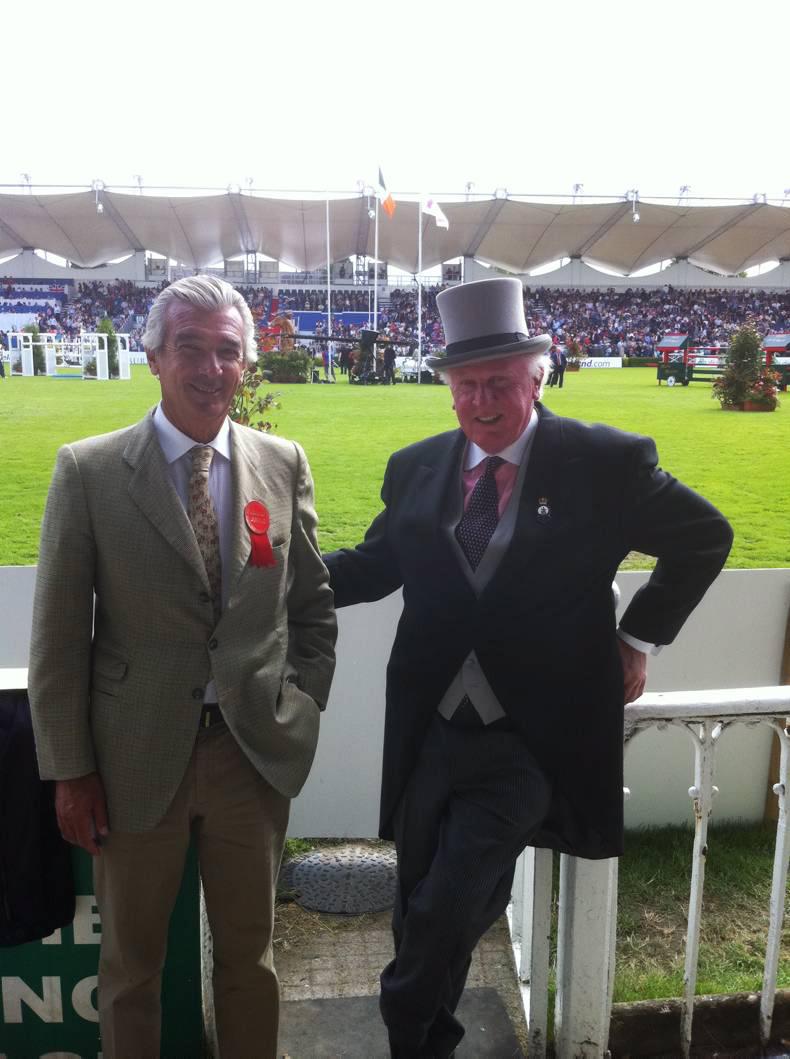
A rider of classic Spanish style, when Luis Alvarez Cervera entered the arena you could almost imagine an Ennio Morricone theme playing in the background.
He has excelled in showjumping and eventing right up to Olympic level. Beginning in 1972 at Munich and through to Barcelona in 1992, Luis created a record of sorts by taking part in six Olympic Games. At Barcelona, he represented Spain in both eventing and showjumping.
But there is more to Luis than his career in the saddle. He is also a knowledgeable young horse judge and breeder, who has given a great deal of time to the development of a Spanish sport horse breeding programme.
He was a founder member along with Alfredo Goyene and Pio Delgado of the Asiciacion Criadores de Caballos deport de Espana, their breed association, which was established in 1993. For the first three years, he served as vice president and then as president for the next 12. He is still a board member.
Breeding
During his almost 50-year competitive career, Luis rode French-, British- and German-bred horses, but since retiring from the international circuit, he has concentrated on trying to build up the Spanish Stud Book (CDE).
“The native mares back in the 1990s were mostly Anglo Arab. We would like to have brought in some good Holstein dams but they are just not for sale. So we first got some from France. Then we went for a number of VDL in Holland with which we had good success.
“They did not attempt to do stallion or mare inspections. We felt that each breeder was his own artist. But with some sponsorship and a Government budget, we concentrated on testing our young stock in a “classic circle” like they had in France. The two- and three-year-olds were judged over three days in October for conformation, walk, trot, canter and loose jumping.
“Due to the budget and sponsorship, we had good money in the classes, and breeders were encouraged to keep their young stock and to look after them well. In five years, we went from 250 registered foals to 1,000.”
Among the judges brought in for these show days was Alain Storme of Waterside Stud in Co Meath, who officiated there on up to 10 occasions.
“Because they focused on small numbers and performance, we saw some very nice horses,” he says. Among the successes out of this system is the nice grey Fardon, which is ridden at the top level by Anna-Julia Kontio of Finland. This one was brought on by Luis himself before it went abroad. He also notes that a number of eventers that went to Andrew Nichlolson also came out of this programme.
Part of their success lay in the encouragement they gave to breeders for using good performance stallions. “While we had the money, we gave subsidies of 50% up to a maximum €2,000 for the use of sires like Kannan, Baloubet, Diamant de Semilly and your own Cruising. If a breeder came to us with a proposal for a good young stallion with good breeding background, we would support that also.”
However, when the 2008 crash happened, both sponsorship and the government budget dried up, Luis reports that in recent years the number of foals being bred has dropped back from the 1,000 to around 400 a year.
The Irish connection
Luis has long had an association with the Irish horse scene. Back in the 1980s, he sent a young horse that he bred himself called Belenio to be ridden by Edward Doyle. Edward rode him as a six-year-old.
Later he was to win the Luxembourg Grand Prix for Luis. More recently he has on three occasions judged at Dublin Horse Show.
He recalls officiating at the thoroughbred stallions class and the Breeders Championship. Along with Charles Gordon Watson, he also did the potential event horse class, which was won by a thoroughbred.
Asked how he views the Irish sport horse breeding scene, he says, “It is difficult to have a clear opinion. When I come to Ireland, I am usually at the Dublin Horse Show and I do not get a chance to be out in the country to see what is happening there.
“But when I talk to people, I get two different opinions: some who are very much for the continental breeds and others would like to go back to the old type of nice Irish mares and cover them with the stallions that match them, in order to keep the source that made Ireland the leading country producing great horses like Rockbarton, Loch an Easpaig and Mullacrew.”
But looking at the present globalisation of sport horsebreeding, Luis went on to quote what he described as a very good article from the breeding director of the Holsteiner association, Dr Thomas Nissen, when he says, “It is only some stallions that we take from outside.
“Thoroughbred stallions, we need the thoroughbred to make the horses intelligent, tough and modern. We are always looking for foreign blood and we prefer stallions from France. But it is difficult because every breed, the Dutch, the Belgian, all the German breeds, they go around the world looking for interesting blood.
“With globalisation, the flow of information on the internet, it is very hard to find and exclusive source of new blood anywhere. We need to add fresh influences to our population with stallions from outside.”
Luis noted that Dr Nissen is also very protective of their cohort of Holsteiner mares, saying that even if only 3,000 of their 7,000 dams are now being bred from, they should still be kept in the country – a wise philosophy.
Watching Eduardo
For the past six years, Luis has shared his expertise with the New Zealand eventing team as showjumping coach. He, of course, is very much involved in the career of his son, Eduardo Alvarez Aznar, who is now shortlisted on the Spanish Olympic team for Rio with the French-bred Rocfeller by L’Arc de Triomph.
“I get very nervous watching him jump. But he rides like I would have liked to ride myself. He has a very good position and is very organised. He is a much, much better rider than I ever was.” Humble words from a man who has done it all and whose image can be seen in Eduardo.


SHARING OPTIONS