Now that our quilt top has been completed, we need to look at the finishing process. This includes making a quilt sandwich (layering), quilting the three layers together and then attaching the binding. However, let’s take a look at what we need first. We need to cut our backing fabric and wadding to suit the size of our quilt, but even if your quilt top is smaller or bigger than the one I am working on, it doesn’t matter. The same criteria applies to all sizes.
Note: Finished size of quilt 74” by 96”.
Layer, Quilt & Bind
Completed quilt top
Backing fabric (see below)
Fabric for binding strips (see below)
Wadding (same size as backing fabric)
Basting pins
Masking tape
General sewing items
Measure the quilt top and then cut the backing fabric 8” larger, which will give about 4” around each side of the quilt. If the fabric is not large enough, you will need to piece or join the backing fabric and it is preferable to have two joins down the length rather than one, with the wider piece in the middle and the narrower pieces sewn to each side (see figure 1). Open and press seams to reduce bulk and avoid stitching through another layer.Cut wadding the same size as the backing fabric. Wadding is sold as 90” wide or more, so there should be no need to join this.To calculate how much fabric you need for binding strips, add up the four sides of your quilt top, eg 74” + 74” + 96” + 96” = 340”. I like to add about 16” on top of that. This is to allow for piecing the binding strips together and turning around each corner of quilt top, etc. Then take that number 340” + 16” = 356” and divide by the width of your fabric (which is usually about 42” to 44”) 356” ÷ 42”= 8.47, which should be rounded off to nine. This is the number of strips that need to be cut at 2” high. So 9 X 2” = 18”. This is the amount of fabric needed for binding.Layering
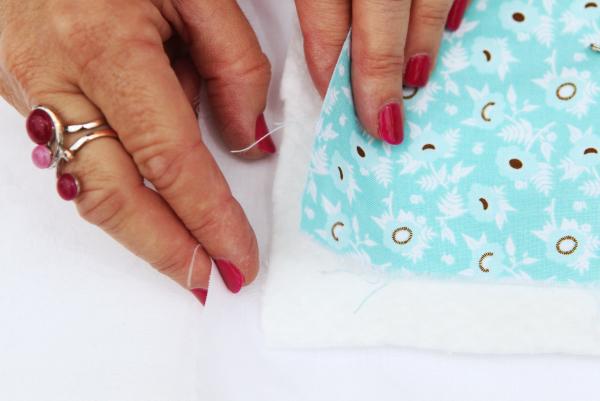
Lay backing fabric down on a flat surface, wrong side facing up, and keeping it taut use masking tape to stick it down.Lay wadding down next, smoothing out any wrinkles.Lay quilt top down, right side up, again smoothing out any wrinkles.Baste three layers together from the centre out, placing pins all over the quilt not more than 4” apart. Good preparation now will make quilting a lot easier later, so take your time.Quilting
This is often the stage where patch workers stumble and it is easy to see why. You are faced with your very large quilt top and the thought of layering, quilting and binding can seem overwhelming.
Take it one step at a time. Get a friend in to help with the layering and pinning process, or if you are part of a craft group bring it to your next meeting. It is great to get it to this stage and you have only one more step to go. However, if you are suffering from “quilt fatigue”, put it to one side and work on a small sewing project instead until you have your quilt mojo back.
Make sure your machine is in top working order and that you have a reasonable amount of arm length (this is the space between your needle on the left part of your machine and the vertical part on the right) to enable you to get that quilt under there.
Get yourself organised. Some quilters like to push the table up against a wall to stop the quilt from falling down the other side and then dragging and pulling. Others have used an ironing board placed to one side to take the bulk of the quilt weight.
Some quilters like to fold their quilt before they put it under the machine. Others like to bunch it up. You need to try it out to find what suits you best.
Quilting can be done by hand, by machine or professionally by a long-arm quilter. There is quite a difference between hand quilting and machine quilting, so try out some small samples (10” squares) before you decide which method to use.
Once you have decided how you want to quilt, you need to choose a quilting pattern to tie in with your quilt top. Long-arm quilters are very knowledgeable and will help you choose a quilting design if you decide to go that route. I chose an all over swirl pattern and quilted around the picture blocks.
If you are going to use your machine, you have another choice to make, will it be straight-line quilting using a walking-foot, or free-motion quilting, which allows you to quilt any pattern you wish, including circles, swirls, loops and the figure eight, etc.
To free-motion quilt, you need to drop the feed dogs (the teeth that move the fabric) on your machine, or at least cover them in some way, and attach a free-motion foot. Look for the switch on your machine that allows you to drop the feed dogs – it’s there somewhere and if not you may find a flat plastic plate which will cover them instead.
You will also need a free-motion foot, but check your manual. If you have what’s called a “darning foot” as part of your accessories, then it is the same thing.
You should really give this “free-motion quilting” a go. Drop the feed dogs, attach the darning foot (aka free-motion quilting foot), take some scrap fabric, make a quilt sandwich (about 10” square), put it under the machine and start sewing.
You can, if you wish, trace a quilting pattern onto your quilt top before you make the quilt sandwich using a water-soluble pen, which can be rinsed out later, or just go at it free-hand. It’s up to you. It’s very creative and loads of fun.
For this quilt I chose a swirly pattern. Rather than draw on my quilt top, I took a pencil and some scrap paper and doodled until I had the run of the pattern in my head and then I started free-motion quilting on the sewing machine.
To give this a try:
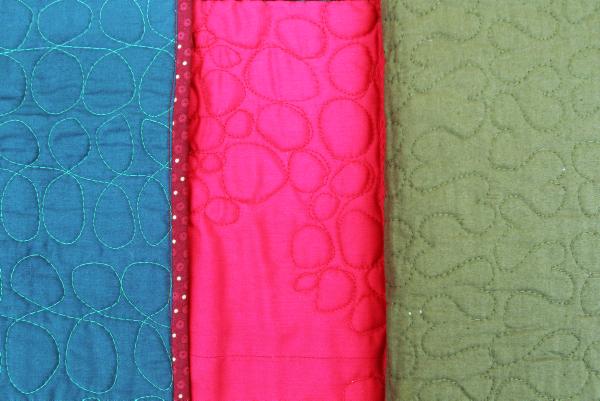
• Start on the outside edge of your quilt and stitch a big swirl (like a wave) until you get to the centre, then stop and stitch out again and try to keep the spacing between your stitching lines even, about ¼” is good. Don’t think about this too much at the start, it will just happen automatically eventually. Just keep stitching those swirls.• When you get to the end of the first swirl, branch over to the right and make another one exactly the same as before.• Repeat these steps until you have made a set of waves all across your quilt.• Remember to remove the pins as you go, clearing a space for your next couple of swirls each time.There are very many free-motion patterns you could look at. How about trying some pebbles (good for background filler), hearts (good as overall pattern) and the figure eight (perfect for borders).
To prepare the quilt for binding, trim away excess wadding and backing fabric so that raw edges are straight and even.
Binding
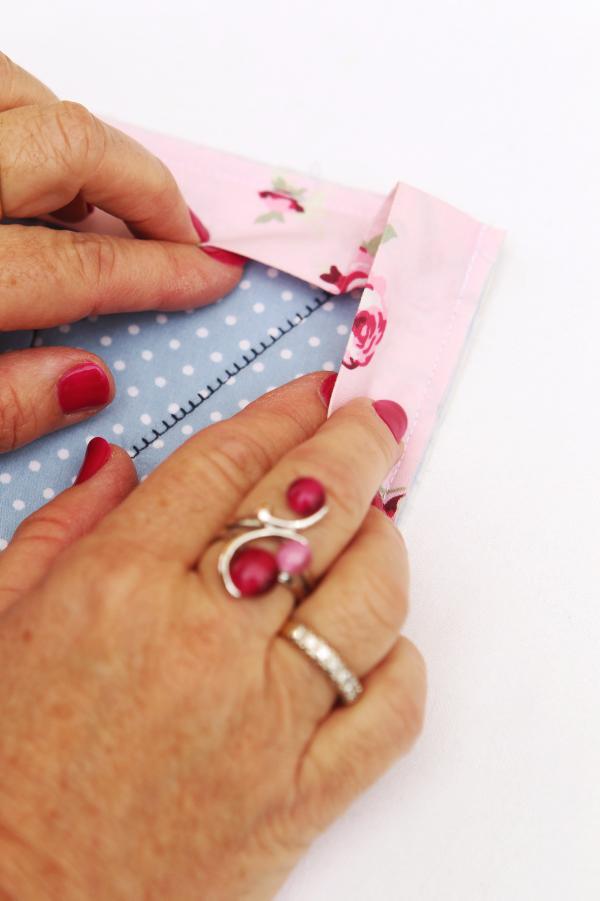
• Once you have your binding strips cut, sew all strips together to make one long continuous piece (see figure 2), then fold and press the binding in half lengthways, wrong sides together, to create a double fold binding.• To attach binding to front of quilt, align raw edge of binding with raw edge of quilt and sew through all layers. Stop stitching ¼” from the corner and backstitch.• Remove quilt from under the machine, fold binding up then refold binding down (figure 3).• Start sewing from the corner again, applying the binding all around the outside edge of the quilt in this way.• When you get back to the start bring two edges of binding together, stitch and trim. Fold the binding over to the back of the quilt and slip stitch in place to finish.Next Week: Create a matching pillow sham.
Now that our quilt top has been completed, we need to look at the finishing process. This includes making a quilt sandwich (layering), quilting the three layers together and then attaching the binding. However, let’s take a look at what we need first. We need to cut our backing fabric and wadding to suit the size of our quilt, but even if your quilt top is smaller or bigger than the one I am working on, it doesn’t matter. The same criteria applies to all sizes.
Note: Finished size of quilt 74” by 96”.
Layer, Quilt & Bind
Completed quilt top
Backing fabric (see below)
Fabric for binding strips (see below)
Wadding (same size as backing fabric)
Basting pins
Masking tape
General sewing items
Measure the quilt top and then cut the backing fabric 8” larger, which will give about 4” around each side of the quilt. If the fabric is not large enough, you will need to piece or join the backing fabric and it is preferable to have two joins down the length rather than one, with the wider piece in the middle and the narrower pieces sewn to each side (see figure 1). Open and press seams to reduce bulk and avoid stitching through another layer.Cut wadding the same size as the backing fabric. Wadding is sold as 90” wide or more, so there should be no need to join this.To calculate how much fabric you need for binding strips, add up the four sides of your quilt top, eg 74” + 74” + 96” + 96” = 340”. I like to add about 16” on top of that. This is to allow for piecing the binding strips together and turning around each corner of quilt top, etc. Then take that number 340” + 16” = 356” and divide by the width of your fabric (which is usually about 42” to 44”) 356” ÷ 42”= 8.47, which should be rounded off to nine. This is the number of strips that need to be cut at 2” high. So 9 X 2” = 18”. This is the amount of fabric needed for binding.Layering
Lay backing fabric down on a flat surface, wrong side facing up, and keeping it taut use masking tape to stick it down.Lay wadding down next, smoothing out any wrinkles.Lay quilt top down, right side up, again smoothing out any wrinkles.Baste three layers together from the centre out, placing pins all over the quilt not more than 4” apart. Good preparation now will make quilting a lot easier later, so take your time.Quilting
This is often the stage where patch workers stumble and it is easy to see why. You are faced with your very large quilt top and the thought of layering, quilting and binding can seem overwhelming.
Take it one step at a time. Get a friend in to help with the layering and pinning process, or if you are part of a craft group bring it to your next meeting. It is great to get it to this stage and you have only one more step to go. However, if you are suffering from “quilt fatigue”, put it to one side and work on a small sewing project instead until you have your quilt mojo back.
Make sure your machine is in top working order and that you have a reasonable amount of arm length (this is the space between your needle on the left part of your machine and the vertical part on the right) to enable you to get that quilt under there.
Get yourself organised. Some quilters like to push the table up against a wall to stop the quilt from falling down the other side and then dragging and pulling. Others have used an ironing board placed to one side to take the bulk of the quilt weight.
Some quilters like to fold their quilt before they put it under the machine. Others like to bunch it up. You need to try it out to find what suits you best.
Quilting can be done by hand, by machine or professionally by a long-arm quilter. There is quite a difference between hand quilting and machine quilting, so try out some small samples (10” squares) before you decide which method to use.
Once you have decided how you want to quilt, you need to choose a quilting pattern to tie in with your quilt top. Long-arm quilters are very knowledgeable and will help you choose a quilting design if you decide to go that route. I chose an all over swirl pattern and quilted around the picture blocks.
If you are going to use your machine, you have another choice to make, will it be straight-line quilting using a walking-foot, or free-motion quilting, which allows you to quilt any pattern you wish, including circles, swirls, loops and the figure eight, etc.
To free-motion quilt, you need to drop the feed dogs (the teeth that move the fabric) on your machine, or at least cover them in some way, and attach a free-motion foot. Look for the switch on your machine that allows you to drop the feed dogs – it’s there somewhere and if not you may find a flat plastic plate which will cover them instead.
You will also need a free-motion foot, but check your manual. If you have what’s called a “darning foot” as part of your accessories, then it is the same thing.
You should really give this “free-motion quilting” a go. Drop the feed dogs, attach the darning foot (aka free-motion quilting foot), take some scrap fabric, make a quilt sandwich (about 10” square), put it under the machine and start sewing.
You can, if you wish, trace a quilting pattern onto your quilt top before you make the quilt sandwich using a water-soluble pen, which can be rinsed out later, or just go at it free-hand. It’s up to you. It’s very creative and loads of fun.
For this quilt I chose a swirly pattern. Rather than draw on my quilt top, I took a pencil and some scrap paper and doodled until I had the run of the pattern in my head and then I started free-motion quilting on the sewing machine.
To give this a try:
• Start on the outside edge of your quilt and stitch a big swirl (like a wave) until you get to the centre, then stop and stitch out again and try to keep the spacing between your stitching lines even, about ¼” is good. Don’t think about this too much at the start, it will just happen automatically eventually. Just keep stitching those swirls.• When you get to the end of the first swirl, branch over to the right and make another one exactly the same as before.• Repeat these steps until you have made a set of waves all across your quilt.• Remember to remove the pins as you go, clearing a space for your next couple of swirls each time.There are very many free-motion patterns you could look at. How about trying some pebbles (good for background filler), hearts (good as overall pattern) and the figure eight (perfect for borders).
To prepare the quilt for binding, trim away excess wadding and backing fabric so that raw edges are straight and even.
Binding
• Once you have your binding strips cut, sew all strips together to make one long continuous piece (see figure 2), then fold and press the binding in half lengthways, wrong sides together, to create a double fold binding.• To attach binding to front of quilt, align raw edge of binding with raw edge of quilt and sew through all layers. Stop stitching ¼” from the corner and backstitch.• Remove quilt from under the machine, fold binding up then refold binding down (figure 3).• Start sewing from the corner again, applying the binding all around the outside edge of the quilt in this way.• When you get back to the start bring two edges of binding together, stitch and trim. Fold the binding over to the back of the quilt and slip stitch in place to finish.Next Week: Create a matching pillow sham.






SHARING OPTIONS