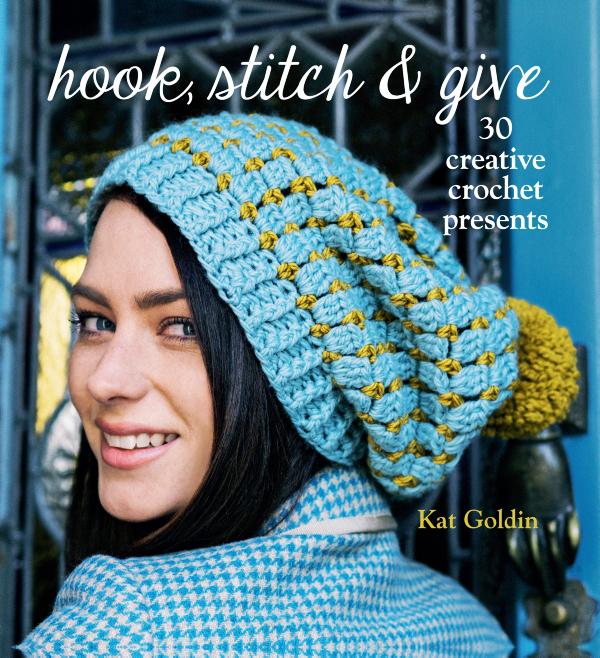
The book boasts 30 creative crochet patterns for every occasion, from birthdays and baby showers to christenings and Christmas. Projects include beanies, baby bonnets and blankets, cosy mittens, a delicate caplet, a table runner, a cabled cushion, a classic square blanket and much more. This week, we share Kat’s pattern for this cute slouch and bobble hat – perfect for hitting the slopes or simply the shops.
Level: Advanced beginner
Materials
Main colour (MC): 1 x 100g hank of Quince and Co Osprey (100% wool – Bird’s Egg
Contrast colour (CC): 1 x 100g hank of Quince and Co Osprey (100% wool) –Honey
5mm hook
• Yarn review: This worsted weight yarn has a smooth handle and comes in a rainbow of colours.• Yarn alternative: Cascade 22O.• Tension: Work 14 sts and 4.5 rows in Raised Treble Ribbing to measure 10cm square using 5mm hook, or size needed to achieve tension.• Pattern notes: Do not count the tch as a stitch unless stated. Instructions
Raised treble ribbing
With MC, leaving a 15cm tail for sewing up the gap in the ribbing at the end, 72 (76, 80)ftr. Join to work in round. Rounds 1–4: 3ch, *1RtrF, 1RtrB; rep from * around. Join. 72 (76, 80) sts.
Hat
Round 1: Join CC, 1ch, *1dc into RtrF, 2ch, miss 1RtrB*; rep from * around. Join. 36 (38, 40) dc sts.
Round 2: With MC, 1slst to chsp, 3ch (counts as 1tr) 2tr into chsp, 1ch, miss 1dc, *3tr into chsp, 1ch, miss 1dc; rep from * around. Join. 108 (114, 120) sts.
Round 3: Switch to CC, 1ch, 1dc into last chsp of previous round, 2ch, miss 3tr, *1dc into chsp, 2ch, miss 3tr; rep from * around. Join.
Work rows 2–3 a total of 8 (8, 9) times (for a less slouchy hat, work fewer repeats).Crown decreases
Round 1: 1slst to chsp, 3ch (counts as 1tr) 1tr into chsp, 1ch, miss 1dc, *2tr into chsp, 1ch, miss 1dc; rep from * around. Join. 72 (76, 80) sts.
Round 2: Switch to CC, 1ch, 1dc into last chsp of the previous round, miss 2tr, *1dc into chsp, miss 2tr; rep from * around. Join. Break yarn. 36 (38, 40) dc sts.Finishing
Using the yarn and needle, sew up the gap at the top of the hat, pulling tight to gather the stitches together. Tie the yarn off to secure. Using the tail left at the beginning foundation round, sew up the gap at the bottom edge of the ribbing. Make a large pom-pom out of CC and sew securely to the top of the hat.
This is a fun pattern to play with colour. Try to keep the ribbing and trebles the same colour and alternating colour on the double crochet stitches for a different look.Reading a pattern
Reading a pattern can be like reading a code. It can be tricky at first, but patterns are written using standard abbreviations for stitches and what to do. Know the code and you’ve got it.
Stitch or instruction: Abbreviation
Back loop only: BLO
Beginning chain: Beg ch
Between: btwn
Chain: ch
Chain space: chsp
Double crochet: dc
Double treble crochet: dtr
Foundation double crochet: fdr
Foundation treble crochet: ftr
Half treble crochet: htr
Increase: inc
Place marker: pm
Raised back: RxxB (xx can be any stitch)
Raised front: RxxF (xx can be any stitch)
Remove marker: rm
Right Side: RS
Slip marker (move the marker up a row): sm
Slipstitch: slst
Space: sp
Stitches: sts
Treble crochet: tr
Treble/Triple treble crochet: ttr
Turning chain: tch
Work 2 x together: x2tog (xx can be any stitch)
Wrong side: WS
Yarn over: YO
Example:
Rows 1–2 (3, 4, 5): 1 ch, [2dc in dc, 2dc] three times, 2 (3,4, 5)dc, *2dc in dc; repeat from * to end. Join. Turn. 20 (21, 22, 23) sts.
* Numbers in round brackets ( ) relate to the instructions for the various sizes from smallest to largest, working left to right. They can be row or round numbers, stitch counts or repeats.
* The instruction ‘2dc in dc, 2dc’ means make two double crochet in the next double crochet stitch, then double crochet in the next two stitches.
* Instructions in square brackets [ ] are to be repeated a set number of times, as directed immediately following the second bracket. There may be variations relating to the size, in which case follow the appropriate number in round brackets.
* When instructions are proceeded by a *, repeat that sequence of stitches as many times as indicated, usually to the end of the round or row.
* “Join” means join the round.
* “Turn” means turn your work.
* The stitch counts at the end of the row tell you how many stitches you should have worked in that row or round.
* “Work even” means continue in the stitch pattern as presented.
The book boasts 30 creative crochet patterns for every occasion, from birthdays and baby showers to christenings and Christmas. Projects include beanies, baby bonnets and blankets, cosy mittens, a delicate caplet, a table runner, a cabled cushion, a classic square blanket and much more. This week, we share Kat’s pattern for this cute slouch and bobble hat – perfect for hitting the slopes or simply the shops.
Level: Advanced beginner
Materials
Main colour (MC): 1 x 100g hank of Quince and Co Osprey (100% wool – Bird’s Egg
Contrast colour (CC): 1 x 100g hank of Quince and Co Osprey (100% wool) –Honey
5mm hook
• Yarn review: This worsted weight yarn has a smooth handle and comes in a rainbow of colours.• Yarn alternative: Cascade 22O.• Tension: Work 14 sts and 4.5 rows in Raised Treble Ribbing to measure 10cm square using 5mm hook, or size needed to achieve tension.• Pattern notes: Do not count the tch as a stitch unless stated. Instructions
Raised treble ribbing
With MC, leaving a 15cm tail for sewing up the gap in the ribbing at the end, 72 (76, 80)ftr. Join to work in round. Rounds 1–4: 3ch, *1RtrF, 1RtrB; rep from * around. Join. 72 (76, 80) sts.
Hat
Round 1: Join CC, 1ch, *1dc into RtrF, 2ch, miss 1RtrB*; rep from * around. Join. 36 (38, 40) dc sts.
Round 2: With MC, 1slst to chsp, 3ch (counts as 1tr) 2tr into chsp, 1ch, miss 1dc, *3tr into chsp, 1ch, miss 1dc; rep from * around. Join. 108 (114, 120) sts.
Round 3: Switch to CC, 1ch, 1dc into last chsp of previous round, 2ch, miss 3tr, *1dc into chsp, 2ch, miss 3tr; rep from * around. Join.
Work rows 2–3 a total of 8 (8, 9) times (for a less slouchy hat, work fewer repeats).Crown decreases
Round 1: 1slst to chsp, 3ch (counts as 1tr) 1tr into chsp, 1ch, miss 1dc, *2tr into chsp, 1ch, miss 1dc; rep from * around. Join. 72 (76, 80) sts.
Round 2: Switch to CC, 1ch, 1dc into last chsp of the previous round, miss 2tr, *1dc into chsp, miss 2tr; rep from * around. Join. Break yarn. 36 (38, 40) dc sts.Finishing
Using the yarn and needle, sew up the gap at the top of the hat, pulling tight to gather the stitches together. Tie the yarn off to secure. Using the tail left at the beginning foundation round, sew up the gap at the bottom edge of the ribbing. Make a large pom-pom out of CC and sew securely to the top of the hat.
This is a fun pattern to play with colour. Try to keep the ribbing and trebles the same colour and alternating colour on the double crochet stitches for a different look.Reading a pattern
Reading a pattern can be like reading a code. It can be tricky at first, but patterns are written using standard abbreviations for stitches and what to do. Know the code and you’ve got it.
Stitch or instruction: Abbreviation
Back loop only: BLO
Beginning chain: Beg ch
Between: btwn
Chain: ch
Chain space: chsp
Double crochet: dc
Double treble crochet: dtr
Foundation double crochet: fdr
Foundation treble crochet: ftr
Half treble crochet: htr
Increase: inc
Place marker: pm
Raised back: RxxB (xx can be any stitch)
Raised front: RxxF (xx can be any stitch)
Remove marker: rm
Right Side: RS
Slip marker (move the marker up a row): sm
Slipstitch: slst
Space: sp
Stitches: sts
Treble crochet: tr
Treble/Triple treble crochet: ttr
Turning chain: tch
Work 2 x together: x2tog (xx can be any stitch)
Wrong side: WS
Yarn over: YO
Example:
Rows 1–2 (3, 4, 5): 1 ch, [2dc in dc, 2dc] three times, 2 (3,4, 5)dc, *2dc in dc; repeat from * to end. Join. Turn. 20 (21, 22, 23) sts.
* Numbers in round brackets ( ) relate to the instructions for the various sizes from smallest to largest, working left to right. They can be row or round numbers, stitch counts or repeats.
* The instruction ‘2dc in dc, 2dc’ means make two double crochet in the next double crochet stitch, then double crochet in the next two stitches.
* Instructions in square brackets [ ] are to be repeated a set number of times, as directed immediately following the second bracket. There may be variations relating to the size, in which case follow the appropriate number in round brackets.
* When instructions are proceeded by a *, repeat that sequence of stitches as many times as indicated, usually to the end of the round or row.
* “Join” means join the round.
* “Turn” means turn your work.
* The stitch counts at the end of the row tell you how many stitches you should have worked in that row or round.
* “Work even” means continue in the stitch pattern as presented.







SHARING OPTIONS