

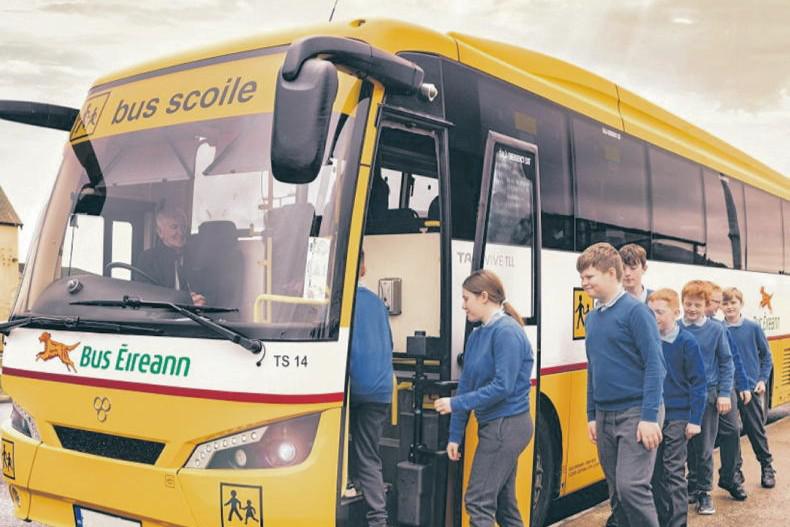
A controversial rule that prohibits drivers aged 70 and over from driving school buses could be relaxed, following a meeting of the Oireachtas Committee on Transport to discuss rural bus transport.
Bus Éireann currently operates a policy that forces school bus drivers to retire at 70, on the advice of a report for the Road Safety Authority (RSA) that warned of the potential risks posed by older drivers.
However, Bus Éireann chief executive Stephen Kent has told politicians that while safety of passengers is the company’s number one priority, there may be some room for progress on the matter of the upper age restriction.
Sinn Féin senator Joanne Collins told the Joint Committee meeting she had been contacted by many older drivers in her Co Limerick constituency who were very upset at being forced to retire.
“I had one man crying down the phone to me. He went to work as usual on a Thursday morning but when he woke the next day, his 70th birthday, he could no longer [due to this policy] drive the bus. Is this a Bus Éireann rule or where did it come from?”
Stephen Kent said the company was not alone in implementing the policy but said it was under review.
“This is a Bus Éireann policy but we are not alone as Dublin Bus has the same policy. This is a decision that has been informed by the need to manage the services as safely as possible, given the nature of the School Transport Scheme.”
Increased risk
Senator Collins asked if there was any potential for the policy to be reviewed or amended given the ongoing shortage of schoolbus drivers in rural areas.
“This policy is reviewed quite frequently and we have done a lot of work with the department given the pressure on driver numbers and everyone calling for a way to open it up,” added Stephen.
“The Department of Education commissioned a study, through the Road Safety Authority’s National Office for Traffic Medicine. Professor Luke O’Neill was commissioned to conduct the research. He pointed out a number of critical issues that might emerge, risk factors attached to older drivers. We discussed his findings with our board and our safety committee, which a lot of his findings suggested we would be taking on increased risk as there is a much higher risk of collision [with older drivers] based on this study.

Senator Joanne Collins.
“The report has identified a high risk associated with larger buses, anything from 34 seats up to 79 seats, when driven by older drivers.
“In order to move forward, because of the current demand for services in our school transport scheme, we are looking at our smaller public service vehicles, which transport eight people or less and which make up one third of our fleet. We are assessing the risk for smaller buses with an independent study to see if that is something we can do to allow older drivers to continue working on. There may be an opportunity to move in that direction but for the larger vehicles we have to follow the advice that we need to be careful.”
Senator Collins pointed out the double standard of having older drivers driving children to other school events.
“It’s ironic that private operators can have these same drivers, aged 70 and over, drive children to their school sports games and school tours,” she added.
Stephen said Bus Éireann recognised there were many of very capable individuals aged 70 and over but with 10,600 routes around the country the company had to ensure the safety of everyone.
Speaking to Irish Country Living, a Co Limerick bus driver described the rule as “stupid”.
“I’ve been driving children to school for 24 years. This year I wasn’t allowed to finish the school year as I turned 70 on 2 June,” he says.
“I am not allowed to take the children to the school but I can go into that same school half an hour later, take those children on a bus as far as Belfast and there’s no issue.
“I had one man, who has given his life to school transport, in tears on the phone when he had to stop. I myself was bringing children with special needs to school and they don’t understand where I’ve gone. I have a fleet of five buses but that will fall to four in the new year when another of my drivers reaches 70.
“The Local Link services all over the country can be driven by people of all ages, but we can’t drive a school bus for Bus Éireann. I’m a fit man, and I’d happily have a medical every six months to prove my fitness to drive but this rule is stupid.”
Smart ticketing system
Kerry Independent TD Danny Healy Rae also objected to the limitation of older drivers only being allowed to drive smaller school buses.
“I’m not happy with this notion that drivers 70 and over can only drive eight-seater buses. There are very experienced drivers out there who are well capable of driving medium buses, the majority of which are on the school transport scheme and have up to 34 seats.
“If an 80-year-old can drive a car with four passengers and himself without any problem and within the law, then this proposed solution isn’t going to advance in any way on what we’re asking for, which is for drivers over 70 to be allowed to continue doing their jobs,” he said.
“Surely if you have someone willing to undergo one or two medical tests a year to prove their fitness to drive that would offer more certainty than a younger driver who isn’t tested as regularly?”
Meanwhile, Bus Éireann has confirmed that a Smart ticketing scheme, where digital tickets are issued and can be used on smartphones, is under consideration for school transport.

Danny Healy Rae Independent TD.
Galway East Sinn Féin TD Louis O’Hara asked why such a system hasn’t already been introduced, given the annual frustration and inefficiency in the current system.
Miriam Flynn, chief schools officer with Bus Éireann said the scheme was in development.
“We issued 179,000 school bus tickets this year, a 5% increase on 2024, and we are very conscious that we have a very tight timeframe to get the service up and running,” she said.
“We appreciate the challenges for families, particularly those who may not get tickets. But it is an eligible scheme and there are clearly defined criteria in terms of determining who is eligible for a ticket. Priority goes to ensuring that cohort are facilitated first and all other pupils are then given access where capacity exists.
“We are looking at the whole area of smart ticketing with the Department at the moment. We have a project ongoing to see if we can replace the existing model with smart tickets which would give us far more information in relation to the utilisation of services,” added Miriam.
It would also modernise a number of areas around the application and make it more customer friendly.
Deputy O’Hara queried why the system was not already in place.
“A lot of these projects are subject to the availability of funding, but this project is part of the scheme that is currently under review by the Department,” said Miriam.
“There is a clear recognition that smart technology will form a key aspect of the school transport scheme going forward.”
In short
The National Office for Traffic Medicine is a joint initiative with Trinity College Dublin that develops road traffic medicine policy and medical fitness-to-drive guidelines for the Republic of Ireland.Earlier this year, the Government confirmed it would examine whether to allow those 70 and over to drive school buses. The School Transport Scheme, operated by Bus Éireann, on behalf of the Department of Education, is the largest scheme of its kind in Europe.It operates 58m journeys every year, transporting 173,000 passengers every day on a fleet of 8,300 school buses.
A controversial rule that prohibits drivers aged 70 and over from driving school buses could be relaxed, following a meeting of the Oireachtas Committee on Transport to discuss rural bus transport.
Bus Éireann currently operates a policy that forces school bus drivers to retire at 70, on the advice of a report for the Road Safety Authority (RSA) that warned of the potential risks posed by older drivers.
However, Bus Éireann chief executive Stephen Kent has told politicians that while safety of passengers is the company’s number one priority, there may be some room for progress on the matter of the upper age restriction.
Sinn Féin senator Joanne Collins told the Joint Committee meeting she had been contacted by many older drivers in her Co Limerick constituency who were very upset at being forced to retire.
“I had one man crying down the phone to me. He went to work as usual on a Thursday morning but when he woke the next day, his 70th birthday, he could no longer [due to this policy] drive the bus. Is this a Bus Éireann rule or where did it come from?”
Stephen Kent said the company was not alone in implementing the policy but said it was under review.
“This is a Bus Éireann policy but we are not alone as Dublin Bus has the same policy. This is a decision that has been informed by the need to manage the services as safely as possible, given the nature of the School Transport Scheme.”
Increased risk
Senator Collins asked if there was any potential for the policy to be reviewed or amended given the ongoing shortage of schoolbus drivers in rural areas.
“This policy is reviewed quite frequently and we have done a lot of work with the department given the pressure on driver numbers and everyone calling for a way to open it up,” added Stephen.
“The Department of Education commissioned a study, through the Road Safety Authority’s National Office for Traffic Medicine. Professor Luke O’Neill was commissioned to conduct the research. He pointed out a number of critical issues that might emerge, risk factors attached to older drivers. We discussed his findings with our board and our safety committee, which a lot of his findings suggested we would be taking on increased risk as there is a much higher risk of collision [with older drivers] based on this study.

Senator Joanne Collins.
“The report has identified a high risk associated with larger buses, anything from 34 seats up to 79 seats, when driven by older drivers.
“In order to move forward, because of the current demand for services in our school transport scheme, we are looking at our smaller public service vehicles, which transport eight people or less and which make up one third of our fleet. We are assessing the risk for smaller buses with an independent study to see if that is something we can do to allow older drivers to continue working on. There may be an opportunity to move in that direction but for the larger vehicles we have to follow the advice that we need to be careful.”
Senator Collins pointed out the double standard of having older drivers driving children to other school events.
“It’s ironic that private operators can have these same drivers, aged 70 and over, drive children to their school sports games and school tours,” she added.
Stephen said Bus Éireann recognised there were many of very capable individuals aged 70 and over but with 10,600 routes around the country the company had to ensure the safety of everyone.
Speaking to Irish Country Living, a Co Limerick bus driver described the rule as “stupid”.
“I’ve been driving children to school for 24 years. This year I wasn’t allowed to finish the school year as I turned 70 on 2 June,” he says.
“I am not allowed to take the children to the school but I can go into that same school half an hour later, take those children on a bus as far as Belfast and there’s no issue.
“I had one man, who has given his life to school transport, in tears on the phone when he had to stop. I myself was bringing children with special needs to school and they don’t understand where I’ve gone. I have a fleet of five buses but that will fall to four in the new year when another of my drivers reaches 70.
“The Local Link services all over the country can be driven by people of all ages, but we can’t drive a school bus for Bus Éireann. I’m a fit man, and I’d happily have a medical every six months to prove my fitness to drive but this rule is stupid.”
Smart ticketing system
Kerry Independent TD Danny Healy Rae also objected to the limitation of older drivers only being allowed to drive smaller school buses.
“I’m not happy with this notion that drivers 70 and over can only drive eight-seater buses. There are very experienced drivers out there who are well capable of driving medium buses, the majority of which are on the school transport scheme and have up to 34 seats.
“If an 80-year-old can drive a car with four passengers and himself without any problem and within the law, then this proposed solution isn’t going to advance in any way on what we’re asking for, which is for drivers over 70 to be allowed to continue doing their jobs,” he said.
“Surely if you have someone willing to undergo one or two medical tests a year to prove their fitness to drive that would offer more certainty than a younger driver who isn’t tested as regularly?”
Meanwhile, Bus Éireann has confirmed that a Smart ticketing scheme, where digital tickets are issued and can be used on smartphones, is under consideration for school transport.

Danny Healy Rae Independent TD.
Galway East Sinn Féin TD Louis O’Hara asked why such a system hasn’t already been introduced, given the annual frustration and inefficiency in the current system.
Miriam Flynn, chief schools officer with Bus Éireann said the scheme was in development.
“We issued 179,000 school bus tickets this year, a 5% increase on 2024, and we are very conscious that we have a very tight timeframe to get the service up and running,” she said.
“We appreciate the challenges for families, particularly those who may not get tickets. But it is an eligible scheme and there are clearly defined criteria in terms of determining who is eligible for a ticket. Priority goes to ensuring that cohort are facilitated first and all other pupils are then given access where capacity exists.
“We are looking at the whole area of smart ticketing with the Department at the moment. We have a project ongoing to see if we can replace the existing model with smart tickets which would give us far more information in relation to the utilisation of services,” added Miriam.
It would also modernise a number of areas around the application and make it more customer friendly.
Deputy O’Hara queried why the system was not already in place.
“A lot of these projects are subject to the availability of funding, but this project is part of the scheme that is currently under review by the Department,” said Miriam.
“There is a clear recognition that smart technology will form a key aspect of the school transport scheme going forward.”
In short
The National Office for Traffic Medicine is a joint initiative with Trinity College Dublin that develops road traffic medicine policy and medical fitness-to-drive guidelines for the Republic of Ireland.Earlier this year, the Government confirmed it would examine whether to allow those 70 and over to drive school buses. The School Transport Scheme, operated by Bus Éireann, on behalf of the Department of Education, is the largest scheme of its kind in Europe.It operates 58m journeys every year, transporting 173,000 passengers every day on a fleet of 8,300 school buses.
SHARING OPTIONS