

The emotional turmoil involved when a farming family agrees to sign over land to the next generation is one of the many reasons why succession remains such a thorny issue in rural Ireland.
While families are urged to sit down and develop a plan collectively, the growing number of families who don’t have a natural successor among their ranks makes this an unviable option for many farm families, especially those who don’t want to step back from active farming.
However, the rise of share farming partnerships around the country in recent years is giving those who are considering retirement a realistic way of reducing their involvement in active farming, while still having a say in how their land is farmed.
It is also, crucially, cultivating the next generation of farmers who are not being held back due to the lack of farmland in their own name.
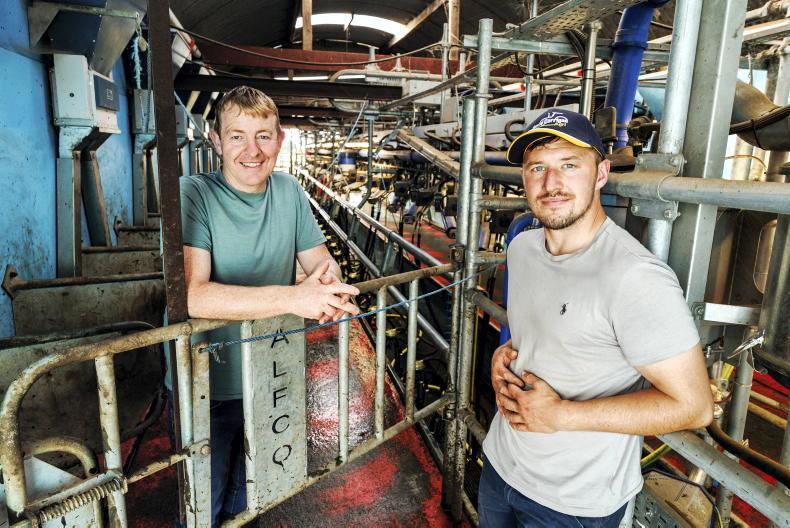
Four years into a 10-year share farming partnership, Tony McCormack and Chris Cahill spoke to Irish Country Living on how the arrangement is working for them on their dairy farm in Delvin Co Westmeath.
Goals and visions
Tony is a part-time dairy farmer who opted for the share farm model to future-proof his holding which had previously been a mix of dairy and beef.
Having struggled to find a suitable farm to lease, with land prices too high in his native Co Cavan, Chris initially found it hard to find many opportunities in share farming until he got a call from the Land Mobility Service’s facilitator for the North Eastern and Midlands Region, Paddy Brady.
The Land Mobility Service is a nationwide, independent service that offers expert advice to farmers on collaborative farming arrangements to the benefit of both parties. Its work includes share farming, long leases and partnerships.
“I had been chatting to Paddy a fair bit but while there were share farming opportunities down the country, there didn’t seem to be a lot coming up near me here until I got a call in May 2021,” explains Chris.
“I had bought 30 bulls and heifers the previous month which put the skids under me as I had to find somewhere for them, but I think it also gave me a leg up with the bank as they could see I was serious and I had a reasonably robust business plan to back me up.
“I met with Tony and we sat down and went through the goals and visions we had and found they were the same.”
Tony says this meeting and several more the two men held before they agreed to enter a share farming partnership were crucial to the success of their arrangement.
“I have had a full-time job in rural development for the past 26 years and had taken the farm as far as I could working it part-time, but there were too many pressure points. I knew I needed to do something to secure the future of the farm.
“I have three daughters and no clear succession path so the idea of share farming appealed. I contacted Land Mobility Services four years ago and having met a number of candidates, once I sat down with Chris, I knew we were on the same page in terms of what we wanted to achieve.
“I never wanted to lease the land as I always wanted to still be involved but I didn’t want to walk away from my job either, so this is proving a very good option for me.

Tony McCormack and Chris Cahill walk among the dairy herd on the share farming partnership they are involved in at Tony's farm at Caddagh, near Delvin, Co Westmeath. \ Philip Doyle
“We needed to build scale and critical mass in order to draw two incomes from the farm and that is exactly what we’ve done.”
Chris and Tony have a ten-year share farming agreement in place, with a commitment by Tony to review it after eight years, to see where both parties stand.
“The agreement is long enough for me to clear my stock loans and long enough for Tony’s daughters to decide if they’re interested in taking on the farm or if Tony himself wants to step back completely,” says Chris.
“The future depends on everyone’s circumstances to determine the next stage.”
For now, both men are enjoying a fruitful working relationship, with Tony having invested in new farm buildings and Chris growing the herd to 240 cows, with a 20% replacement rate annually.
“We meet regularly to go through bills and key decisions that have to be taken but there are other less formal contacts such as when the first cut is happening, I will always check in with Tony as I value his experience,” says Chris.
Keeps my hand in
Tony equally enjoys the call to labour, and says his evening walks on the land reassure him he has made the right decision.
“I do still like to be involved and while Chris has a farm manager working alongside him, I’d be delighted to get the odd call for milking, it keeps my hand in and that is the main reason I went down the share farming route.
“If I had one bit of advice for anyone thinking of doing this I’d say do as much research as you can, whether you’re the landowner or the share farmer. No two agreements are the same and you absolutely need to get good advice. Give yourself time, don’t be in a rush. Cost everything out on both sides and make sure you’ve all aspects covered. We spent six months in the planning phase before anything was signed and that preparation served us well.”
Chris says he has met many families in recent years where there is no succession plan in place.
“I was doing a bit of grass measurement for a man recently who is in his 70s. He has three sons who have no interest in the farm which is a dairy farm with a herd of 200. When I asked what they would do into their old age his wife said he would never be able to watch someone farm his land. So, it is a very hard thing for some people to consider.
“I had worked on my uncle’s farm but I was never going to inherit the land. I went to university and got my Ag Science degree in Dairy Business, so while I had no guarantee I would end up farming, I had the opportunity to work in agriculture. I worked with Lakeland for many years but every time I would be driving out of a really great farmyard, I always thought I’d love to be involved in something like that.
“Here I’m building a business and there is satisfaction in being your own boss. I love the figures side of things, which is my business background coming through, especially when it comes to breeding. I love going through the data.
“But it’s been a learning curve, the first year was great but my second was the worst in 50 years in the dairy sector. So far 2025 is proving a great year but you don’t know what’s around the corner.”
Tony says the share farming partnership offers great opportunities for both young and older farmers.
“The Department of Agriculture need to incentivise this from the very beginning,” he said.
Chris agrees and suggests the costs could be offset by grants.
“If the grant aid was towards the fees at the very start, whether that be for your accountant or your solicitor, that would be a big help. The whole agriculture industry needs to get behind this. I was at a Land Mobility Service session at a farm walk in Bailieborough earlier this year and it was the first time I’ve ever come across it. There needs to be a national rollout so farmers can get to one to learn of the possibilities that share farming can offer.”
Shared arrangements work well for those landowners with sizeable holdings, but can also work where the land size is smaller and the landowner is willing to allow it be included in the share farmer’s BPS/BISS return.Under a share farm agreement, the landowner supplies the land and infrastructure including any infrastructure enhancement while the share farmer supplies the labour, daily management and livestock. Farm revenues and operating costs are shared while both parties remain active farmers. Share farming is most common in the tillage and dairy sector but is also in place on beef and sheep holdings.To find out more, check the collaborative farming section of teagasc.ie and hit the shared farming tab.
The emotional turmoil involved when a farming family agrees to sign over land to the next generation is one of the many reasons why succession remains such a thorny issue in rural Ireland.
While families are urged to sit down and develop a plan collectively, the growing number of families who don’t have a natural successor among their ranks makes this an unviable option for many farm families, especially those who don’t want to step back from active farming.
However, the rise of share farming partnerships around the country in recent years is giving those who are considering retirement a realistic way of reducing their involvement in active farming, while still having a say in how their land is farmed.
It is also, crucially, cultivating the next generation of farmers who are not being held back due to the lack of farmland in their own name.
Four years into a 10-year share farming partnership, Tony McCormack and Chris Cahill spoke to Irish Country Living on how the arrangement is working for them on their dairy farm in Delvin Co Westmeath.
Goals and visions
Tony is a part-time dairy farmer who opted for the share farm model to future-proof his holding which had previously been a mix of dairy and beef.
Having struggled to find a suitable farm to lease, with land prices too high in his native Co Cavan, Chris initially found it hard to find many opportunities in share farming until he got a call from the Land Mobility Service’s facilitator for the North Eastern and Midlands Region, Paddy Brady.
The Land Mobility Service is a nationwide, independent service that offers expert advice to farmers on collaborative farming arrangements to the benefit of both parties. Its work includes share farming, long leases and partnerships.
“I had been chatting to Paddy a fair bit but while there were share farming opportunities down the country, there didn’t seem to be a lot coming up near me here until I got a call in May 2021,” explains Chris.
“I had bought 30 bulls and heifers the previous month which put the skids under me as I had to find somewhere for them, but I think it also gave me a leg up with the bank as they could see I was serious and I had a reasonably robust business plan to back me up.
“I met with Tony and we sat down and went through the goals and visions we had and found they were the same.”
Tony says this meeting and several more the two men held before they agreed to enter a share farming partnership were crucial to the success of their arrangement.
“I have had a full-time job in rural development for the past 26 years and had taken the farm as far as I could working it part-time, but there were too many pressure points. I knew I needed to do something to secure the future of the farm.
“I have three daughters and no clear succession path so the idea of share farming appealed. I contacted Land Mobility Services four years ago and having met a number of candidates, once I sat down with Chris, I knew we were on the same page in terms of what we wanted to achieve.
“I never wanted to lease the land as I always wanted to still be involved but I didn’t want to walk away from my job either, so this is proving a very good option for me.

Tony McCormack and Chris Cahill walk among the dairy herd on the share farming partnership they are involved in at Tony's farm at Caddagh, near Delvin, Co Westmeath. \ Philip Doyle
“We needed to build scale and critical mass in order to draw two incomes from the farm and that is exactly what we’ve done.”
Chris and Tony have a ten-year share farming agreement in place, with a commitment by Tony to review it after eight years, to see where both parties stand.
“The agreement is long enough for me to clear my stock loans and long enough for Tony’s daughters to decide if they’re interested in taking on the farm or if Tony himself wants to step back completely,” says Chris.
“The future depends on everyone’s circumstances to determine the next stage.”
For now, both men are enjoying a fruitful working relationship, with Tony having invested in new farm buildings and Chris growing the herd to 240 cows, with a 20% replacement rate annually.
“We meet regularly to go through bills and key decisions that have to be taken but there are other less formal contacts such as when the first cut is happening, I will always check in with Tony as I value his experience,” says Chris.
Keeps my hand in
Tony equally enjoys the call to labour, and says his evening walks on the land reassure him he has made the right decision.
“I do still like to be involved and while Chris has a farm manager working alongside him, I’d be delighted to get the odd call for milking, it keeps my hand in and that is the main reason I went down the share farming route.
“If I had one bit of advice for anyone thinking of doing this I’d say do as much research as you can, whether you’re the landowner or the share farmer. No two agreements are the same and you absolutely need to get good advice. Give yourself time, don’t be in a rush. Cost everything out on both sides and make sure you’ve all aspects covered. We spent six months in the planning phase before anything was signed and that preparation served us well.”
Chris says he has met many families in recent years where there is no succession plan in place.
“I was doing a bit of grass measurement for a man recently who is in his 70s. He has three sons who have no interest in the farm which is a dairy farm with a herd of 200. When I asked what they would do into their old age his wife said he would never be able to watch someone farm his land. So, it is a very hard thing for some people to consider.
“I had worked on my uncle’s farm but I was never going to inherit the land. I went to university and got my Ag Science degree in Dairy Business, so while I had no guarantee I would end up farming, I had the opportunity to work in agriculture. I worked with Lakeland for many years but every time I would be driving out of a really great farmyard, I always thought I’d love to be involved in something like that.
“Here I’m building a business and there is satisfaction in being your own boss. I love the figures side of things, which is my business background coming through, especially when it comes to breeding. I love going through the data.
“But it’s been a learning curve, the first year was great but my second was the worst in 50 years in the dairy sector. So far 2025 is proving a great year but you don’t know what’s around the corner.”
Tony says the share farming partnership offers great opportunities for both young and older farmers.
“The Department of Agriculture need to incentivise this from the very beginning,” he said.
Chris agrees and suggests the costs could be offset by grants.
“If the grant aid was towards the fees at the very start, whether that be for your accountant or your solicitor, that would be a big help. The whole agriculture industry needs to get behind this. I was at a Land Mobility Service session at a farm walk in Bailieborough earlier this year and it was the first time I’ve ever come across it. There needs to be a national rollout so farmers can get to one to learn of the possibilities that share farming can offer.”
Shared arrangements work well for those landowners with sizeable holdings, but can also work where the land size is smaller and the landowner is willing to allow it be included in the share farmer’s BPS/BISS return.Under a share farm agreement, the landowner supplies the land and infrastructure including any infrastructure enhancement while the share farmer supplies the labour, daily management and livestock. Farm revenues and operating costs are shared while both parties remain active farmers. Share farming is most common in the tillage and dairy sector but is also in place on beef and sheep holdings.To find out more, check the collaborative farming section of teagasc.ie and hit the shared farming tab.
SHARING OPTIONS