


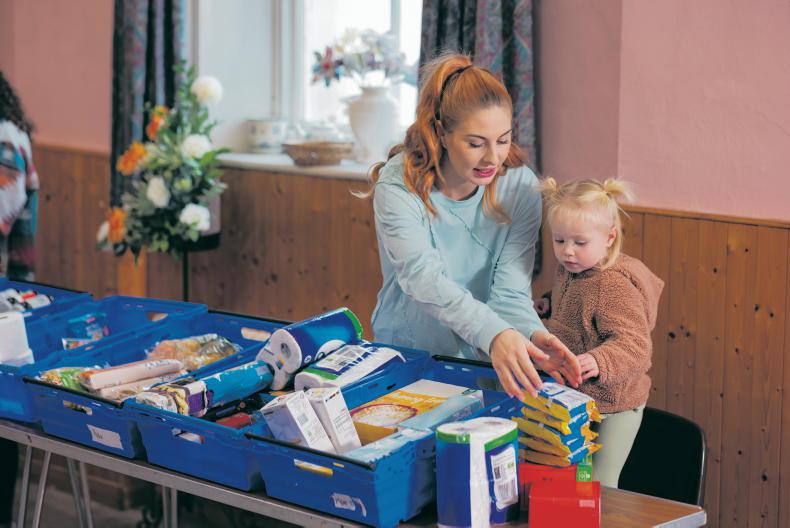
The cost of living crisis continues to affect thousands of families throughout rural Ireland and with no sign of any further help from Government coming in next month’s Budget, the winter months will be a struggle for many.
With an ESRI report earlier this month stating that one in five Irish children are now living below the poverty line, after housing costs are taken into account, it has also been shown that average household incomes are declining.
Food banks first came into the public consciousness during the pandemic, when community initiatives sought to support the elderly and vulnerable who were unable to get the shops under lockdown restrictions.
Five years on however, more and more members of rural communities, from young families to individuals of all ages are relying on weekly or monthly food parcels.
Those working on the front line of these services, in the main run by family resource centres, say the easing of food bills allows families to use income to pay for other bills such as childcare, heat and energy.
Irish Country Living spoke to the co-ordinators of three different food banks in counties Limerick, Meath and Wexford to learn how demand is stretching resources in rural Ireland.
Increased demand
Mary McGrath is the co-ordinator of Hospital Family Resource Centre on the Limerick/Tipperary border.
The centre’s food bank has been running for over a decade and Mary says the demand for the service has soared since the pandemic.
“We are recipients of the Food for European Aid for the Most Deprived (FEAD) programme that allows us to support families in our area, and we have a monthly food bank where we distribute up to 160 food parcels to those in need,” she explains.
“In the past we would have had scope to provide food for people attending our programmes here at the centre, but the increased demand on the food bank means that is no longer possible. Our parcels used to contain an average 15 items but now its down to between 10 and 12 and there are some months where our volunteers are having to make up additional parcels from whatever surplus stock we have, which is never very much.
“We try to ensure everyone who comes to the food bank gets something and we have a huge cross-section of people using the service.
“We don’t means test people, but we do register those who seek the support of the food bank and in the case where we’re supporting families, we require identification to verify the number of children in a family. Likewise, if a person is collecting a parcel on behalf of someone, we need ID to make sure they are who they say they are, but we don’t judge anyone.”
Mary says that while food banks used to be a crisis intervention, the ongoing cost-of-living crisis has made them a part of life for a lot of families.
“The idea is that people only use a food bank in a crisis but the reality is it is sustaining many families’ monthly income,” she adds.
“We are a small rural community and we have people coming form as far away as Charleville and Kilmallock. We try to manage it and not turn anyone away because it’s not as if there is another equivalent service in the area.

Local food producers
“Putting food in black bags for people is not the right way to help them [in the long term] and while we are grateful to offer tangible support to those in need, this kind of work is very challenging.”
Justyna Doherty is the co-ordinator of Trim Family Resource Centre and says more and more working people are relying on the dig out of a food bank to feed their families.
“We cover south Meath, probably a 25km radius around Trim, and the demand has definitely increased since Covid,” she says.
“Working people feel bad using the food bank as they are conscious of taking food from people they think are more needy than they are, even though they are in crisis. We encourage them to use the service so that they can use the money they save on food and put it towards other bills.”
When Trim FRC first began its food bank in 2022, it supported 85 families. By April of this year that number had almost doubled to 158 families.
“We offer a weekly food bank as we receive our fresh food from local supermarkets that are signed up to Food Cloud, while the non-perishable goods are delivered monthly by Food Cloud too. We have no control over what comes in but we have a full log of products and while not everyone will want the food available, there is good variety and plenty to choose from.
“We are also building relationships with local food producers as it is great to be able to offer fresher produce where possible. We started out in a cupboard, supporting a small number of local people. We now have two rooms in the centre given over to food bank with three large freezers, five fridges and we’re at our limit. We can’t expand and so far, we haven’t had to turn anyone away but we are conscious that it may yet happen.”

Social supermarket
In Wexford, a social supermarket has been serving the small rural community of Ramsgrange in the south west of the county for the past number of years.
South West Wexford Family Resource Centre has been supporting people with food poverty initiatives since 2015. Sinead Colfer says demand has been steadily increasing since 2023.
“A social supermarket is very similar to a food bank, but it allows people to maintain their dignity by enabling them to come in and do their own shopping instead of receiving a physical hand out,” explains the family support worker.
“The supermarket is open one day a week and the biggest difference we are seeing with this model is that more and more working families are finding themselves in need of help. We have up to 50 families using the supermarket every week, which amounts to 220 people.
“Back in 2015 it was predominantly families on low incomes or elderly people living alone that we were supporting but now it’s families where both parents are working and they just can’t meet their bills.
“We also find a lot of families where a long-term illness or a disability has meant one parent can no longer work and that’s having a huge effect on people making ends meet.
“Over the summer we had families asking to use the service for a few weeks so that they could free up money to pay for their children to go to summer camps [with their friends]. Others find themselves in a crisis when a huge electricity bill lands or the car breaks down. There is still a stigma out there but more and more people are finding themselves in crisis and in need of our help.”
The social supermarket was supporting people from all over Wexford until the start of this year, when Sinead and her team had to pull back.
“We were dealing with massive queues where people were coming from all over the county, some of whom would be here at 6am and we didn’t open until 11am. We just couldn’t cope with the demand so we had to bring it back to local people only.
“The problem is there aren’t any other services like ours in the county, so Food Cloud is launching an initiative to try to encourage more communities to get on board.”
A special event takes place on Tuesday 23 September at Wexford Arts Centre, designed to strengthen food sharing throughout the county. Organised by FoodCloud, the event will examine how food redistribution can build a stronger, more sustainable food system in the county. The event is free to attend but registration is required at food-sharing-wexford.eventbrite.ie.
FoodCloud connects participating supermarkets with community groups and charitable organisations for the distribution of food that cannot be sold. If it accepts the food offered, the charity collects the surplus food and redistributes it to those in need.
FoodCloud hubs operate in every county in Ireland, through three redistribution hubs in Dublin, Cork and Galway.

