



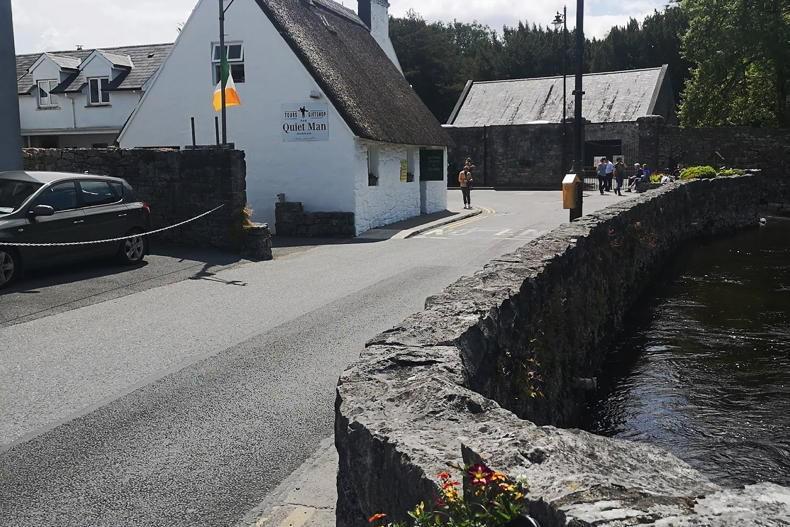
The picturesque village of Cong is synonymous with the five-star Ashford Castle estate and its idyllic location along the shores of Lough Corrib.
However, its peace has been upended in recent months over plans to build a relief road around the village to ease chronic traffic congestion.
Mayo County Council, in conjunction with Galway County Council, launched the Cong Relief Road project earlier this year, but the plans have been met with fierce resistance from the local community.
Cong straddles the county border, with Lough Corrib on the Galway side and Lough Mask to the north in Mayo making it a very popular spot for tourists, with summer traffic levels particularly intense.
The relief road project has identified a total of 11 potential routes to carry heavy goods vehicles away from the village, but none are deemed acceptable by residents who say there are more cost effective, environmentally friendly ways of tackling traffic congestion.
Sinead O’Brien lives in Drumshiel, on the outskirts of the village and is involved in the campaign to fight the road project. She says there has been little to no engagement from the council or its elected members with the local community.
“We’ve held public meetings that have drawn large numbers from the community but no one from the council has shown up. Phone contact is minimal and one council executive has told us that it’s his job to build the road and our job to stop him,” she says.
No engagement
“There is huge support for the removal of HGV traffic from the village centre but we don’t support any of the 11 proposed routes as they won’t remove traffic, they’ll funnel it into the village.
“Cong has geological heritage of national and international significance and this road will compromise that. People in the village feel the council is pushing this through with next to no engagement with local people. When we try to engage, we are being told to wait until the 11 routes proposed are whittled down to three. But when none of them are acceptable already how is that going to make a difference?
Susan O’Dowd was born in the village and says everyone is acutely aware of the danger posed by traffic.
“We are living in daily fear of a fatality from the volume of traffic, particularly heavy goods vehicles coming through. Everyone ignores the double yellow lines, but it is only the parking on both sides of the narrow streets that is actually slowing traffic down,” she says.
“My home house is on the corner as you come into the village and my brother lives there in constant fear of a truck going through the gable wall. We all want a solution to the traffic but a relief road that won’t actually solve the problem isn’t the answer.”

The community group has asked the council to implement a HGV ban in the village, but this request has fallen on deaf ears.
“We have asked for a HGV ban but we’ve been told that to do that, byelaws would have to be introduced which wouldn’t be an issue when everyone agrees that the traffic is a problem,” adds Sinead.
“But it seems the truck drivers, the majority of whom deliver and collect loads from the ECC timber factory in Clonbur don’t want to make the longer journey by going through Ballinrobe. Google maps will always give the shortest route and unfortunately that means going through Cong.”
Economic needs
Irish Country Living sought a comment on the matter from Mayo County Council but no comment was forthcoming.
The official website set up in support of the project states the need for a relief road to “divert the large proportion of HGVs away from the centre and facilitate an improved quality of environment with enhanced safety for those in the village”. A traffic survey conducted by the local authority recorded daily traffic volumes of up to 100 heavy goods vehicles travelling through the village.
Fine Gael councillor Michael Burke says the process could have been handled a lot better.
“The system so far has been a bit crazy to be honest, coming up with 11 routes – one of which would have taken out the only grocery shop in the village,” he says.
“They’ve gone back to the drawing board as the current options have given almost everyone a reason to be unhappy. The hope is that when it’s narrowed down to three proposed routes, it will be an easier battle to fight.
“Under the current options they were proposing a man’s farm be ripped apart which I would not be in any way supportive of. The hope is that modifications or merging of some route options will deliver a smaller selection, one of which would be acceptable to the majority.”
Cllr Burke, who is Cathaoirleach of Claremorris and Swinford Municipal District Council, said the most important consideration was the protection and preservation of Cong village.
“We have to be very careful with this as Cong is a very special place in the west of Ireland and offers a unique experience to visitors and residents alike,” he explains.
“I am aware of the opposition to all the routes and I purposely didn’t attend the public meetings as I think we need to steady our nerve until we’re down to a smaller option pool. Then it is up to us as councillors to engage with the representatives from the campaign group to get majority support for whichever is deemed the best route.”
Cllr Burke said it would be very difficult to implement byelaws restricting HGV access through the village as it would be detrimental to local businesses and the tourist economy.

“How can you say no to trucks driving through the village but allow tourist buses, of which there are up to 12 a day at the height of the summer season?” he reasons. “The economic need of our village cannot be overlooked and both McGraths Quarry and the ECC sawmill are huge local employers and very good to Cong. They are also rate payers so a balance needs to be struck.”
However, both Sinead and Susan believe the €200m funding allocated already toward the project would be better spent upgrading the main Ballinrobe to Clonbur road to attract HGV traffic away from Cong.
“We were originally told a decision would be made in June but that has now been pushed back to next month, even though we were also told that the deadline for the funding application was 1 June,” adds Susan.
“Our geohydrological heritage in Cong, where the two lakes are linked through a series of underground caves and canals, is world class. We have natural springs and underground rivers that will come under serious threat if a road is built in any of the locations being proposed by the council.
“Before any road is suggested or proposed the council needs to engage in a statutory consultation with the Geological Society of Ireland as these sites have been recommended as Natural Heritage Areas which should afford them protection.
“The Cong canal viaduct dates back to 1848 and is a protected structure as are the bridges over the dry canal. These have to be protected for future generations and a new road project is not going to do that.”
Cllr Burke said a clearer picture should emerge in the coming weeks when the three preferred routes are identified.
“I have spoken to a number of people in the village who understand the need for a relief road but recognise the upset that the current proposals are causing,” he adds.
“Several local businesses are anxious to see a solution to the traffic issues. I am confident that, with the removal of the majority of contentious routes, 50% of the issues causing such consternation can be eradicated.”
Funding of €200m was allocated to Mayo County Council earlier this year by the Department of Transport for the Cong Relief Road project.
According to the official Cong Relief Road website, congreliefroad.com, the next steps in the process, once the selection phase is complete, involve preliminary design, environmental impact assessment, compulsory purchase orders, planning and the statutory processes.
All stages are subject to the availability of funding, with costings for the project estimated at €11m.
Public submissions will also be possible as part of the subsequent planning process.


SHARING OPTIONS