

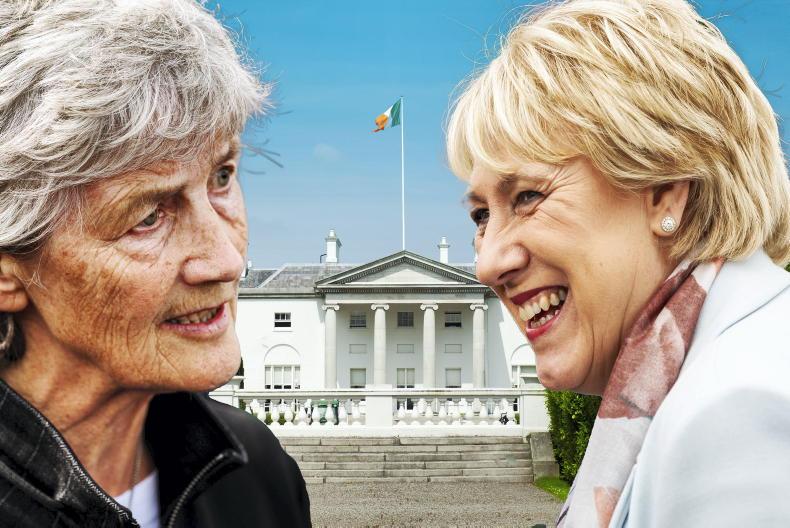
Next week’s presidential election has the least number of candidates since 1973, following the decision by the Fianna Fáil candidate Jim Gavin to exit the race.
Independent TD Catherine Connolly and former Fine Gael deputy leader Heather Humphreys have covered the length and breadth of the nation since they launched their respective campaigns, seeking support to succeed Michael D Higgins, who steps down after 14 years as Head of State next month.
Irish Country Living has spoken to both candidates, in separate interviews, on a range of farming and community issues to see what they will bring to the presidency from a rural perspective.
When asked for their thoughts on succession, Catherine Connolly says she believes the best approach is through partnership models.
“I’d like to see the partnership model developed more but we can’t be ageist in any way towards older people, so succession has to be done with consent,” she says.
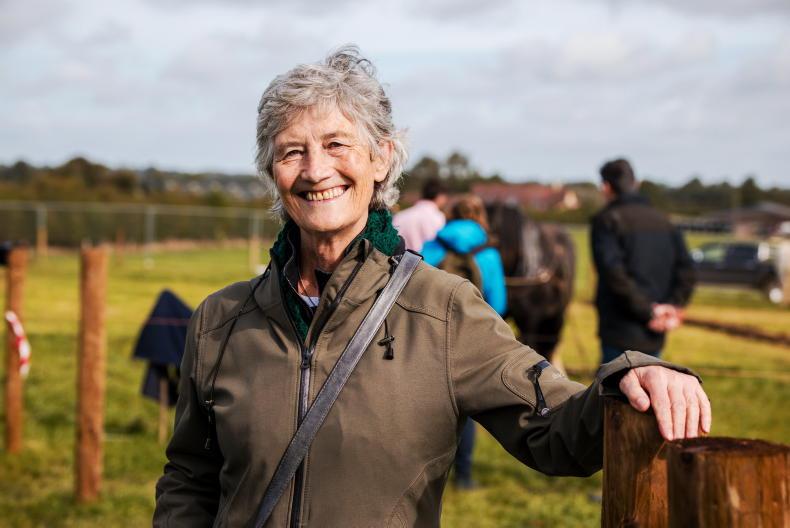
Presidential candidate Catherine Connolly pictured during her visit to the National Ploughing Championships in Screggan, Tullamore 2025. \Claire Nash
“The challenges faced by young people in farming or people coming from outside farming who want to start are enormous. I will absolutely be a voice for farmers of all ages in any way that I can as president.”
Heather Humphreys agrees that succession is a challenge but says she wants to encourage young people.
“Succession is a challenge, but I want to see young people involved in farming and I want to see them encouraged,” she says.
“This affects my family as my husband farms full-time so I’m hoping that my daughter will take over and run it as a viable farm. It’s about how you can have an arrangement that works for everyone.”
Rural depopulation
When it comes to the divide between rural and urban communities, both candidates say they appreciate the differences in services and infrastructure.
“I fully understand the concerns of people in rural Ireland, and I’ve always been unhappy with that rhetoric on the divide between urban and rural,” says Catherine.
“Farmers and farming are essential and we need to reconnect the rural areas with the cities. We need to look at the depopulation in rural areas. Planning permission, housing, lack of infrastructure are all huge problems and I’m an absolutely committed to advocate for an integrated public transport system. We still haven’t achieved it in our towns and cities where it should be easier. It’s much more difficult in rural areas.”
Heather says bringing rural and urban communities closer together has been her mission for many years.
“Rural needs urban and urban needs rural and I worked very hard to bring them together during my time as Minister for Rural and Community Development,” she says.
“We have some of the most magnificent communities right across this country and it’s how I can support them as president. One area I am very proud of from my days as minister is how I championed the remote working connected hubs, which are now all over the country as part of the Our Rural Future policy which the OECD said was an example for the rest of the world.”
Two of the main challenges currently facing the farming community, the nitrates derogation and the Mercosur trade deal are recognised by both candidates as having huge significance for the future of agriculture.
“As president, I will use my voice to say how important it is to reflect farmers concerns on the ground,” says Catherine.
“We need to champion farmers, 35% of whom recently said are looking at changing their ways to be more environmentally friendly. I think we’re heading in the right direction but we need to do it in a more positive way with farmers working with them and recognising their efforts. We need food security for the future, these are themes I will be championing as president.”
Heather says she completely understands farmers’ concerns around both issues.
“We produce food in this country, 90% of which we export, to very, very high standards. If we are competing with other countries, we expect to do so on a level playing field with the same standards. What comes in must meet the same standards that we have to adhere to and that is only fair.
“I know all about the Nitrates Directive and I think that farming by dates is not the way to go. We are doing all we can to keep the derogation and I think it needs a fresh look.”
Rural regeneration
The continued exodus of young people from Ireland is something the candidates view differently.
Catherine believes that if elected president there will be an onus on her to give people who have left Ireland hope for the future.
“There is a sense of despair as I travel the country among young people and I think there is an onus on me, if I’m elected president, to give hope to people and reflect what is happening on the ground,” she says.
“When I think of young people emigrating, I ask where is this sense of despair coming from and I think we need to show leadership in giving hope. Part of that is we need homes for our people and not just in cities but in the rural areas as well.”
Heather believes young people will always want to travel and experience life in other parts of the world.
“The world has become a much smaller place and some young people do emigrate; they go to Australia and New Zealand and Canada for the experience. You find then when they have children, a lot of them might like to come back home and it’s how we facilitate that to make sure the opportunities are there for them when they do come home,” she says.

Fianna Gael presidential candidate Heather Humphreys at the National Ploughing Championships 2025. \ Philip Doyle
“For young people living overseas, their hearts will always be in Ireland. It’s the role of the president to reach out and talk to young people, the diaspora and I will always be promoting Ireland. We are nearly at full employment but it’s how we can create top quality jobs in Ireland that bring the young people home.”
While the president has no role in formulating Government policy, both Catherine and Heather support a farmer’s right to build a home on their own land.
“As a former TD, I have always defended the right of somebody to build a house on their own land so that they can continue farming,” says Heather.
“I was glad that both of my daughters were able to build, one in Leitrim and one in Monaghan. What this does is strengthen the area – it means there’s children for the schools, children for the football clubs. We need that for the regeneration of the youth in rural Ireland. If we don’t have people in rural Ireland, we end up in a very lonely place.”
Catherine believes the difficulties surrounding rural planning will continue until the planning sections in local authorities are adequately staffed.
“We need thriving rural areas, thriving towns and villages to balance cities and we do not need to keep building cities out of all proportion and capacity,” she says.
“I have grave doubts that the new planning act, which still hasn’t been published, will deal with the issues facing rural planning. We have a huge number of vacancies within the planning system around the country and we should have looked at that before we ever went changing legislation.”
Acknowledging the challenges in many rural communities with the arrival of migrants, both candidates say the country needs immigrants to support both the health and agriculture sectors.
“I think there is a small group of people who have been very vocal and I think that group do not reflect the people of Ireland,” says Catherine.
“That doesn’t mean I don’t share some of the concerns in relation to what has happened in rural communities where hotels have been taken over on a long-term basis with obscene profits for the owners. I would like to think I speak for the vast majority of people who share values of solidarity, kindness, standing with someone who is less well off. At the same time, the Government needs to have a more effective system for processing [migrant] applications.”
Heather says the country needs migrant workers and that more needs to be done to integrate communities.
“There are concerns in rural communities, but I think a lot of those concerns, you have to dig a bit deeper to see why they’re concerned,” she says.
“We need people to come to our country, to work in the hospitals, to work in the meat factories. If we didn’t have the immigrants in our meat factories, the animals would not be processed and that is a fact of life so we do need immigrants. It’s about bringing people together and it’s about trying to explain and explode these myths and preconceived notions.”
A potential State visit by American President Donald Trump during the next presidential term is something neither candidate would be fazed by.
President Donald Trump
“I welcomed President Joe Biden to the Dáil in my capacity as Leas Ceann Chomhairle, I shook that president’s hand even though I had and still have serious problems with his policy in relation to Israel and the Middle East,” says Catherine.
“I don’t foresee any problem welcoming President Trump. I don’t have to agree with the person I’m meeting but I certainly have to extend a handshake.”
Heather points out that the role of the president is above politics.
“As president, I will not be in charge of foreign policy – that will be a matter for the Minister for Foreign Affairs – and if there was a state visit organised of course I will receive any elected Head of State that I was asked to do,” she says.
“I would be straight about that because that is the role of the president, who is above politics so I would work within those parameters.”
Others who would be more than welcome in the Áras are the furry friends of both candidates.
Catherine has two cats, while Heather has a Yorkshire Terrier and a rescue cat.
“The cats are seven years old and are brother and sister,” says Catherine.
“I did keep chickens in my garden in the Claddagh and we had fresh eggs all the time, it was lovely.
“My husband is a beekeeper so we’re privileged to have bees, but he tells me it was a very bad year for the honey,” adds Catherine.
Heather says, “Rusty is a little house dog who we’re very fond of but I would say that if you are allowed to bring any pets to the Áras, my husband will want to bring the Hereford cattle that he rears.”
Next week’s presidential election has the least number of candidates since 1973, following the decision by the Fianna Fáil candidate Jim Gavin to exit the race.
Independent TD Catherine Connolly and former Fine Gael deputy leader Heather Humphreys have covered the length and breadth of the nation since they launched their respective campaigns, seeking support to succeed Michael D Higgins, who steps down after 14 years as Head of State next month.
Irish Country Living has spoken to both candidates, in separate interviews, on a range of farming and community issues to see what they will bring to the presidency from a rural perspective.
When asked for their thoughts on succession, Catherine Connolly says she believes the best approach is through partnership models.
“I’d like to see the partnership model developed more but we can’t be ageist in any way towards older people, so succession has to be done with consent,” she says.

Presidential candidate Catherine Connolly pictured during her visit to the National Ploughing Championships in Screggan, Tullamore 2025. \Claire Nash
“The challenges faced by young people in farming or people coming from outside farming who want to start are enormous. I will absolutely be a voice for farmers of all ages in any way that I can as president.”
Heather Humphreys agrees that succession is a challenge but says she wants to encourage young people.
“Succession is a challenge, but I want to see young people involved in farming and I want to see them encouraged,” she says.
“This affects my family as my husband farms full-time so I’m hoping that my daughter will take over and run it as a viable farm. It’s about how you can have an arrangement that works for everyone.”
Rural depopulation
When it comes to the divide between rural and urban communities, both candidates say they appreciate the differences in services and infrastructure.
“I fully understand the concerns of people in rural Ireland, and I’ve always been unhappy with that rhetoric on the divide between urban and rural,” says Catherine.
“Farmers and farming are essential and we need to reconnect the rural areas with the cities. We need to look at the depopulation in rural areas. Planning permission, housing, lack of infrastructure are all huge problems and I’m an absolutely committed to advocate for an integrated public transport system. We still haven’t achieved it in our towns and cities where it should be easier. It’s much more difficult in rural areas.”
Heather says bringing rural and urban communities closer together has been her mission for many years.
“Rural needs urban and urban needs rural and I worked very hard to bring them together during my time as Minister for Rural and Community Development,” she says.
“We have some of the most magnificent communities right across this country and it’s how I can support them as president. One area I am very proud of from my days as minister is how I championed the remote working connected hubs, which are now all over the country as part of the Our Rural Future policy which the OECD said was an example for the rest of the world.”
Two of the main challenges currently facing the farming community, the nitrates derogation and the Mercosur trade deal are recognised by both candidates as having huge significance for the future of agriculture.
“As president, I will use my voice to say how important it is to reflect farmers concerns on the ground,” says Catherine.
“We need to champion farmers, 35% of whom recently said are looking at changing their ways to be more environmentally friendly. I think we’re heading in the right direction but we need to do it in a more positive way with farmers working with them and recognising their efforts. We need food security for the future, these are themes I will be championing as president.”
Heather says she completely understands farmers’ concerns around both issues.
“We produce food in this country, 90% of which we export, to very, very high standards. If we are competing with other countries, we expect to do so on a level playing field with the same standards. What comes in must meet the same standards that we have to adhere to and that is only fair.
“I know all about the Nitrates Directive and I think that farming by dates is not the way to go. We are doing all we can to keep the derogation and I think it needs a fresh look.”
Rural regeneration
The continued exodus of young people from Ireland is something the candidates view differently.
Catherine believes that if elected president there will be an onus on her to give people who have left Ireland hope for the future.
“There is a sense of despair as I travel the country among young people and I think there is an onus on me, if I’m elected president, to give hope to people and reflect what is happening on the ground,” she says.
“When I think of young people emigrating, I ask where is this sense of despair coming from and I think we need to show leadership in giving hope. Part of that is we need homes for our people and not just in cities but in the rural areas as well.”
Heather believes young people will always want to travel and experience life in other parts of the world.
“The world has become a much smaller place and some young people do emigrate; they go to Australia and New Zealand and Canada for the experience. You find then when they have children, a lot of them might like to come back home and it’s how we facilitate that to make sure the opportunities are there for them when they do come home,” she says.

Fianna Gael presidential candidate Heather Humphreys at the National Ploughing Championships 2025. \ Philip Doyle
“For young people living overseas, their hearts will always be in Ireland. It’s the role of the president to reach out and talk to young people, the diaspora and I will always be promoting Ireland. We are nearly at full employment but it’s how we can create top quality jobs in Ireland that bring the young people home.”
While the president has no role in formulating Government policy, both Catherine and Heather support a farmer’s right to build a home on their own land.
“As a former TD, I have always defended the right of somebody to build a house on their own land so that they can continue farming,” says Heather.
“I was glad that both of my daughters were able to build, one in Leitrim and one in Monaghan. What this does is strengthen the area – it means there’s children for the schools, children for the football clubs. We need that for the regeneration of the youth in rural Ireland. If we don’t have people in rural Ireland, we end up in a very lonely place.”
Catherine believes the difficulties surrounding rural planning will continue until the planning sections in local authorities are adequately staffed.
“We need thriving rural areas, thriving towns and villages to balance cities and we do not need to keep building cities out of all proportion and capacity,” she says.
“I have grave doubts that the new planning act, which still hasn’t been published, will deal with the issues facing rural planning. We have a huge number of vacancies within the planning system around the country and we should have looked at that before we ever went changing legislation.”
Acknowledging the challenges in many rural communities with the arrival of migrants, both candidates say the country needs immigrants to support both the health and agriculture sectors.
“I think there is a small group of people who have been very vocal and I think that group do not reflect the people of Ireland,” says Catherine.
“That doesn’t mean I don’t share some of the concerns in relation to what has happened in rural communities where hotels have been taken over on a long-term basis with obscene profits for the owners. I would like to think I speak for the vast majority of people who share values of solidarity, kindness, standing with someone who is less well off. At the same time, the Government needs to have a more effective system for processing [migrant] applications.”
Heather says the country needs migrant workers and that more needs to be done to integrate communities.
“There are concerns in rural communities, but I think a lot of those concerns, you have to dig a bit deeper to see why they’re concerned,” she says.
“We need people to come to our country, to work in the hospitals, to work in the meat factories. If we didn’t have the immigrants in our meat factories, the animals would not be processed and that is a fact of life so we do need immigrants. It’s about bringing people together and it’s about trying to explain and explode these myths and preconceived notions.”
A potential State visit by American President Donald Trump during the next presidential term is something neither candidate would be fazed by.
President Donald Trump
“I welcomed President Joe Biden to the Dáil in my capacity as Leas Ceann Chomhairle, I shook that president’s hand even though I had and still have serious problems with his policy in relation to Israel and the Middle East,” says Catherine.
“I don’t foresee any problem welcoming President Trump. I don’t have to agree with the person I’m meeting but I certainly have to extend a handshake.”
Heather points out that the role of the president is above politics.
“As president, I will not be in charge of foreign policy – that will be a matter for the Minister for Foreign Affairs – and if there was a state visit organised of course I will receive any elected Head of State that I was asked to do,” she says.
“I would be straight about that because that is the role of the president, who is above politics so I would work within those parameters.”
Others who would be more than welcome in the Áras are the furry friends of both candidates.
Catherine has two cats, while Heather has a Yorkshire Terrier and a rescue cat.
“The cats are seven years old and are brother and sister,” says Catherine.
“I did keep chickens in my garden in the Claddagh and we had fresh eggs all the time, it was lovely.
“My husband is a beekeeper so we’re privileged to have bees, but he tells me it was a very bad year for the honey,” adds Catherine.
Heather says, “Rusty is a little house dog who we’re very fond of but I would say that if you are allowed to bring any pets to the Áras, my husband will want to bring the Hereford cattle that he rears.”
SHARING OPTIONS