Much like life, farming and growing is a balancing act and is about keeping up the momentum. No one knows this more than Shannon Copland, who, at eight and a half feet tall, is towering above me today – on stilts.
“This is surely the first stilt walker you’ve taken a photo of holding a pitchfork,” she jokes, posing close to her gaggle of honking Hungarian Sebastopol geese, which are her “pride and joy”, as Baloo, her Bernese Mountain dog watches on curiously.
Many growers and farmers have part-time jobs these days, but Shannon has a particularly unique combination – performing at all kinds of festivals and events (she was a scarecrow on stilts at Clonfert Farm over Halloween) – and then supplying some of Ireland’s top restaurants with rare and unusual vegetables and edible flowers. Everything is grown on Shannon’s Eco Farm which is 1.5ac, close to Rathconrath in Co Westmeath.
“Summer is peak farm and performing time, so now this is burnout time,” she says, adding that she could be on the farm until midnight in the height of the season. “I’m more focused on tunnel crops in winter and then production slows down because you just don’t have the light levels.
“Everything is hand-sown, hand-transplanted and hand-harvested, so all by hand. It’s very physical, and my body is giving out about that,” she says, laughing. “But I do love it, whereas the circus [work] is a good income, but I don’t have the same grá for it as I do for this.”
At the same time, she acknowledges the stilt walking work gets her off the farm and meeting people and seeing other performers.
“I would be a hermit otherwise. I’m quite content with my own company and the animals,” explains Shannon, before letting out her Welsh Harlequin ducks, geese and hens from the coop. There are also rabbits and native black bees nearby, and Kunekune pigs in the next field.
“I call it my balancing act,” Shannon quips of her unusual work combination as she totters over to the coop. Walking on non-solid ground like this, is a challenge on stilts, she admits – but it’s clear she is not one to shy away from a test in work or in life.
“Momentum is what keeps me upright,” she explains, asking me to try and walk on my heels to get the idea of balance and the need to stay moving.
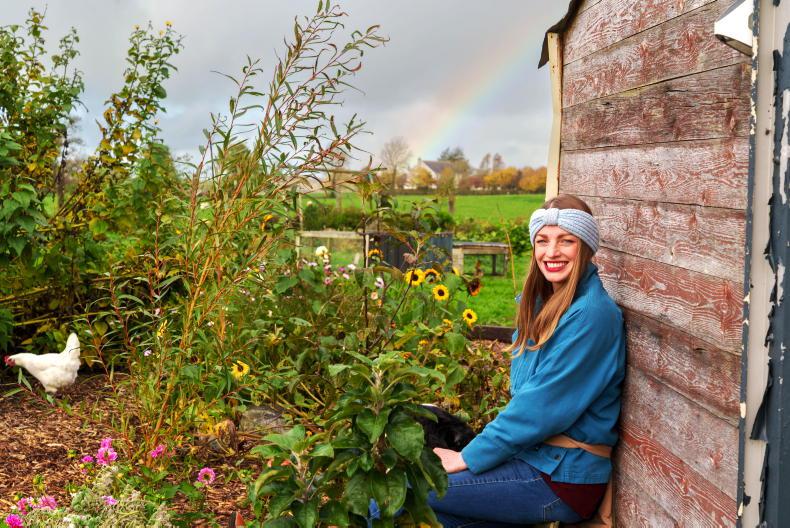
Shannon Copland on her eco farm at Crosses, close to Rathconrath in Co Westmeath. \ Barry Cronin
Amazingly, she learned stilt walking after just one lesson and practised on the lanes nearby, just a stone’s throw from where she grew up on a beef and sheep farm. She had a good foundation, though, having been selected with other members of the public to intensively learn wire walking back in 2020. It culminated in a performance on the Corrib with BassAlto, an all-female wire-walking troupe, which Shannon describes as an “opportunity of a lifetime”.
“It was great and such a challenge,” she says of learning the daredevil skill. “It’s so good for the head because you have to focus [just on the wire] and forget all the other stuff that’s going on in your brain, and it helps you wind down,” adds Shannon.
Walking tall
When she admits she could do a shoulder stand on the wire and trained on another occasion at 6m high (with a harness), one wonders has she no fear? However, she shakes her head, saying, “It scares me.”
“You have to scare yourself, though; otherwise, you won’t grow. I try and scare myself regularly,” the grower says, with a smile. Asked if she considers herself adventurous, Shannon shrugs her shoulders and laughs before admitting that she is qualified in scuba diving as well and free dives.
A marine scientist by trade, her plans to study the reefs in Australia changed slightly when she had her son Harvey (8) in her final year of college. A vegetarian all her life, she started growing some vegetables herself while living in Galway and then neighbours started asking to buy some from her because they wanted local organic veg.
During the COVID-19 pandemic, she worked as a data analyst in a geochemistry lab but decided it wasn’t for her and realised she needed to be working outside. “I took the leap and started selling to fine dining restaurants,” she recalls, before moving home three years ago.
“It’s still a work in progress – I have lots more plans,” says Shannon, taking us on a tour of the well-laid-out growing beds focused on perennial and ancient heirloom crops on the scenic hill site, close to where she grew up.
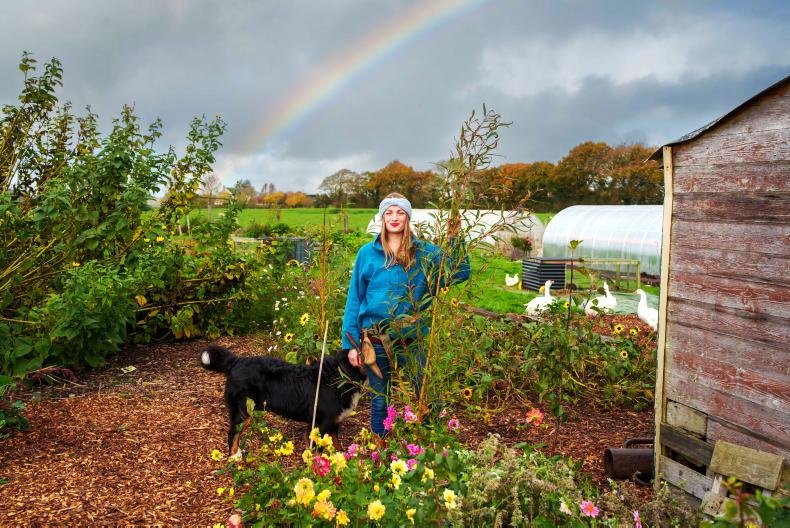
Shannon Copland checks the flowers and vegetables with Baloo. \ Barry Cronin
Shannon, who is entirely self-taught in terms of growing via “YouTube and lots of books”, operates a no-dig policy and uses regenerative methods with no chemicals or pesticides in her market garden.
The garden is fully off-grid, relying on rainwater harvesting and solar power to pump water from the nearby spring. She even generates heat to germinate her seedlings by using “hot beds” of wool and manure in her polytunnels.
Shannon points with obvious pride to the myriad of different plants and edible flowers she is growing in a small area. There are names we know, like horseradish, sunflowers, fennel, runner beans, cornflowers, Jerusalem artichokes and even sugar beet. But then there are the much less known vegetables like mallow, kalettes, a hybrid between Brussels sprouts and kale, rainbow chard, and rainbow and purple carrots (which are purple on the outside and orange inside), asparagus kale, and lemon sorrel, which chefs make oils from.
“I didn’t know anything about growing, so I said I’ll try [growing] all the things and see what works, and it turns out you can grow quite a lot in Ireland,” she says. When pressed for how many plant varieties she has, “a few hundred easily” is what she comes up with.
“Because I’m working with fine dining restaurants, they are looking for something a bit different and a bit more special, and they are willing to pay a fairer price.”
Friday is delivery day for her produce, which then makes its way onto menus in some of the best restaurants in the country. These include Thyme in Athlone; and Kai, Aniar, Ardbhia, The Universal Bar and Blackrock Cottage, all in Galway.
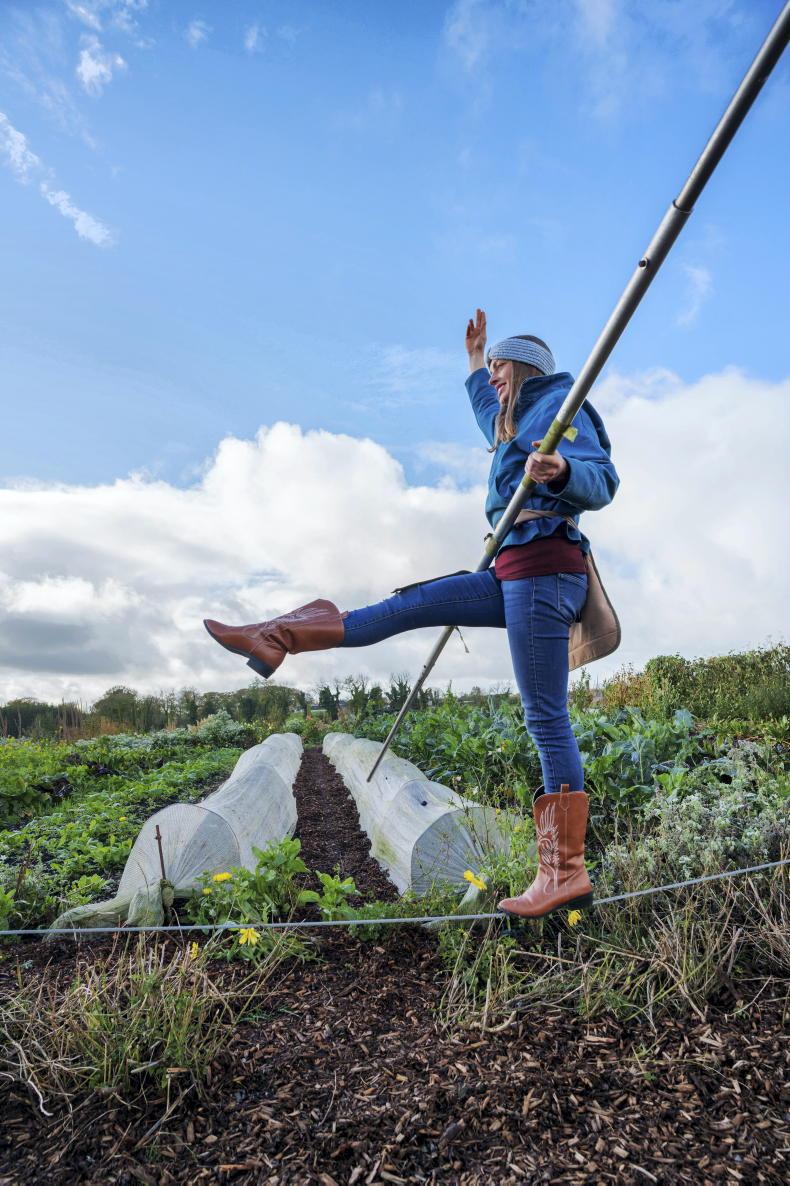
Shannon Copland gives a demo of her wire walking skills. \ Barry Cronin
“I love what I do, and I think that love comes out in the produce. The quality is higher as is the nutritional value. I’m able to feed my son and myself high-quality food from the ground, and I like sharing that with chefs that have a passion for it.
“They will take a simple vegetable and turn it into an artwork of flavours to look at, taste and smell. I love that. And sometimes they feed me, which is great.”
While the hours are long, it’s a rewarding life for Shannon, and she’d love to see others trying to grow their own vegetables, particularly children, before society gets too detached from the land and where food comes from.
“If you look at my 15m x 75cm beds, if you have six of those, you can feed your family year-round pretty much,” she comments, saying learning on the job has served her well.
She’s managed everything from maintenance to plumbing to building her polytunnels and her compost toilet.
As things slow down for the winter, Shannon diverts into making soaps and salves from her own beeswax and honey mixed with some floristry. She is also planning for spring and the harvest ahead.
Ultimately though, her big dream is “to build a house from scratch” and live on-site in the future.
In the meantime, she’s walking tall.
See shannons_eco_farm on Instagram
Much like life, farming and growing is a balancing act and is about keeping up the momentum. No one knows this more than Shannon Copland, who, at eight and a half feet tall, is towering above me today – on stilts.
“This is surely the first stilt walker you’ve taken a photo of holding a pitchfork,” she jokes, posing close to her gaggle of honking Hungarian Sebastopol geese, which are her “pride and joy”, as Baloo, her Bernese Mountain dog watches on curiously.
Many growers and farmers have part-time jobs these days, but Shannon has a particularly unique combination – performing at all kinds of festivals and events (she was a scarecrow on stilts at Clonfert Farm over Halloween) – and then supplying some of Ireland’s top restaurants with rare and unusual vegetables and edible flowers. Everything is grown on Shannon’s Eco Farm which is 1.5ac, close to Rathconrath in Co Westmeath.
“Summer is peak farm and performing time, so now this is burnout time,” she says, adding that she could be on the farm until midnight in the height of the season. “I’m more focused on tunnel crops in winter and then production slows down because you just don’t have the light levels.
“Everything is hand-sown, hand-transplanted and hand-harvested, so all by hand. It’s very physical, and my body is giving out about that,” she says, laughing. “But I do love it, whereas the circus [work] is a good income, but I don’t have the same grá for it as I do for this.”
At the same time, she acknowledges the stilt walking work gets her off the farm and meeting people and seeing other performers.
“I would be a hermit otherwise. I’m quite content with my own company and the animals,” explains Shannon, before letting out her Welsh Harlequin ducks, geese and hens from the coop. There are also rabbits and native black bees nearby, and Kunekune pigs in the next field.
“I call it my balancing act,” Shannon quips of her unusual work combination as she totters over to the coop. Walking on non-solid ground like this, is a challenge on stilts, she admits – but it’s clear she is not one to shy away from a test in work or in life.
“Momentum is what keeps me upright,” she explains, asking me to try and walk on my heels to get the idea of balance and the need to stay moving.
Shannon Copland on her eco farm at Crosses, close to Rathconrath in Co Westmeath. \ Barry Cronin
Amazingly, she learned stilt walking after just one lesson and practised on the lanes nearby, just a stone’s throw from where she grew up on a beef and sheep farm. She had a good foundation, though, having been selected with other members of the public to intensively learn wire walking back in 2020. It culminated in a performance on the Corrib with BassAlto, an all-female wire-walking troupe, which Shannon describes as an “opportunity of a lifetime”.
“It was great and such a challenge,” she says of learning the daredevil skill. “It’s so good for the head because you have to focus [just on the wire] and forget all the other stuff that’s going on in your brain, and it helps you wind down,” adds Shannon.
Walking tall
When she admits she could do a shoulder stand on the wire and trained on another occasion at 6m high (with a harness), one wonders has she no fear? However, she shakes her head, saying, “It scares me.”
“You have to scare yourself, though; otherwise, you won’t grow. I try and scare myself regularly,” the grower says, with a smile. Asked if she considers herself adventurous, Shannon shrugs her shoulders and laughs before admitting that she is qualified in scuba diving as well and free dives.
A marine scientist by trade, her plans to study the reefs in Australia changed slightly when she had her son Harvey (8) in her final year of college. A vegetarian all her life, she started growing some vegetables herself while living in Galway and then neighbours started asking to buy some from her because they wanted local organic veg.
During the COVID-19 pandemic, she worked as a data analyst in a geochemistry lab but decided it wasn’t for her and realised she needed to be working outside. “I took the leap and started selling to fine dining restaurants,” she recalls, before moving home three years ago.
“It’s still a work in progress – I have lots more plans,” says Shannon, taking us on a tour of the well-laid-out growing beds focused on perennial and ancient heirloom crops on the scenic hill site, close to where she grew up.
Shannon Copland checks the flowers and vegetables with Baloo. \ Barry Cronin
Shannon, who is entirely self-taught in terms of growing via “YouTube and lots of books”, operates a no-dig policy and uses regenerative methods with no chemicals or pesticides in her market garden.
The garden is fully off-grid, relying on rainwater harvesting and solar power to pump water from the nearby spring. She even generates heat to germinate her seedlings by using “hot beds” of wool and manure in her polytunnels.
Shannon points with obvious pride to the myriad of different plants and edible flowers she is growing in a small area. There are names we know, like horseradish, sunflowers, fennel, runner beans, cornflowers, Jerusalem artichokes and even sugar beet. But then there are the much less known vegetables like mallow, kalettes, a hybrid between Brussels sprouts and kale, rainbow chard, and rainbow and purple carrots (which are purple on the outside and orange inside), asparagus kale, and lemon sorrel, which chefs make oils from.
“I didn’t know anything about growing, so I said I’ll try [growing] all the things and see what works, and it turns out you can grow quite a lot in Ireland,” she says. When pressed for how many plant varieties she has, “a few hundred easily” is what she comes up with.
“Because I’m working with fine dining restaurants, they are looking for something a bit different and a bit more special, and they are willing to pay a fairer price.”
Friday is delivery day for her produce, which then makes its way onto menus in some of the best restaurants in the country. These include Thyme in Athlone; and Kai, Aniar, Ardbhia, The Universal Bar and Blackrock Cottage, all in Galway.
Shannon Copland gives a demo of her wire walking skills. \ Barry Cronin
“I love what I do, and I think that love comes out in the produce. The quality is higher as is the nutritional value. I’m able to feed my son and myself high-quality food from the ground, and I like sharing that with chefs that have a passion for it.
“They will take a simple vegetable and turn it into an artwork of flavours to look at, taste and smell. I love that. And sometimes they feed me, which is great.”
While the hours are long, it’s a rewarding life for Shannon, and she’d love to see others trying to grow their own vegetables, particularly children, before society gets too detached from the land and where food comes from.
“If you look at my 15m x 75cm beds, if you have six of those, you can feed your family year-round pretty much,” she comments, saying learning on the job has served her well.
She’s managed everything from maintenance to plumbing to building her polytunnels and her compost toilet.
As things slow down for the winter, Shannon diverts into making soaps and salves from her own beeswax and honey mixed with some floristry. She is also planning for spring and the harvest ahead.
Ultimately though, her big dream is “to build a house from scratch” and live on-site in the future.
In the meantime, she’s walking tall.
See shannons_eco_farm on Instagram



SHARING OPTIONS