



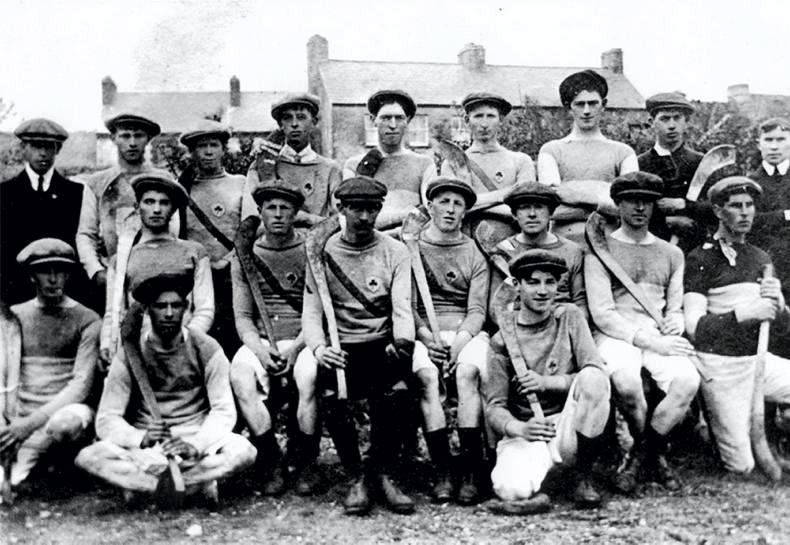
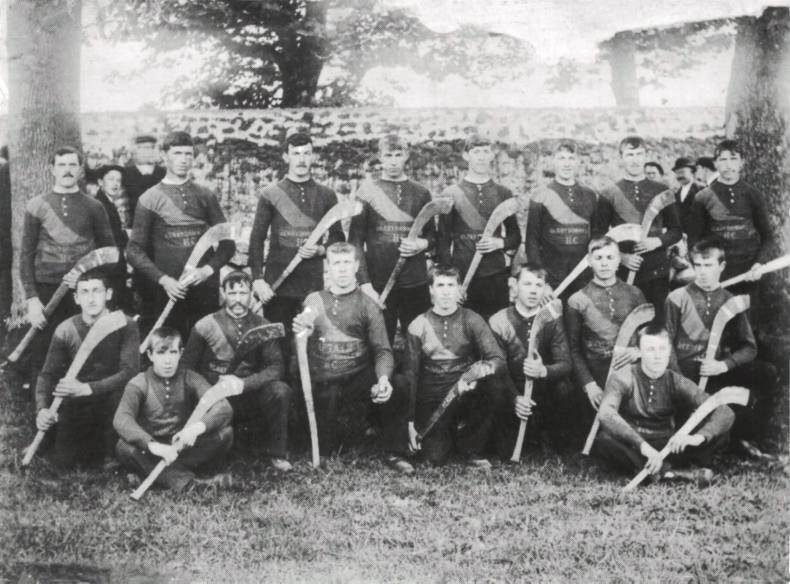
Sport, as it still does today, played an important part in Irish society around 1916. Most prominently the Gaelic Athletic Association (GAA) provided a link between Irish sporting organisations and the quest for independence.
From its earliest days, the GAA (as detailed in its museum and website) was linked with the Irish Republican Brotherhood (IRB). Of the seven men who attended the initial meeting in Hayes Hotel, Thurles, on 1 November 1884, three were known members of the IRB.
The founding fathers realised the importance of establishing a national organisation to make athletics more accessible to the masses and to revive and nurture traditional, indigenous sports and pastimes.
At that time, it was largely only the gentry and aristocracy who were allowed to participate in athletics. All that was Irish was being steadily eroded by emigration, intense poverty and outside influences.
Sport and politics
Within six months of that famous first meeting, GAA clubs began to spring up all over Ireland and people began to play the games of hurling and Gaelic football and take part in athletic events with pride.
Throughout its formative years Michael Cusack often had to deny the GAA was established as a political body. Cusack was insistent that the GAA was founded solely for the purposes of opening up athletics to the ordinary citizen and reversing the decline of native pastimes.
However, as legislative independence was the burning issue of the time, keeping politics out of a parish-based but nationwide organisation such as the GAA was near impossible.
For most of the 19th century, nationalist Ireland was split between two clear factions: those in favour of peaceful political agitation (home rule) and those who favoured physical force (IRB).
Both factions took an early interest in the GAA, and this came to a head at the 1887 annual congress, when IRB candidate Edward Bennett defeated Maurice Davin for the presidency of the GAA.
Fr John Scanlon, who favoured the home rule side, left the annual congress and announced his intention to form a rival athletic association. Archbishop Croke brought both sides together and, at a special congress in January 1888, Maurice Davin was re-elected as president of the GAA.
The Rising
Although not officially involved, many members of the GAA took part in the 1916 Rising. GAA activities throughout the country came to a halt, as many members were imprisoned.
In 1916 the GAA entered the political arena when it agreed to send a delegation to a Dublin Corporation conference for the purpose of forming a political prisoners amnesty association.
After the 1916 Rising, the British authorities severely curtailed the movement of traffic throughout Ireland, and this included trains taking people to Croke Park.
In 1918 the British authorities informed Luke O’Toole (then secretary of the GAA) that no hurling or football games would be allowed unless a permit was obtained from Dublin Castle.
Defiance
The GAA, at their meeting of 20 July 1918, unanimously agreed that no such permit be applied for under any conditions and that any person applying for a permit – or any player playing in a match in which a permit had been obtained – would be automatically suspended from the GAA.
In a further act of defiance the Council organised a series of matches throughout the country for Sunday 4 August 1918. Matches were openly played throughout the country, with an estimated 54,000 members taking part. This became known as Gaelic Sunday.
Infamous act of vengeance
The GAA is associated with one of the most infamous incidents in the fight for independence, which took place on Sunday 21 November 1920.
The Dublin football team was scheduled to play Tipperary in Croke Park and the proceeds of this great challenge match were to be donated to the Irish Republican Prisoners’ Fund. The night before the match, Michael Collins sent his “squad” out to assassinate the Cairo gang, a team of undercover British agents working and living in Dublin.
A series of shootings took place throughout the night, which left 14 members of the British Forces dead.
In reprisal, the British military entered Croke Park and opened fire, killing 14 people. The fatalities included Tipperary player Micheal Hogan. This became known as Bloody Sunday.
Plenty to see
Gaelic games hence play a prominent role in the Farming and Country Life 1916 event. The event will stage live hurling, football and camogie matches in the attire of the day.
Local teams with links to the time with take part in exhibition matches. These include Athenry, Liam Mellows, Pádraig Pearses, Na Piarsaigh, Craughwell, Sean MacDiarmada and Killimor, among others. Matches will be staged using traditional rules and equipment of the day.
In additional to Gaelic football, hurling and camogie, other GAA-related games of the era including rounders and handball, will be staged at the event. A rounders exhibition match will be staged on the main pitch area on Saturday and a handball exhibition will be staged throughout the event.
A series of street games of the time will be organised and children coming to the event will be actively encouraged to participate. These games include an egg and spoon race, sack race, three-legged races, obstacle course race and hopscotch.
An exhibition area around sporting life will also feature. National and local cups will be on display, along with local memorabilia.
The exhibition area will include a series of local and national stories and pictures reflective of sporting life of the time.
Titanic connection
One such story relates to Andy Keane of Derrydonnell, Athenry, who died on the Titanic on 14 April 1912. He had won a county senior championship medal in 1911 with Derrydonnell.
Andy was one of three brothers on the 1911 Derrydonnell team and was aged 25 years when he set sail on the ill-fated Titanic to go to the USA in 1912.
Having decided to emigrate, his sister who was already in America sent him the fare of £8 and he booked through Mahon Travel Agents, Athenry.
Mahon advised him to go on a different ship, when conditions would be much better, but he decided to take the Titanic. He had with him a dozen hurleys, a melodeon and his county medal when the Titanic went down.


SHARING OPTIONS