


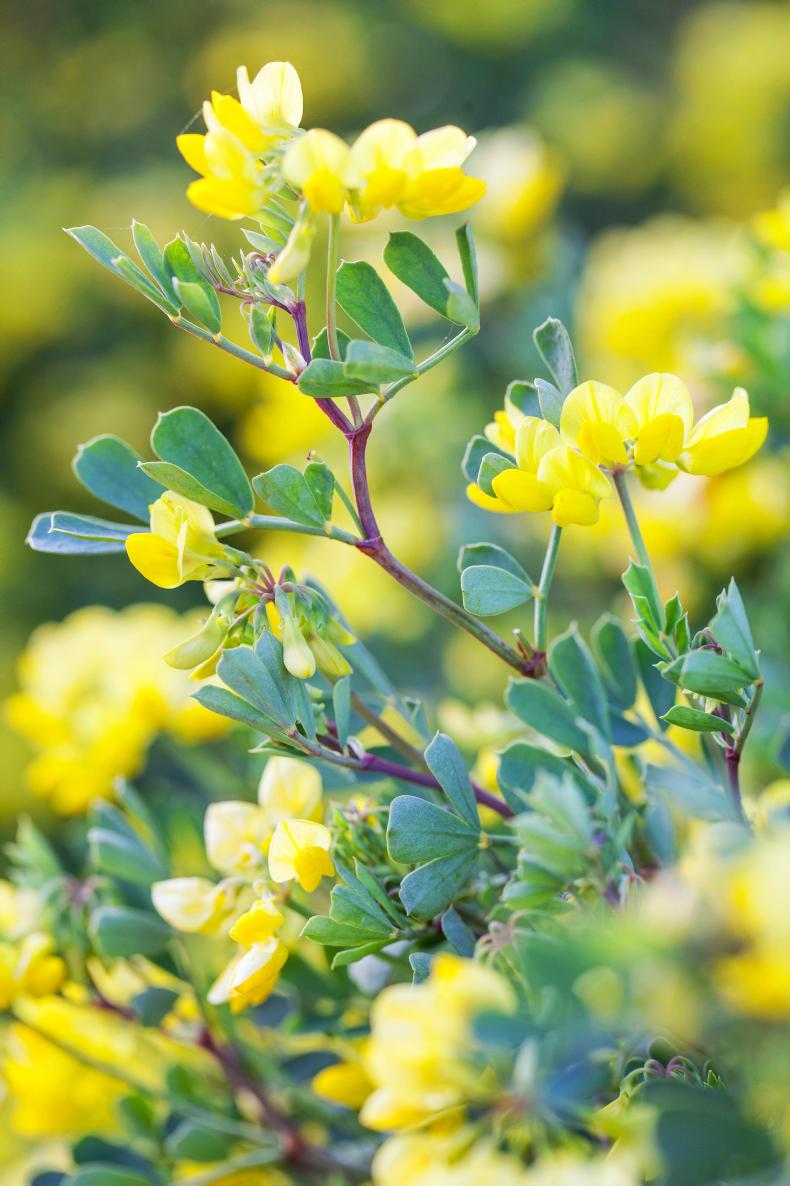
Coronilla is the botanical name for this plant and is derived from Spanish, meaning ‘‘little crown’’. And it does make a rounded cluster of flowers, a little crown with a bit of imagination. The plant probably has no business growing in Irish gardens because it is native to Spain and most parts of the Mediterranean rim, including parts of the North African coast. But some Mediterranean plants can hold their own reasonably well further north because they have adapted to the mild winters and hot, dry summers of their native range by growing when it is cooler and damper and just marking time in summer, waiting out the drought. So this shrub starts into growth in the damper part of the year and that corresponds to an Irish winter and spring.
An evergreen plant can grow a little in winter, and coronilla takes its chances. Last year, it was in flower, to some degree, almost all year. Normally, there are early flowers in autumn and late winter, full flowering in spring with a scattering in summer. But, last year, with a summer of sunshine and showers, it seemed to be in flower constantly, producing new shoots. Coronilla is a small shrub but not notably woody. The stems are slender and, though flexible, can be brittle but it is bushy and withstands wind exposure remarkably well, which is a feature of plants from the windy Mediterranean hills. It reaches to about one metre or so, and a bit wider, forming a relatively low bush.
The flowers are like those of peas, and many other members of the pea family, winged to the side and with a landing pad for pollinating insects. And they are sweetly scented. Being part of the pea family is generally a good indicator of the soil and conditions that need to be provided. The pea family likes well-drained, light, open soil, sandy if possible, and coronilla is no different. It reacts poorly and dies off readily if the ground is too heavy and wet, especially if water lies in winter. It thrives if planted in a raised bed or by a retaining wall where drainage is good. Although it must have good drainage, the ground should not be baked dry. And if the soil is too rich, it can make a lot of foliage with small divided leaves, each leaflet rounded and less flowering.
The foliage of the main species is bright green, a good winter colour, but there is a form with blue-green, or glaucous, leaves. This kind has a waxy bloom that protects the leaves from drying winds, and this is the usual kind seen for sale. The flowers are bright yellow, very like broom to which it is related. It is a cheery colour but some people find it a bit brash and the pale lemon-yellow variety ‘‘Citrina’’ is very popular. There is a variegated form that appeals to some but has a tendency to look sickly and not thriving.
While coronilla is usually grown as a broad, somewhat sprawling bush, its sprawling habit and light stems can be trained to tumble down from a bed or bank, or to the base of a wall or trellis. It is occasionally seen trained as a small lollipop on a stem.
The main stem is always weak and needs a good cane or light stake. The top can get too heavy and snap off, so be careful to prune lightly at the end of spring flowering and to tie the top to the cane at some point, or points, above the level of the top of the clear stem. These little lollipops often produce shoots low on the stem that should be removed as soon as seen. Sometimes grown in pots, the plants do nicely for a couple of years until they are too restricted by the pot and go into decline, not having a good root-run.
Ivy-hunting
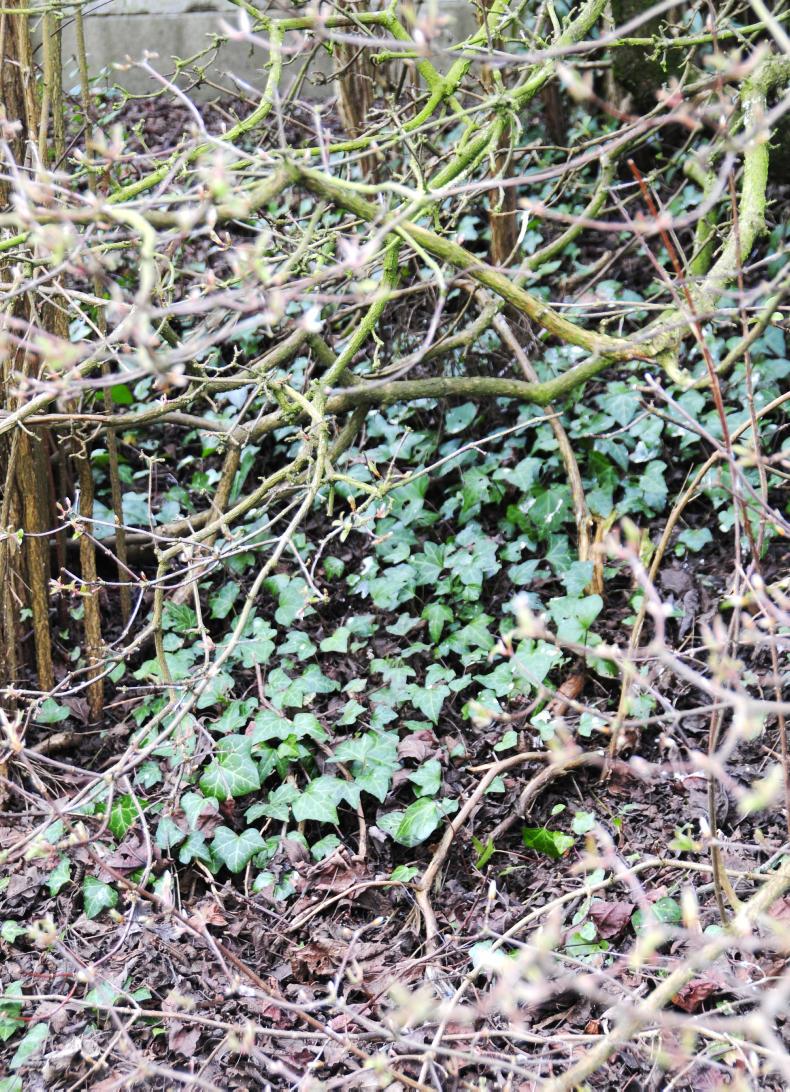
Some people hate ivy, others love it and a debate always starts. Its value as a garden plant is much appreciated and its value for wildlife is well documented, but it can be a nasty weed too. It grows on walls, tree trunks and on the ground. On walls it can look very ornamental, but it can compromise the structure of old stone walls by growing into the wall.
Ivy does not kill trees but it exploits ailing trees and some people just do not like the look of it. It can be cut at the base of walls and trees, and if it re-sprouts can be treated with glyphosate product. Ivy growing on the ground can be a useful ground-cover but it can climb from there into shrubs, perennial flowers and hedges. Growing on the ground, it can be chopped out with a spade and even cut with a brush-cutter to keep it low. Ivy can be seen easily now — a good time to tackle it.
>> This week
Trees, shrubs and roses
Continue planting in good weather. Check all trees and shrubs planted last autumn for signs of wind-rocking where the stem meets the ground, such as rubbing and smoothing of the soil, and water gathering. Use a cane to steady it for a year or two. Roses can be pruned at any time.
Fruit, vegetables and herbs
The seed potatoes of early varieties can be put in a bright place to sprout for four to five weeks. Fruit trees and bushes can still be planted during suitable weather. Check for damage to the fruit buds of apple trees, pears, blackcurrants and plums by bullfinches and apply netting if it is severe.
Flowers
Watch for bulbs because their tops are now pushing through the soil and it is surprising how easy it is to walk on them. Border flowers can be lifted and divided, if necessary, and new kinds planted. If some types have not done well, try them in different conditions, such as better space and light.
Lawn
Mow the grass if there is a suitable dry period when the ground is firm. Lawn moss is best controlled by autumn application of sulphate of iron, but if the moss is now taking over the grass, the mosskiller will help. Trim the edges if the grass has grown out on to borders and pathways.
Greenhouse and house plants
Bedding flowers, such as begonias and geranium, can be started off from seeds in a heated propagator now, but it is still too early for most of the easy kinds. If a frost protection heater is used, check that the thermostat is working. Watch for greenflies on the buds and shoots of greenhouse plants.


SHARING OPTIONS