


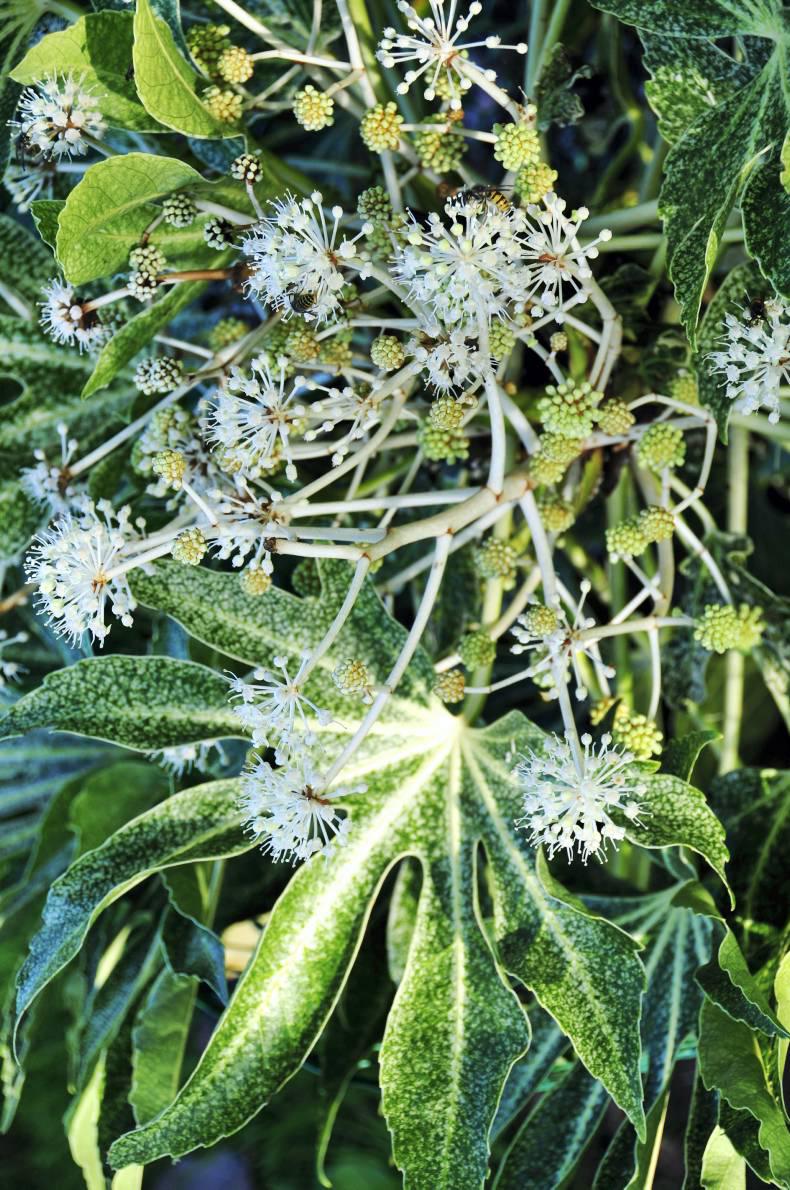
Bucking the trend of general decline at this time of year, fatsia flowers in autumn and into winter, just when many other plants are slowing down. Fatsia seems to turn the seasons in reverse. It flowers in autumn and winter and forms its berry-like fruits in late winter and spring. The other plant that does the same is ivy, and a glance at the flowers will reveal the family likeness, Fatsia japonica being part of the ivy or aralia family.
The flower heads are composed of a branched head of rounded clusters of individual flowers, each of these single flowers open to reveal pollen-carrying stamens and female parts. Later, when pollinated, the flowers become a cluster of black berries, just as ivy does. These seeds are usually viable, and new plants can be raised.
Like ivy, fatsia provides late nectar for bees and other flying insects but only on a sunny day when the insects can venture forth.
Flowering at the “wrong” time of year confers a certain benefit on the ivy and fatsia, as pollinators such as bees are enthusiastic visitors in the absence of many other flowers. And beekeepers depend on a good flow of ivy nectar to boost the sugar stores of bee colonies for winter.
There is no difficulty in allowing the bees to have ivy, and fatsia, honey because it is a thin, tasteless form of honey, not attractive to human taste. The ivy berries are avidly taken by birds in spring, especially pigeons, performing a role as seed distributors, which explains how ivy turns up under bushes and trees. Fatsia berries are not as attractive to birds, which is just as well, as they can continue in their decorative role.
The plant is so easy to grow from seeds that many of the plants sold in garden centres are really composed of about 10 to 20 seedlings, forming a densely bushy plant for sale.
Fatsia is a shrub with woody stems and can reach to well over two metres. The stems are not very hard and, as the stems get longer, they tend to flop outwards a little, making a broad bush. Native to Japan and Korea, it is evergreen with large leaves, often more than 30cm long and almost as wide, divided into seven to 11 long finger-like segments. The name fatsia is derived from a Japanese word for “eight”.
Although it is not completely hardy, it is hardier than given credit for and survives well in gardens, except perhaps in the coldest parts of the country. Even when damaged by frost, usually as a young plant, it sprouts back from buds lower down on the damaged stems.
Apart from late-autumn flowering and good glossy evergreen foliage, fatsia has other useful qualities. Very unusually for a large-leaved plant, it tolerates coastal exposure very well, being a coastal woodland plant in its home territory. It can tolerate a significant degree of shade, its dark-green leaves coping well. So it is an excellent plant for bringing a touch of year-round greenery.
Fatsia is also good in a pot for areas with no access to soil such as a yard or paved area, and it is a fine conservatory plant for greenery in winter, revelling in the warmth of a conservatory. Grown in a pot, it needs to be watered and fed through the growing season. If it gets too big, it can be pruned as hard as wanted in early April and it will sprout new shoots and foliage. There are variegated forms, ‘Variegata’ with cream edges and white ‘Marginata’. ‘Spider’s Web’, which is shown in the photograph, has white speckled leaves, a lovely recent release, not as tough as the plain green.
Remarkable raspberries
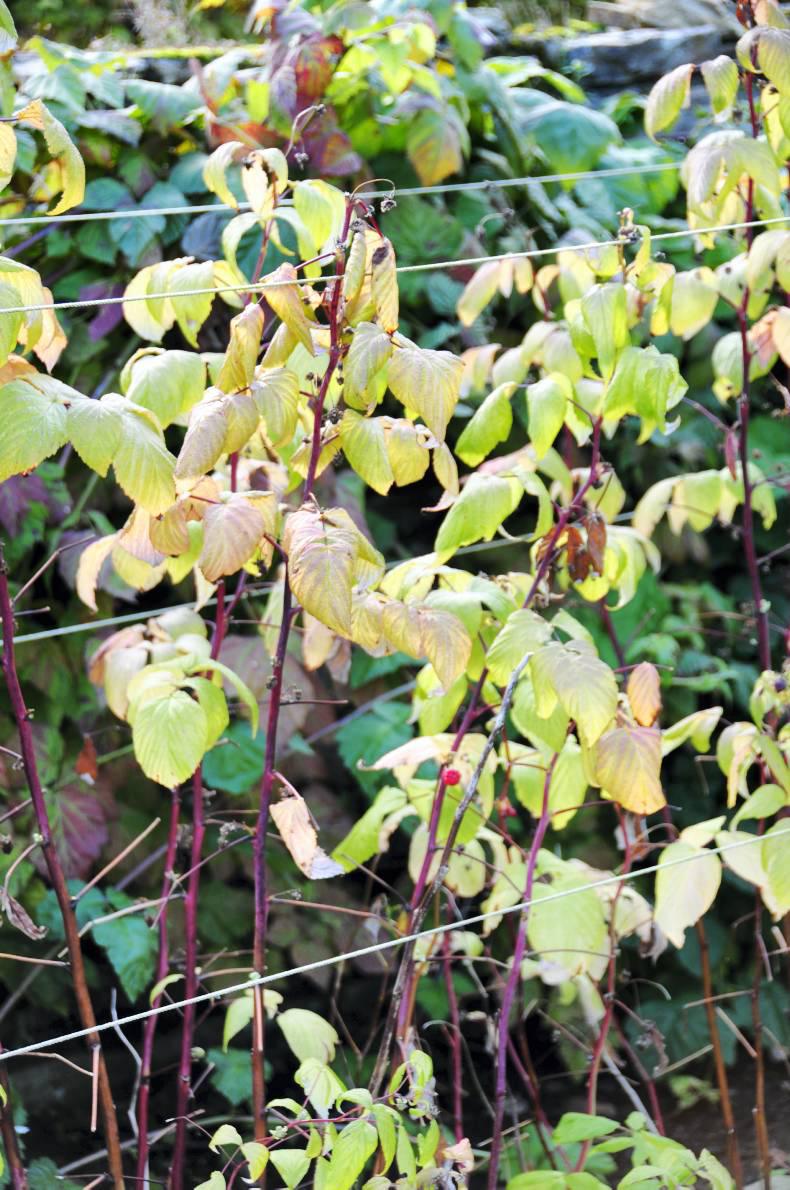
Raspberries have had a remarkable year. The summer was perfect for this northern European, including Ireland, native, because it likes sunshine and lots of showers, but good drainage too. It thrived this summer, pushing up ancillary flowering shoots that do not appear every year but provide some late fruit when they do, and this was not just on recognised autumn-fruiting, but on the summer varieties too.
Along came that great spell of autumn sunshine and a bounty of late-season raspberries was the result. Things have turned chilly since, and there are lots of green berries and flowers even that will not mature, but that happens most years to the wild blackberries, which are related to raspberries. Give them a few weeks more and then prune out the fruited shoots of summer raspberries, and cut autumn kinds down to 10cm in early spring.
Flowers
Bulb planting must be finished off as soon as possible. Tulips and alliums can be planted well into November, but it is best to plant early. If the soil is not wet, perennial flowers can be lifted and divided or new kinds planted. Gladiolus and dahlias may need to be covered with sand or soil or lifted to store.
Trees, shrubs and roses
Bare-root trees are cheaper than pot-grown specimens. Do not plant into waterlogged ground. Evergreens can still be planted, but it would be best to wait until spring in an exposed site where winter winds might dry out the foliage. Rose bushes can be planted now. Check the tree ties on young trees.
Lawn
Grass growth has slowed although lawns are generally in good condition. If lawn moss is obvious, apply sulphate of iron.
Repairs to a damaged lawn can be carried out and humps and hollows fixed. Seed will be slow to germinate now, but it can still be sown.
Fruit, vegetables and herbs
The vegetable area can be tidied up, and perhaps dug over, but weeds should certainly be controlled now. Plant fruit trees and bushes. Most fruits are very easy to grow, but they must have a good site, some shelter and good deep soil for best results. Prune apple and pear, but not plum or cherry, trees.
Greenhouse and house plants
Check for pests such as greenflies that can cause a lot of damage now. Remove all plant debris and dead plants. Pots and trays can be washed and the glass cleaned to improve light levels. Tidy away old tomato plants. Water house plants very little and do not stand the pots in saucers of water.


SHARING OPTIONS