



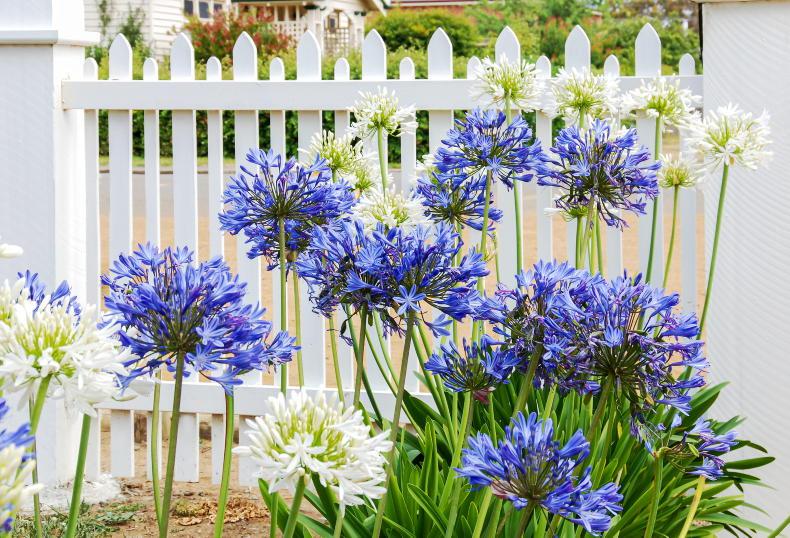
I love flowering plants that just get on with it, and by that, I mean they grow and flower with a minimum of care and attention. That for me sums up Agapanthus.
They are native to South Africa and the choice we have for our gardens is vast. They are commonly known as the African Lily. In Australia they are known as the Star of Bethlehem as they flower at Christmas time there.
Agapanthus like to be planted in a sunny position and protected from the harshest of winter weather. Some are evergreen and others are deciduous. My favourite ones are the evergreen type as they hold their presence in the garden all year round with perfectly formed foliage.
The deciduous ones die back to the ground as herbaceous perennials do. These are the hardier of the two types. However, with the recent change in the Irish climate I find it does not matter much.
Agapanthus flowers stand high above the foliage, they are ball shaped and these are botanically known as umbels. Each umbel can hold up to 60 individual flowers in shades of blue or white, usually with a darker central stripe. They are sometimes described as a starburst of colour and their presence in the garden can be described as architectural.
Agapanthus vary in height from miniatures, suitable for pots and planters, so are useful for gardeners with little space like patios or balconies. Then there are those that dominate the space with flower spikes that tower to 1.5m in height. Where the height of the plant is stated it refers to the height to the top of the flowering umbel.
Agapanthus praecox ‘Blue’ is a bulky clump forming plant with evergreen leaves of shining olive-green colour. The flower spikes are1.5m tall with a cluster of purest blue flowers and a deeper blue stripe.
A.‘Purple Cloud’ is equally tall but is deciduous with deeper blue flowers, highlighted by a deeper blue stripe. A. ‘Starry Night’ is described as exceptional in several catalogues and I agree, it is deciduous and will reach1.5m. The flowers are deep inky blue that bring an intensity of colour to the border.
Agapanthus ‘Blue Triumphator’ is a robust grower with tall stems that hold light blue flowers and a darker stripe. It is deciduous growing to 1.2m and as its cultivar name indicates, it is a winner.
Light and airy
Brightening the scene and of similar height is A.‘Silver Moon’ with its cream and green variegated deciduous foliage. The flowers are pale blue held loosely in the umbels which brings lightness to any flower scheme. A.‘Blue Storm’ gives you a very long flowering season from late June to the end of September. It has pale blue flowers to 80cm high above its evergreen foliage.
Light and airy is my best description of Agapanthus ‘Dr. Brouwer’ with is light blue flowers growing to 80cm over its evergreen foliage. In stark contrast is A.‘Black Buddhist’ with its dark blue flowers held on striking black stems over evergreen foliage, it grows to over 70cm. Of similar size and evergreen too is A.‘Midnight Sky’, it is dark as a starless midnight sky. A. ‘Charlotte’ is a compact plant with beautiful clear blue flowers and a purple stripe, produced over a three-month period. It grows to 45cm.
To lighten the colour palette, use Agapanthus ‘Fireworks’ – it is a bright sparkling display of blue and white flowers over semi-evergreen foliage. It is a compact grower suitable for growing in pots or containers. It is very similar to A. ‘Twister’ and a good substitute.
Again, both are suitable for container growing, as they grow to 50cm. If pure white is what you want, look for A.‘Petite Eskimo’ and it is just that, petite in every way growing to 50cm with pure white flowers.
Agapanthus cultivation is straightforward. However, you must bear in mind that they require five years to reach their full potential, so with that in mind soil preparation is key. Prepare the area well by digging in good quality spent compost and some grit for drainage.
Plant in May and monitor watering in the initial phase, make sure that when they are positioned in established borders they will not be overcrowded during their first growing season.
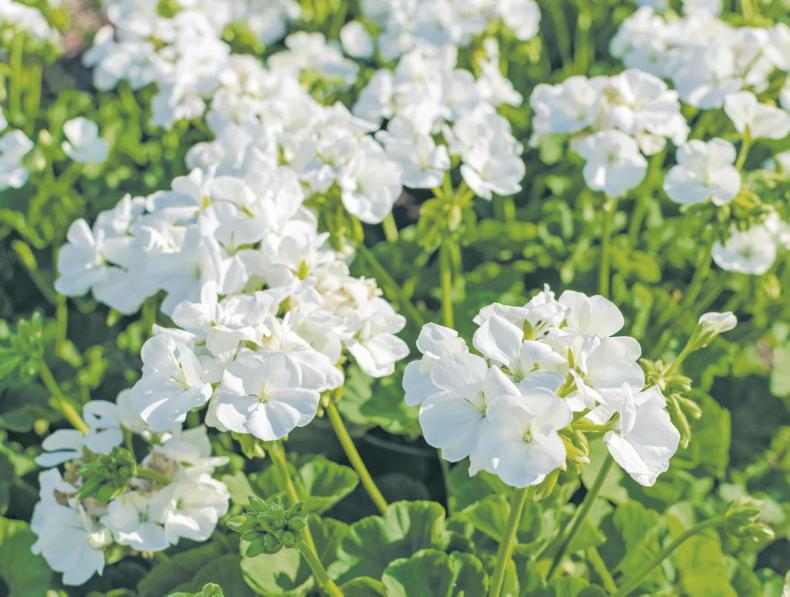
I’ve been given a present of a Peppermint Geranium. Can I plant it outside and how do I keep it over winter? It looks very fragile. – Kevin Flood, Co Waterford
What a wonderful present and it is great plant for its scented foliage. Pelargonium tomentosum is its botanical name and it is tender. You can plant it outdoors for the summer period, however, it is best grown in a pot as it is a low spreading plant. It’s best appreciated cascading from pots creating a mound of grey furry peppermint-scented foliage, beautiful to touch and experience the scent. It does produce small white flowers. You will need to bring it indoors to overwinter it. It also roots easily from cuttings to increase your stock.
Roses: continue dead-heading and encouraging new flowers, lightly prune and
tie-in any wayward shoots of rambling roses that have finished flowering.
Cuttings: cuttings can be taken now of many woody shrubs such as lavender, rosemary, and philadelphus. Place them in a pot and cover with plastic, observe for root growth and remove plastic.
Lawns: continue to keep your cutting level high as lawn are stressed. Do not water lawns, they will recover.
Bedding plants: sow wallflowers, Myosotis and Bellis now for next spring’s bedding display.
Do you have a gardening question? Email icl@farmersjournal.ie; post Irish Country Living, Irish Farm Centre, Bluebell, Dublin 12.


SHARING OPTIONS