



While showing some friends around our garden, the subject of their daughter’s wedding came up and how wonderful it would be to have some wedding photographs taken there. We agreed and got to the point where the location was identified and how many would need to be accommodated. Thankfully, that number was small.
That was late summer, and it was a July wedding the following year. As we walked around, we identified some plants that would create the scene wedding photographs require. As our friends departed, we were left with a frisson of excitement mixed with mild panic, but we started making notes and propagation plans.
Our garden is well stocked and we do all our own propagation, so there are always plants to hand. We worked on the planting design and with all such designs they have to convey a theme, so we planned to embed little messages using the plants to add to the occasion.
We designed the 5m by 5m area as a large pear shape, narrow at the top where the couple would stand. The entrance was wider allowing for the bulk of the planting.
We put a pathway through the centre, which created two beds mirroring each other in shape and plant content.
As the rose is the symbol of love, we planted two Rose ‘Cecile Brunner’, one on each side of where the couple would stand. It is a ‘buttonhole rose’, with small, pale pink flowers throughout summer.
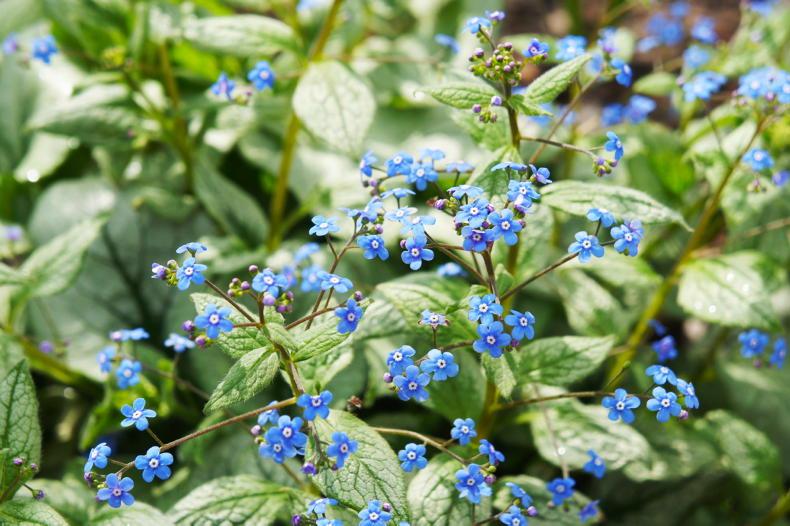
Around the base of these we planted Brunnera macrophylla ‘Alexanders Great,’ which is a low-growing perennial with silver and grey-green heart-shaped leaves symbolising love. It is spring flowering with sprays of beautiful blue flowers, however we were using it for its foliage shape.
Behind that, we positioned Nandina domestica ‘Obsessed’, with deep green leaves and young foliage, which is a rich wine red, and at that time of the year, blends well with the pink of the rose. This we thought brought an element of passion and obsession.
Alongside that, we planted Phormium ‘Platt’s Black’ with its strap-like foliage in a dusky purple shade, building on the intensity of colour. Luckily, we had four of these propagated for a plant sale so we diverted two to the project.
Close by, we added Astrantia ‘Hadspen Blood’, a plant we love for its rich green divided foliage and deep red flowers. It is well described as small exploding fireworks of colour for a carnival atmosphere, perfect for the day it would be.
Golden Arrow
Brightening the scene, we planted Bistorta amplexicaulis ‘Golden Arrow’ a plant that is best grown in some shade to show off its lime-green heart-shaped foliage. Along the edge we planted clumps Hosta ‘Halcyon’ with its cool grey, heart-shaped foliage reinforcing the theme of the day. We backed that with Astelia ‘Red Devil’. It is renowned for its evergreen foliage with a bronze tint and silvery sheen. Around this we softened the planting using Hakonechloa macra ’Aureola’, the Japanese Hakone grass with its bright yellow foliage that sways in the gentlest breeze, symbolising the to and fro of life together in harmony. Close to the entrance we planted Alchemilla mollis ‘Lady’s Mantle’, an old-fashioned plant with lovely soft foliage where droplets form like diamonds after rain. It has a froth of acid green flowers, which tumble on to the pathways.
At the entrance to the area we planted two Taxus baccata ‘Fastigiata’ known as the upright Irish Yew. They formed columns of green foliage framing the entrance, bringing a formality to the area. We surrounded these with a carpet of Stachys lanata ‘Lamb’s Ear’ with its woolly soft-grey foliage as a comforting carpet.
Our garden had almost all the plants needed, so we set to work in September. We carefully lifted two Rose ‘Cecile Brunner’ and potted these in good-quality compost. All other plants were lifted as divisions and likewise potted and put inside our polytunnel, which ensured quality plants ready for spring planting.
Within the space we created two matching pear-shaped beds over winter, with a gravel path through the centre. We planted in April and watered and fed until the area was picture-perfect. The day was perfect too, and the happy couple took some of the plants home to begin their new garden and life together.
It was pleasing for us also as we positioned plants from our garden in different combinations and that is always the way you learn. The planting combination will work for any garden and give an excellent end result.
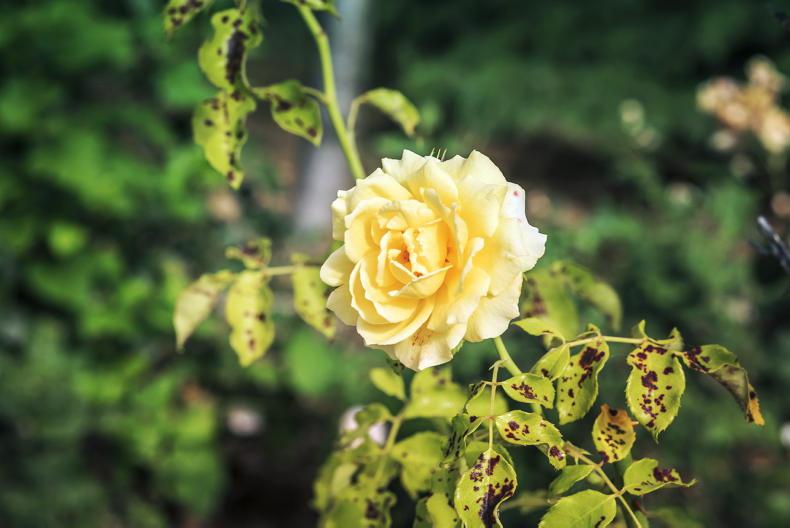
Five years ago, I gave up using chemicals, now my roses succumb to increasing amounts of black spot. – Mary, Co Limerick
Of all the pests and diseases, we manage in our gardens, black spot seems to be the one that is most troublesome. Part of the answer is in your question. Black spot, if left untreated can become progressively worse over time. Start by never allowing infected foliage to rest on the soil beneath the rose. Pick these up and dispose them in your waste bin. Apply a preparatory rose feed to help nourish the plants. Spray with neem oil, which should be available in your local garden centre, making sure to drench the stems as well.
Composting: compost bins and heaps are probably filling up now that grass cutting is in full swing. It is a good plan to keep two bins going, one for filling and one for maturing.
Deadheading: continue removing spent
flowers off all plants, especially roses. Cut back to leaf nodes as this promotes further flowering.
Lawns: grass growing has slowed in the recent hot weather, raise your blades to allow grass to grow and refrain from watering lawns.
Pruning: prune out all flowering shoots of early summer flowering shrubs. Philadelphus and Deutzia need attention to encourage new growth to develop.


SHARING OPTIONS