

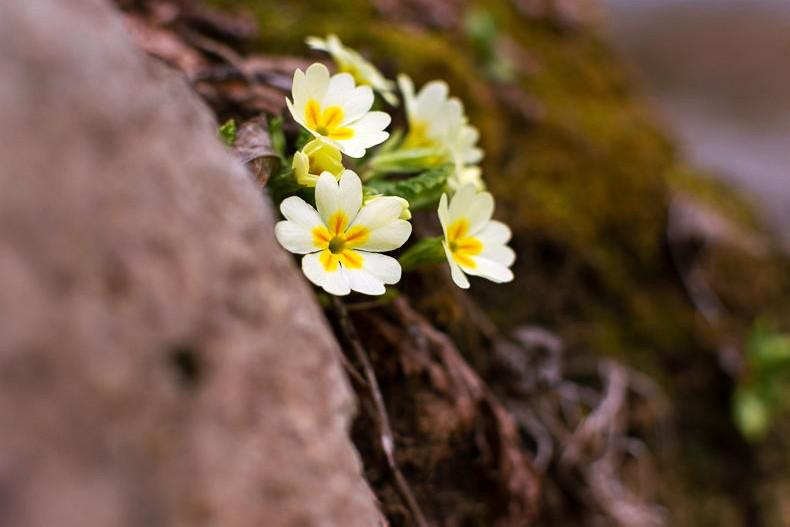
The poet Patrick Kavanagh wrote of the primrose, “Upon a bank I sat, a child made seer, of one small primrose flowering in my mind”. He is reported to have used these lines in order to describe the innocence of childhood and the beauty of nature.
Our roadside ditches and gardens are now in full flower with the bounty of spring colour. Primroses or Primula vulgaris abound at this time of year.
They have a good flowering period from February until mid-April.
Our native Irish flora has two species of primula, Primula vulgaris, the common primrose and P veris, the cowslip. These are distinct and easily identified, the primrose has a cluster of creamy yellow flowers held singly on low stems within the green crinkled foliage. They are usually found in ditches and woodland edges. A pink form exists in the wild, though rarely seen, it is said to be a hybrid of native and garden primulas.
The cowslip is distinct and cannot be confused. It has drooping yellow flowers held on a long single stalk. Cowslips have a richer yellow colour and inhabit grassland.
The polyanthus, well known as a spring garden favourite, is a hybrid of both species. It adopts the character of the cowslip flower having many flowers atop the flower stalk and the flowers nestled in the foliage, like the primrose.
Botanically it is classified as Primula x polyantha, polyantha meaning many flowers. Today, they come in a wide range of colours and forms that are long since residents of our spring gardens, and so considered to be old-fashioned, but worthwhile.
There is an even greater variation of colour and flower type now to charm the gardener. Plants can be sourced as seed or plants from garden centres or online.
Perhaps the most famous varieties are the Primula x polyantha Pacific Giant group, with varying colours and a long flowering period. They arose from a breeding programme in California in the 1950s aiming to provide plants with strong upright blooms. We still grow these today and they are found on many garden centre shelves.
Unlike other spring bedding plants, which are annual we consider these to be perennial, as they will continue from year to year and will hybridise too, which can lead to some lovely new plants with slight variations.
Pretty Polly range
Likewise, but not with the same quality, are the large flowered hybrids and despite their name are smaller in size. They are more variable but also will give you a great display year to year.
You can grow good quality Polyanthus from seed with little difficulty. Look for the Pretty Polly Range from Thompson & Morgan which come in varying shades. These are available as small plants. Primula x polyantha ‘Pretty Polly Buttercream’ has double creamy yellow flowers. P x polyantha ‘Pretty Polly Burgundy’ has velvety burgundy flowers. Both of these have the same lusciousness in the spring garden and blend well with dwarf species of tulips.
Barnhaven primroses are the work of Florence Bellis who began her hybridising in 1936 in the USA. The company is now based in France and operates by mail order, providing beautiful varieties.
Among my favourites are the Gold and Silver-Laced polyanthus. These break the mould and make you question what you are seeing.
They need more care to grow. Look out for Gold-Laced and Silver-Laced polyanthuses, these are wonderful with clearly defined edges to the petals with maroon centres with a perfect gold or silver edges. They are somewhat specialised and need cossetting, so grow them in pots or troughs.
Cultivation: The best way to start your collection is by sowing seed. Look for seed now, and plan to sow in seed trays in early May. Once germinated, pot up your seedlings in 7cm pots in good quality compost. Plant them out in September or October. Once you grow polyanthus, you will have them forever; they are perennial and long-lived. They require moist soil and partial shade for the summer months.
It is amazing how quickly they will make substantial plants with different colour flowers.
Q&A: My hedge is very overgrown?

Griselinia hedges can to take up too much space and need to be cut back. \iStock
My Griselinia hedge is taking up too much space, can I cut it back by two feet without causing it harm? –Tommy, Co Carlow.
Griselinia reacts very well to cutting back and you can cut back almost to the central stems. Hopefully, that will allow you to achieve two feet. Use a sharp saw to make clean cuts and aim to maintain a straight line to renew your hedge. I would wait another two weeks before starting to allow weather to settle.
When growth starts, aim to keep all growth the same length by trimming the longest and most vigorous shoots. Use a general fertiliser at recommended rates to aid recovery. Also, use water from your water butt to water during dry spells.
Perennials: perennial planting can still take place and many new varieties are available in garden centres. Aim to create groups of three to five plants. You may well be able to divide your purchased plants if they are sizeable.
Lawns: use a spring tined rake to remove moss. Continue cutting regularly, feed with a proprietary lawn feed.
Roses: young fresh growth is now abounding on climbers and ramblers, maintain structure by tying in or pruning vigorous shoots to maintain shape.
Weeding: stay ahead of weed growth, effort now will save work in the weeks to come.
Do you have a gardening question? Email icl@farmersjournal.ie or post to Irish Country Living, Irish Farm Centre, Bluebell, Dublin 12.
The poet Patrick Kavanagh wrote of the primrose, “Upon a bank I sat, a child made seer, of one small primrose flowering in my mind”. He is reported to have used these lines in order to describe the innocence of childhood and the beauty of nature.
Our roadside ditches and gardens are now in full flower with the bounty of spring colour. Primroses or Primula vulgaris abound at this time of year.
They have a good flowering period from February until mid-April.
Our native Irish flora has two species of primula, Primula vulgaris, the common primrose and P veris, the cowslip. These are distinct and easily identified, the primrose has a cluster of creamy yellow flowers held singly on low stems within the green crinkled foliage. They are usually found in ditches and woodland edges. A pink form exists in the wild, though rarely seen, it is said to be a hybrid of native and garden primulas.
The cowslip is distinct and cannot be confused. It has drooping yellow flowers held on a long single stalk. Cowslips have a richer yellow colour and inhabit grassland.
The polyanthus, well known as a spring garden favourite, is a hybrid of both species. It adopts the character of the cowslip flower having many flowers atop the flower stalk and the flowers nestled in the foliage, like the primrose.
Botanically it is classified as Primula x polyantha, polyantha meaning many flowers. Today, they come in a wide range of colours and forms that are long since residents of our spring gardens, and so considered to be old-fashioned, but worthwhile.
There is an even greater variation of colour and flower type now to charm the gardener. Plants can be sourced as seed or plants from garden centres or online.
Perhaps the most famous varieties are the Primula x polyantha Pacific Giant group, with varying colours and a long flowering period. They arose from a breeding programme in California in the 1950s aiming to provide plants with strong upright blooms. We still grow these today and they are found on many garden centre shelves.
Unlike other spring bedding plants, which are annual we consider these to be perennial, as they will continue from year to year and will hybridise too, which can lead to some lovely new plants with slight variations.
Pretty Polly range
Likewise, but not with the same quality, are the large flowered hybrids and despite their name are smaller in size. They are more variable but also will give you a great display year to year.
You can grow good quality Polyanthus from seed with little difficulty. Look for the Pretty Polly Range from Thompson & Morgan which come in varying shades. These are available as small plants. Primula x polyantha ‘Pretty Polly Buttercream’ has double creamy yellow flowers. P x polyantha ‘Pretty Polly Burgundy’ has velvety burgundy flowers. Both of these have the same lusciousness in the spring garden and blend well with dwarf species of tulips.
Barnhaven primroses are the work of Florence Bellis who began her hybridising in 1936 in the USA. The company is now based in France and operates by mail order, providing beautiful varieties.
Among my favourites are the Gold and Silver-Laced polyanthus. These break the mould and make you question what you are seeing.
They need more care to grow. Look out for Gold-Laced and Silver-Laced polyanthuses, these are wonderful with clearly defined edges to the petals with maroon centres with a perfect gold or silver edges. They are somewhat specialised and need cossetting, so grow them in pots or troughs.
Cultivation: The best way to start your collection is by sowing seed. Look for seed now, and plan to sow in seed trays in early May. Once germinated, pot up your seedlings in 7cm pots in good quality compost. Plant them out in September or October. Once you grow polyanthus, you will have them forever; they are perennial and long-lived. They require moist soil and partial shade for the summer months.
It is amazing how quickly they will make substantial plants with different colour flowers.
Q&A: My hedge is very overgrown?

Griselinia hedges can to take up too much space and need to be cut back. \iStock
My Griselinia hedge is taking up too much space, can I cut it back by two feet without causing it harm? –Tommy, Co Carlow.
Griselinia reacts very well to cutting back and you can cut back almost to the central stems. Hopefully, that will allow you to achieve two feet. Use a sharp saw to make clean cuts and aim to maintain a straight line to renew your hedge. I would wait another two weeks before starting to allow weather to settle.
When growth starts, aim to keep all growth the same length by trimming the longest and most vigorous shoots. Use a general fertiliser at recommended rates to aid recovery. Also, use water from your water butt to water during dry spells.
Perennials: perennial planting can still take place and many new varieties are available in garden centres. Aim to create groups of three to five plants. You may well be able to divide your purchased plants if they are sizeable.
Lawns: use a spring tined rake to remove moss. Continue cutting regularly, feed with a proprietary lawn feed.
Roses: young fresh growth is now abounding on climbers and ramblers, maintain structure by tying in or pruning vigorous shoots to maintain shape.
Weeding: stay ahead of weed growth, effort now will save work in the weeks to come.
Do you have a gardening question? Email icl@farmersjournal.ie or post to Irish Country Living, Irish Farm Centre, Bluebell, Dublin 12.
SHARING OPTIONS