



If you are anything like us, you have been battling this long dry spell in the garden. Thankfully, rain is finally in the forecast. It is amazing how quickly plants, luxuriant and burgeoning in our normal Irish summers, begin to shrivel in drought. We take hosepipe bans very seriously and resort to using buckets in the shower and a wash-hand basin instead of the sink to harvest waste water.
We use a triage system so worst case comes first, and armed with watering cans carry out what we call ‘fire-brigade’ watering.
Of course, we are asking ourselves now about more drought-resilient gardening, but how often is it required in our Irish climate. We chat about the extra amount of work wastewater harvesting entails, and what changes we can make to deal with periods of extremely dry weather like this.
There are plants we can use that will survive drought but there are also ways to cultivate our soil to offset the worst of it. Trees and large shrubs are best able to overcome long, dry spells but herbaceous perennials are the first to suffer. Shrubs like Pittosporum tenuifolium ‘Silver Queen’ with its bright grey-green foliage and creamy white centres can take the summer heat well. All Olearia species and cultivars thrive too, Olearia macrodonta flowers throughout the summer months with white daisy flowers, and can grow to be a large shrub.
Hypericum ‘Hidcote’ is a rich green foliaged shrub with bright yellow flowers over a long period in midsummer.
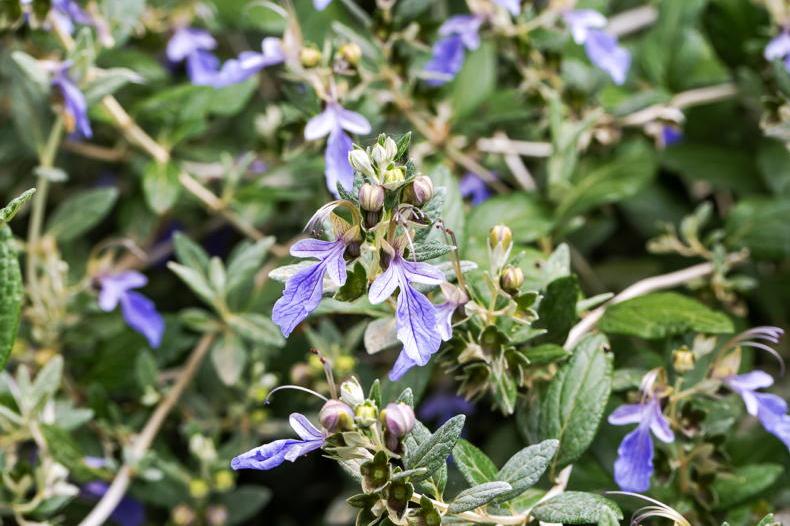
Lower growing is Teucrium fruticans, a grey foliaged shrub, growing to 1.5m with pale blue flowers throughout summer. Its bright silvery grey presence in the border brightens the scene beautifully.
As does Senecio ‘Sunshine’, of similar height, but with chrome yellow flowers that glow in sunshine. Of note here is that many grey foliaged plants survive long, dry periods very well.
When it comes to using drought-resistant plants to replace herbaceous perennials, there are plenty to choose from. Euphorbia characias works extremely well among perennial planting and has an all year-round presence. It grey-green leaves are always picture-perfect crowned by its lime green flower heads. There are some variegated varieties too such as E. x martini ‘Ascot Rainbow’ with its golden and green variegated foliage. It is well worthwhile growing.
Dry sunny borders
Rosemary is another stalwart that thrives when sun is baking the soil. We knew it as Rosmarinus officinalis, however, taxonomists have now decided it should be included in the genus Salvia, so you might find it with a label stating Salvia rosmarinus. It thrives in dry conditions too, and speaking of Salvia, it is another that thrives in dry sunny borders and there are a multitude to choose from.
We love growing Salvia leucantha with its quality grey-green foliage and purple and cream flower spikes. This is a bushy plant growing to over 1m in height. S. microphylla ‘Cerro Potosi’ also provides a sea of pink flowers throughout the summer. Lavandula ‘Munstead’ revels in heat and produces better scent. Plant this in the company of Origanum vulgare ‘Aureum’ with its tiny purple flowers and yellow foliage. It is a beautiful floral picture and bees love it too.
Lower growing and suitable for the front of the border are Sedum ‘Xenox’ with its dark purple leaves and deep red flowers or Sedum spectabile ‘Brilliant’ with pale green leaves and pink flowers in autumn. Both are drought tolerant.
Lower growing again is Bergenia ‘Baby Doll’ with perfectly shaped green foliage and bright pink flowers. You can create a bright edge to the border by using Stachys byzantina with its silver foliage and pink flower spikes.
We can do more to prepare for drought, even though it’s not an annual event. In saying that, we are moving in that direction so it is worth taking heed of.
Soil preparation and maintenance can really help your efforts. Deep digging and incorporating well-rotted farmyard manure is a wonderful start for a new garden. Soil benefits from a mulch of well-rotted garden compost or fine bark mulch in autumn or early winter.
Lightly break open soil with a fork in advance. It allows earthworms to take the mulch deep into the soil to help the gardener.
This year our beech tree has very sparse leaf cover and a multitude of what I assume are seeds. Is this normal or what should we do? – Mary, Co Antrim
This is a natural occurrence whereby beech every few years produces seed, and is called a mast year. When this occurs the foliage of the tree is not a lush as it shares its energy with seed production.
Usually, all beech trees do this in synchronicity. In does not harm the trees and as it is not an annual event they get back to normal growth the following years. If there has there been any changes to ground level around your tree this may have caused it, so check this and if possible rectify.

Roses: hot dry weather has its benefit in preventing Black Spot, however, remove any infected foliage around the base. Continue deadheading.
Shrubs: dead-head all early flowering shrubs, for example, lilac.
Cuttings: as needed take cuttings of woody shrubs, lavender, rosemary, philadelphus, place them in a pot and cover with plastic.Observe for root growth and remove plastic gradually.
Bedding plants: sow wallflowers, Myosotis and Bellis now for next spring’s bedding display.
Do you have a gardening question? Email icl@farmersjournal.ie; post Irish Country Living, Irish Farm Centre, Bluebell, Dublin 12.


SHARING OPTIONS