Witch hazel is well known for its cosmetic properties as an astringent and anti-inflammatory treatment for skin conditions. These properties arise from the American Hamamelis. Flowering from autumn, through winter into spring, they are deciduous and native to China, Japan and Central North America.
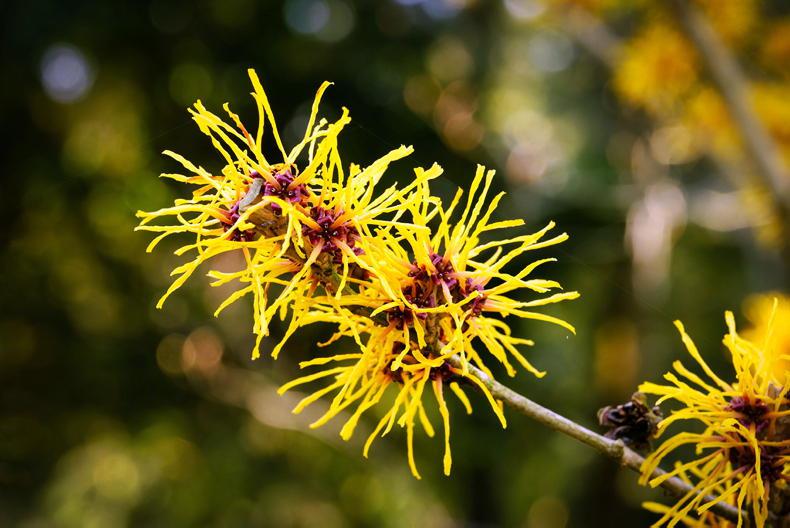
Hamamelis mollis is native to China. It is a handsome large shrub growing to almost 5m with scented, golden yellow flowers. Some gardeners describe the flowers as straggly or spidery and they are, but held in profusion.
H. mollis ‘Pallida’ is lower growing, the flowers are sulphur yellow and scented. This is perhaps a better choice for the smaller garden.
Hamamelis japonica is a Japanese native and is a taller growing plant with flowers of similar shape and size. It flowers slightly earlier starting in December and continuing until March. H. japonica ‘Zucchariniana’ has lemon-yellow flowers held in clusters, which are interesting. It is late flowering, continuing into the month of March.
Hamamelis x intermedia is a hybrid between H. mollis and H. japonica, taking on the best traits of both. Under the keen eye of plant breeders, it was an important development giving us some of the very best garden plants.
Hamamelis x intermedia ‘Arnold Promise’ is an upright growing shrub to 3m. It is a hybrid breed at the Arnold Arboretum, Boston, USA. Its bright yellow flowers appear in February into March and are lightly fragrant. H. x intermedia ‘Aurora’ is a much bulkier shrub growing to over 3.5m high, with similar width.
Its flowers are a paler shade of yellow with a light pink tinge, a wonderful sight where space is available.
Hamamelis virginiana is native to eastern and central North America and is a large shrub growing to 5m or more, which can be classified as a small tree. It is the source of medicinal Hamamelis. Leaves bark and twigs are utilised in its creation.
It was used by native American people in herbal medicine recipes. It is autumn flowering, which broadens the seasonal beauty of the genus.
Hamamelis x intermedia ‘Vesna’ darkens the colour palette of witch hazel. It is upright, almost vase-shaped and striking as it can reach 4m in height and spread, given time. Its fragrant flowers are a golden orange colour and highly fragrant, appearing from January to March.
Bright yellow
Although bright yellow is what gardeners expect from witch hazel flowers, plant breeders have produced a range of plants with colours that go from dark coppery orange to dark red and give more possibilities for the gardener. They don’t stand out as much but they have charm.
Hamamelis x intermedia ‘Diane’ has flowers with a rich red colour. It does not have a powerful fragrance but is certainly a talking point.
Hamamelis x intermedia ‘Magic Fire’ is a showstopper, it is a substantial shrub growing to 3.5m and flowering in January through February.
The flowers are held on the stems almost like tassels, in a glowing red colour and fragrant too. When it comes to cultivation, Hamamelis are large spreading shrubs, so plan well in advance to ensure you have the perfect spot in which to plant. Hamamelis take a while to establish and do not appreciate disturbance as larger shrubs.
It is a pity, due to bad planning if one is deemed to be in the wrong place years later.
The plant appreciates slightly acidic to neutral soil and good moisture. They are perfectly happy treated as a woodland-edge shrub in part sun and part shade.
As a winter flowering plant, it is best positioned where it can be viewed from your windows. You can create a seasonal feature by underplanting with snowdrop or hellebore. And, if all that was not enough, Hamamelis also gives wonderful autumn foliage colour, in colours of yellow, orange and dark red before leaf fall.
Hamamelis needs very little by way of pruning. Look out for branches that are rubbing or have the potential to do so, remove these back to the main stem. Dieback can be removed in the same manner. Maintain natural shape by lightly pruning back any wayward branches.
Sourcing Hamamelis can be difficult as they are not widely available, however as I frequently say, get to know your local garden centre as they are always a source of advice and may well be able to get some Hamamelis plants for you.
Q&A: What are the small yellow apples?

Malus ‘John Downie’ has yellow fruits. \iStock
I recently noticed small yellow apples on a tree in the garden next door,
what could it be? – Melanie, Co Roscommon.
There are several ornamental crab apple trees that are in fruit at the moment. I suggest you look up Malus ‘John Downie’ as it has wonderful yellow fruits at present. This might be what you have seen. It is a tree widely available in Irish nurseries and garden centres. It is particularly beautiful at this time of the year. It is also a beautiful thing in spring as it produces a myriad of white flowers opening from pink buds. It is excellent for wildlife and establishes easily and relatively trouble free with a long growing life.
Frost protection: take time to check plants that have winter protection,
strong winds may have created gaps that frost will penetrate.
Pots and planters: check pots and
planters that there is plenty drainage underneath, if not place pieces of slate underneath.
Beds and borders: check for weed growth, start the year preventing early weed growth.
Pruning: maple and birch should be pruned now, or as soon as possible.
Witch hazel is well known for its cosmetic properties as an astringent and anti-inflammatory treatment for skin conditions. These properties arise from the American Hamamelis. Flowering from autumn, through winter into spring, they are deciduous and native to China, Japan and Central North America.
Hamamelis mollis is native to China. It is a handsome large shrub growing to almost 5m with scented, golden yellow flowers. Some gardeners describe the flowers as straggly or spidery and they are, but held in profusion.
H. mollis ‘Pallida’ is lower growing, the flowers are sulphur yellow and scented. This is perhaps a better choice for the smaller garden.
Hamamelis japonica is a Japanese native and is a taller growing plant with flowers of similar shape and size. It flowers slightly earlier starting in December and continuing until March. H. japonica ‘Zucchariniana’ has lemon-yellow flowers held in clusters, which are interesting. It is late flowering, continuing into the month of March.
Hamamelis x intermedia is a hybrid between H. mollis and H. japonica, taking on the best traits of both. Under the keen eye of plant breeders, it was an important development giving us some of the very best garden plants.
Hamamelis x intermedia ‘Arnold Promise’ is an upright growing shrub to 3m. It is a hybrid breed at the Arnold Arboretum, Boston, USA. Its bright yellow flowers appear in February into March and are lightly fragrant. H. x intermedia ‘Aurora’ is a much bulkier shrub growing to over 3.5m high, with similar width.
Its flowers are a paler shade of yellow with a light pink tinge, a wonderful sight where space is available.
Hamamelis virginiana is native to eastern and central North America and is a large shrub growing to 5m or more, which can be classified as a small tree. It is the source of medicinal Hamamelis. Leaves bark and twigs are utilised in its creation.
It was used by native American people in herbal medicine recipes. It is autumn flowering, which broadens the seasonal beauty of the genus.
Hamamelis x intermedia ‘Vesna’ darkens the colour palette of witch hazel. It is upright, almost vase-shaped and striking as it can reach 4m in height and spread, given time. Its fragrant flowers are a golden orange colour and highly fragrant, appearing from January to March.
Bright yellow
Although bright yellow is what gardeners expect from witch hazel flowers, plant breeders have produced a range of plants with colours that go from dark coppery orange to dark red and give more possibilities for the gardener. They don’t stand out as much but they have charm.
Hamamelis x intermedia ‘Diane’ has flowers with a rich red colour. It does not have a powerful fragrance but is certainly a talking point.
Hamamelis x intermedia ‘Magic Fire’ is a showstopper, it is a substantial shrub growing to 3.5m and flowering in January through February.
The flowers are held on the stems almost like tassels, in a glowing red colour and fragrant too. When it comes to cultivation, Hamamelis are large spreading shrubs, so plan well in advance to ensure you have the perfect spot in which to plant. Hamamelis take a while to establish and do not appreciate disturbance as larger shrubs.
It is a pity, due to bad planning if one is deemed to be in the wrong place years later.
The plant appreciates slightly acidic to neutral soil and good moisture. They are perfectly happy treated as a woodland-edge shrub in part sun and part shade.
As a winter flowering plant, it is best positioned where it can be viewed from your windows. You can create a seasonal feature by underplanting with snowdrop or hellebore. And, if all that was not enough, Hamamelis also gives wonderful autumn foliage colour, in colours of yellow, orange and dark red before leaf fall.
Hamamelis needs very little by way of pruning. Look out for branches that are rubbing or have the potential to do so, remove these back to the main stem. Dieback can be removed in the same manner. Maintain natural shape by lightly pruning back any wayward branches.
Sourcing Hamamelis can be difficult as they are not widely available, however as I frequently say, get to know your local garden centre as they are always a source of advice and may well be able to get some Hamamelis plants for you.
Q&A: What are the small yellow apples?
Malus ‘John Downie’ has yellow fruits. \iStock
I recently noticed small yellow apples on a tree in the garden next door,
what could it be? – Melanie, Co Roscommon.
There are several ornamental crab apple trees that are in fruit at the moment. I suggest you look up Malus ‘John Downie’ as it has wonderful yellow fruits at present. This might be what you have seen. It is a tree widely available in Irish nurseries and garden centres. It is particularly beautiful at this time of the year. It is also a beautiful thing in spring as it produces a myriad of white flowers opening from pink buds. It is excellent for wildlife and establishes easily and relatively trouble free with a long growing life.
Frost protection: take time to check plants that have winter protection,
strong winds may have created gaps that frost will penetrate.
Pots and planters: check pots and
planters that there is plenty drainage underneath, if not place pieces of slate underneath.
Beds and borders: check for weed growth, start the year preventing early weed growth.
Pruning: maple and birch should be pruned now, or as soon as possible.





SHARING OPTIONS