


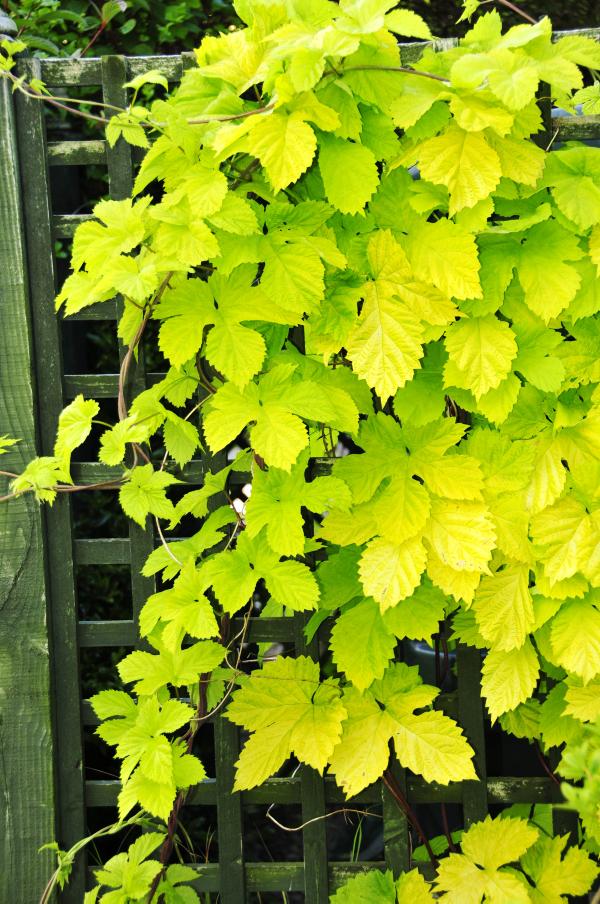
The golden hop is one of those plants that can be seen in gardens of people who know their plants. A glimpse of it is an indication that it has been sought out by the owner who has seen it somewhere and admired it. The golden hop is a yellow-leaved form of the common hop, which has the normal green leaves.
It is native to Europe and it grows wild in a few places around Ireland, having escaped cultivation. The common hop is universally used for flavouring beer, imparting a slightly bitter astringency to the brew.
At one time, hops were grown commercially in Co Kilkenny in hop gardens, trained up strings onto high wires on poles, about four metres off the ground.
The hop stems are cut down during the hop harvesting. Hops are difficult to grow and commercial production is tricky in countries like Ireland, with unpredictable, wet and cool summers.
The part of the plant used in making beer is the conical female flower – very like a small, green pine cone in shape. The flowers grow in bunches. The bracts inside are sticky with resin and it is this resin that provides the slightly bitter taste of hops in brewing.
The resin has antibacterial properties that help preserve natural beers.
Incidentally, the hop plant is part of the cannabis family. Hop plants are sometimes seen growing in hedgerows by roadsides, a scrambling twining climber, but not very dramatic and likely not to be noticed, except by someone familiar with the plant.
The garden form, the golden hop, is not as vigorous but still capable of growing a big plant. It is herbaceous and its stems die down in winter.
This might be considered a fault, but in reality the plant prunes itself each winter and tidying up is a simple matter, just cut away or pull away the withered stems when they have dried out.
However, this is not essential and the old stems are often left in place, withered and all, and they provide climbing material for the young shoots the following spring.
The new shoots grow extremely rapidly and may reach five metres in good conditions. The green form is even more vigorous.
The golden hop is a great plant for growing on a pergola, a trellis, an arch or an obelisk. It looks lovely on timberwork that is painted in a shade of white, green or blue.
The fact that it disappears in winter is attractive because it is seasonal, in full leaf in summer and gone in winter.
The yellow colour is more pronounced when it is grown in sunshine, but can become a bit bleached looking in a very hot and sunny spot and it does not really need such a good position.
It can be very pretty when grown in shade because the foliage stays more of a bright lime-green. But it tends to exhibit these qualities naturally as it grows from shade to sunlight and vice versa.
The yellow or limey-green colour goes beautifully with other climbers, notably clematis and roses. It is a perfect companion because it withers away each year and grows only where it can, not becoming overpowering for other plants.
Growing over a trellis or through other climbers, the golden hop imparts a natural free-flowing touch to the garden, which is ideal in the country.
The stems and leaves are vine-like and rough to the touch, especially the stems.
It is quite easy to grow, needing good rich, well-drained deep fertile soil, well supplied with organic matter to retain moisture in summer. It can be planted now for results this summer.
Early beans and peas
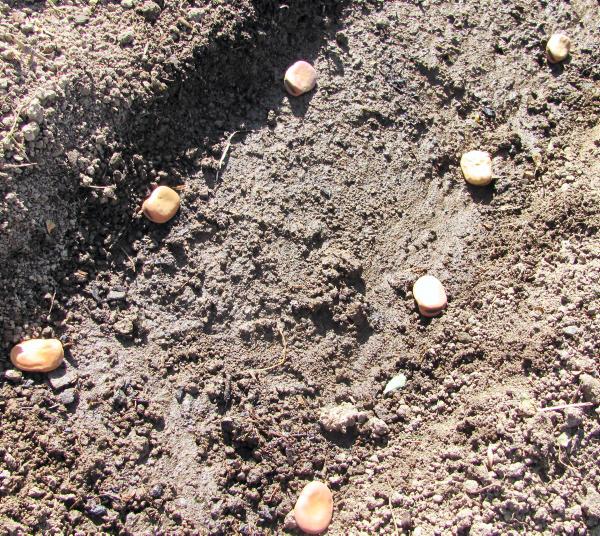
Broad beans and early pea varieties can be sown in the coming weeks, if the soil is dry enough to be lightly raked and levelled.
Broad bean plants sown in late autumn should be quite advanced by now. An early spring sowing can follow as the plants should catch up if the weather is good.
The beans can be sown in a shallow drill, usually in two rows as the plants then afford each other a degree of shelter.
Early pea varieties can be sown now too in order to provide a small, but much appreciated, crop in early summer. There is always a risk in sowing beans and peas so early. Cold weather can cause rotting or an attack by millipedes.
Mice and crows sometimes find them and destroy most seeds, but the cost is slight and there is plenty of time to re-sow.
Flowers
The first of the spring bulbs are showing, mainly snowdrops and crocuses. Border flowers can be lifted and divided, if necessary, but not if the ground is turning to mud or the holes are filling with water. Seeds of geraniums, lobelia, busy lizzie and bedding begonias can be sown in a heated propagator.
Lawn
If a dry spell comes mow the lawn, but otherwise stay off lawns until the rain has drained away. Moss control can be carried out now using sulphate of iron. If a lawn area is being prepared for sowing in the spring it cannot be cultivated until the ground dries, but weed seedlings could be controlled.
Fruit, vegetables and herbs
Seed potatoes of early varieties can be put into a greenhouse or a bright place to sprout now. Sow seeds of early varieties of cabbage, cauliflower, carrots, lettuce and onions under protection to raise plants for planting out in April. Rhubarb stools are ready for forcing in a dark, warm place.
Trees, shrubs and roses
It is still very wet for planting in areas with heavy ground. If hedging or sapling trees have been purchased they can be kept for weeks before planting by being heeled into a trench, after opening out the bundles so that all the plants have access to the soil. Roses can be pruned at any time.
Greenhouse and house plants
Greenhouse grapevines and peach trees will start to come out of dormancy and they should be encouraged by as much water and sun exposure as possible — the earlier the flowers come out the earlier they will fruit next summer. Clean the glass and close the vents.


SHARING OPTIONS