


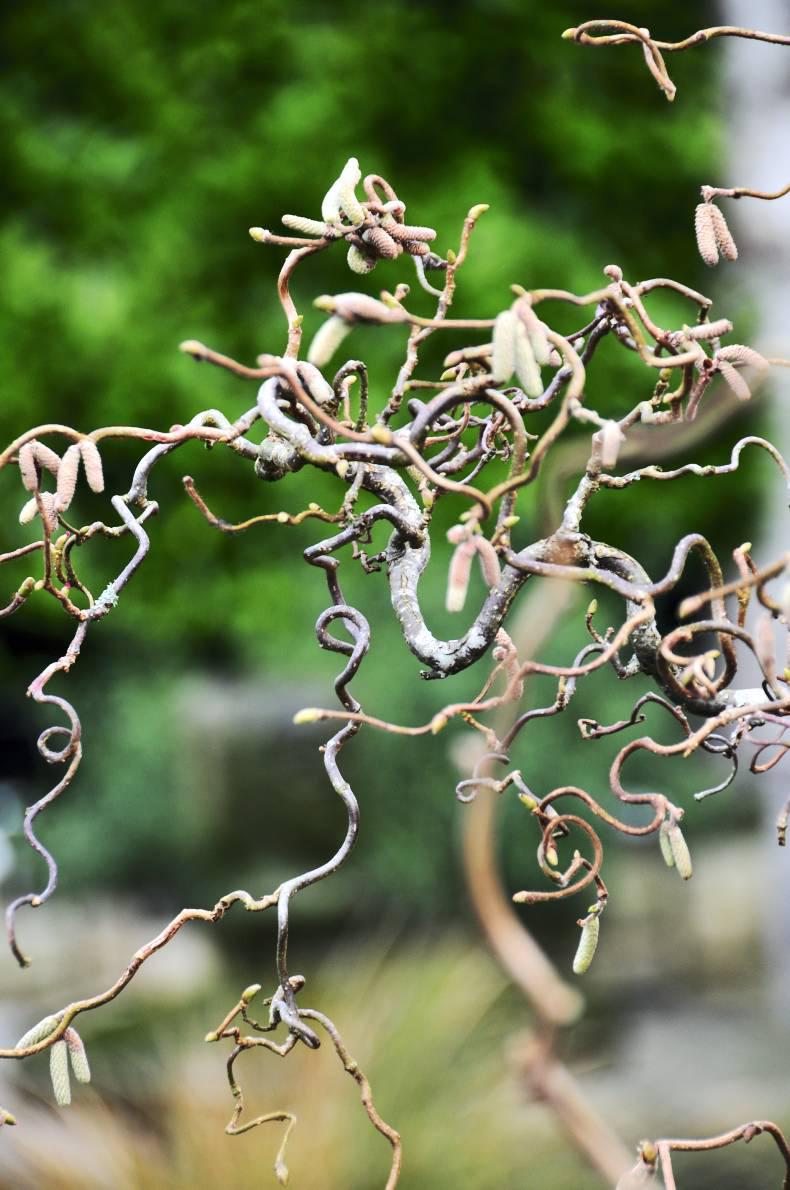
Hardly noticeable in summer when its full coat of leaves hides its twigs and branches, the contorted hazel or twisted hazel comes into its own now when the leaves have fallen. This is a curiosity plant and surprisingly popular.
The catkins are already present, still tightly held in mid-winter but very soon, in a matter of a few weeks, the catkins will elongate and dangle even more dramatically on the curling twigs. Although the branches are twisted and turned, and the leaves are to a considerable extent also twisted, strangely the catkins are not twisted at all and they hang straight down from the twigs and it makes the plant look very decorative.
The contorted hazel, Corylus avellana Contorta, is also known as twisted hazel or corkscrew hazel and, surprisingly widely, as Harry Lauder’s walking stick. Harry Lauder was a Scottish entertainer in the first half of the last century, who used to appear with a crooked walking stick. Whether the stick was made of this kind of hazel is not known, but perhaps it was. It is ironic that the tree has kept the entertainer’s name alive.
The corkscrew hazel is a form of common hazel, apparently found in a hedge more than a century ago and propagated from that original plant. It is usually grafted on to the common hazel because it does not seem to produce hazelnuts and may not come true from nuts in any case. Because it is grafted, it is very common to see the rootstock throw up upright stems. These must be removed as soon as they are noticed because they assume greater vigour and will easy outgrow the twisted branches.
The corkscrew hazel can be grown on its own roots and propagated as suckers but this is a much slower method of increase, which nurseries are unlikely to use. But if one or two plants are needed, it might be possible to get a rooted one from an existing tree.
Not growing more than about three metres tall and less in width, the corkscrew hazel is easily accommodated in most gardens. It is very pretty when the leaves are off but a mound of rather nondescript foliage in summer, so it should be placed somewhere in the middle or background. It looks wonderful with a spread of snowdrops underneath and the spring catkins above.
The corkscrew hazel is used commonly in floral arrangements and the tortured or twisted willow, another twisted twig tree, is also used for this purpose. The twisted willow, Salix matsudana Tortuosa, can grow to five metres or so and it forms an upright tree while the hazel is smaller more mounded in shape.
The curly branches of tortured willow are an interesting feature in winter and spring, but the tree itself is not very appealing in summer, lacking structure and appearing shapeless. It is best planted in the background of shrubs, so that it is not too prominent and it could be cut back from time to time and treated only as a supply of cut stems.
There are a couple of other contorted trees, occasionally seen, but contortion of branches is not a very common mutation. It is generated by a mutation flaw in how the structure of the twigs develops. There is a contorted dwarf caragana that is sometimes seen for sale. It is grafted on an upright rootstock stem and the mass of contorted leaves and twigs forms a low mound of seaweed-like growth. There is also a contorted robinia that makes a small tree and has the leaves contorted as well. Both of these are in the pea family and look quite similar, except that the robinia has larger leaflets. CL
Prune roses early
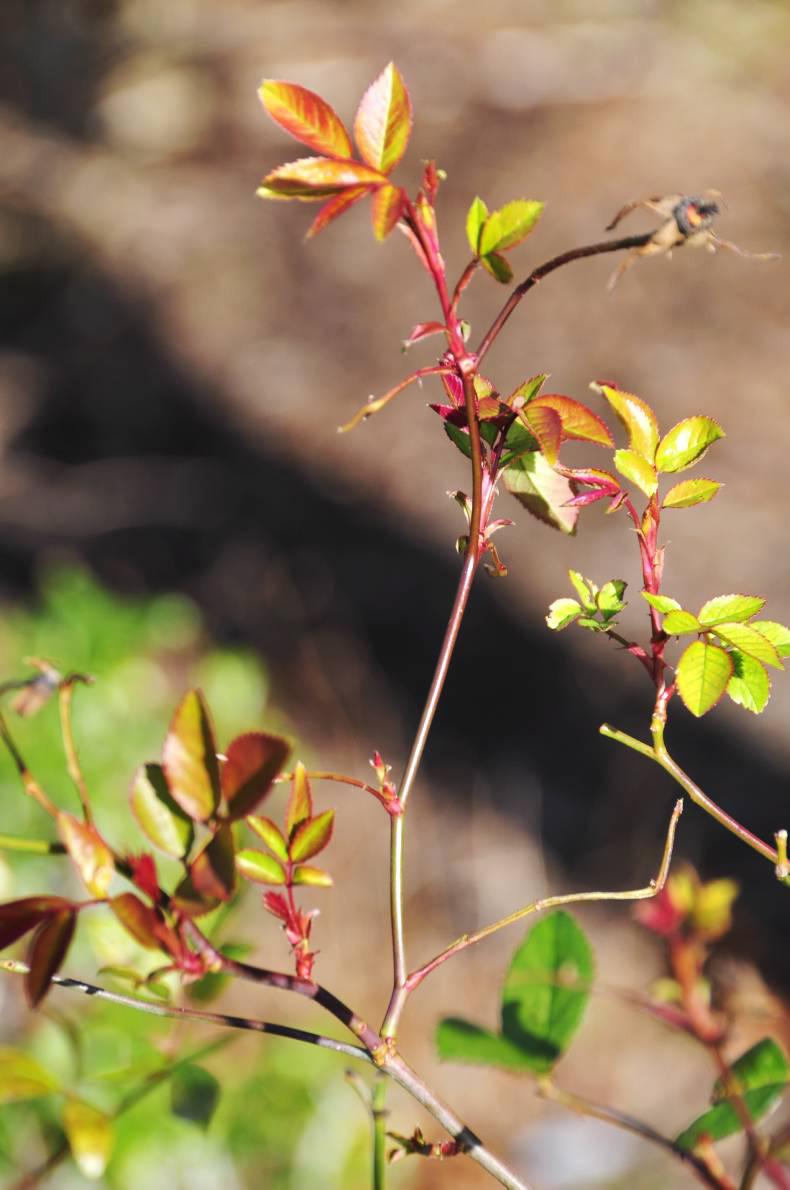
Although the frequently given advice is to prune roses in March, this is much too late. Roses grow practically year-round in this mild climate. Although roses lose their leaves, the growth of new leaves and shoots begins almost right away. By early spring, certainly by March, a lot of new growth is made and, if pruned at that stage, the new growth is lost. So, it is better to prune early, even in December, to direct the plant’s energy into growing new shoots that will later flower. Late pruning of rose bushes and repeat-flowering climbers delay the start of flowering. There is a slight risk of frost damage with early pruning, but this is very small and less than the setback given by late pruning.
Trees, shrubs and roses
Planting of bare-root deciduous trees, hedging and shrubs can go ahead during dry weather. Young trees can be pruned to remove badly placed branches. Roses can be pruned late in the year, including bedding floribunda and hybrid teas roses and climbers, especially in mild areas where there is a very short rest period for roses.
Flowers
Perennial flowers can be lifted and divided to make new plants and re-energise the plant with more space because plants can get very crowded, but delay a while if the ground is wet. Tidy up messy stems and seedheads, but be careful when passing between plants not to trample on bulbs that are emerging.
Fruit and vegetables
Prune fruit trees and bushes now, such as apple and pear trees and blackcurrant bushes and raspberries, if they were not pruned earlier. If possible, dig over vegetable ground, removing old crops. Control weeds in areas of ground that will be dug over later. Spread compost before digging it in. Plant new fruit trees and bushes.
Lawns and ground cover
There has been a lot of autumn grass growth and if there is a dry spell of a few days, and the ground is not soggy, give the lawn a run over with the mower to keep it short and tidy. Take the opportunity to make repairs to damaged or worn areas of the lawn by lifting sods from out-of-the-way corners and fixing patches.
Greenhouse and house plants
Water house plants enough to keep them just moist, even a little towards dry, but not standing in water. In the greenhouse, water very little to reduce the risk of grey mould disease. A greenhouse frost protection heater will save tender plants, such as geraniums or fuchsias, on a frosty night. Remove all debris and dead plants.


SHARING OPTIONS