


Everybody, well nearly everybody, loves the magnificent show of spring blossom that cherry trees provide reliably each spring. It is a massive display of white or pink flowers over a few weeks, covering the trees with colour and the ground too, when millions of petals fall.
These spring cherry trees are mostly Japanese varieties, though not all. Japanese flowering cherries have sterile flowers, almost never producing fruit, and as a result all of their growth effort goes into flowering each year, producing a reliably massive blossom load.
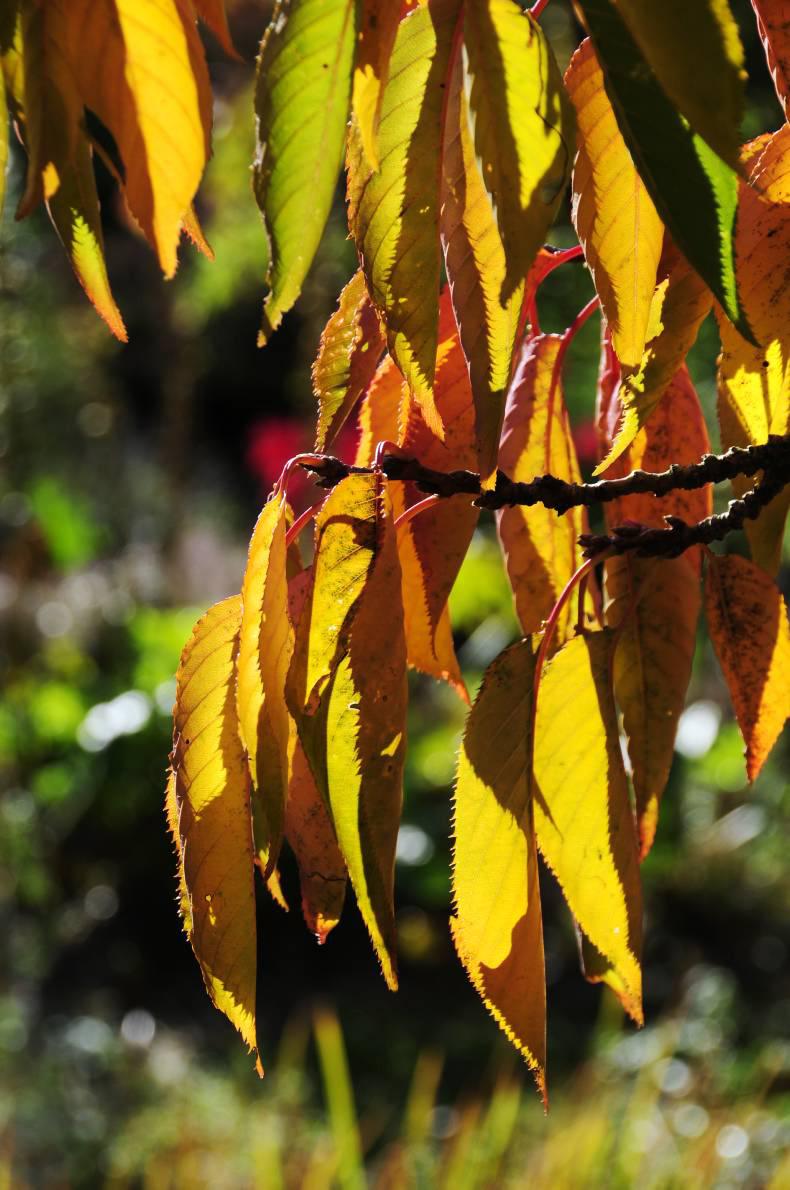
But flowering cherries have a second season of interest in autumn, one that can be as dramatic and as beautiful in its own way. They are renowned for their brilliant autumn colour in shades of yellow, orange, red and purple, often displayed when some of the leaves are still green, making a lovely combination. This aspect of the flowering cherries is only given secondary consideration, if it is taken into account at all, but it is, at very least, a great bonus.
Most of the flowering cherries have good autumn colour but some are better than others. Much depends on the season too. If the early autumn has plenty of sunshine, cool nights, and not much wind, the leaves of the cherries colour more dramatically, but, for colour, they are as reliable as any other group of autumn foliage trees and better than most.
Autumn colour in cherry trees is best seen with sunlight shining through the leaves. It is worth keeping this in mind when choosing a position for an autumn colour cherry tree.
Also bear in mind that candy pink flowering cherry trees can look out of place in a country garden, being too suburban in appearance. If there is countryside in the background, stick with white or pale pink kinds.
One of the best cherries for autumn colour, and one of the first to show autumn colour this year in late August, is Sargent’s cherry, Prunus sargentii. The light pink flowers in spring are single, and the young leaves are reddish. The same leaves are pretty in summer, producing autumn shades of orange and red, with some yellow within the canopy of the tree.
The Fuji cherry, Prunus incisa, is also quite early to flower in spring and produces white flowers in abundance. The autumn leaf colour is excellent, the leaves smaller than Sargent’s cherry but with the same intense show of orange and red. The related Prunus ‘Okame’, which has brilliant pale cerise-pink flowers in spring, turns to lovely orange shades in autumn. Both of these are small trees.
The Yoshino cherry, Prunus yedoensis, has beautiful blush-white, almond-scented flowers in spring along horizontal branches, and has autumn shades of orange and touches of bright red. The autumn flowering cherry, Prunus subhirtella ‘Autumnalis’ carries a first flush of flowers in autumn and often has good autumn coloured leaves just before the flowers.
Some of the general run of Japanese flowering cherries, such as the lovely ‘Pandora’, ‘Shirotae’ and ‘Shirofugen’ have good autumn colour, but others such as the very popular ‘Kanzan’ and ‘Tai-haku’ are not particularly notable.
Many of the best autumn colour trees colour do better if the soil is acidic, but not cherries; they actually prefer a limy soil, although they grow well on acid soil too. They are fine in most ordinary soils, even quite heavy ground, but do poorly in ground that is sodden in winter.
The coming months are a good time to plant flowering cherries. Make sure to allow enough space, as some kinds will make 10 metres across when mature. CL
Lift carrots
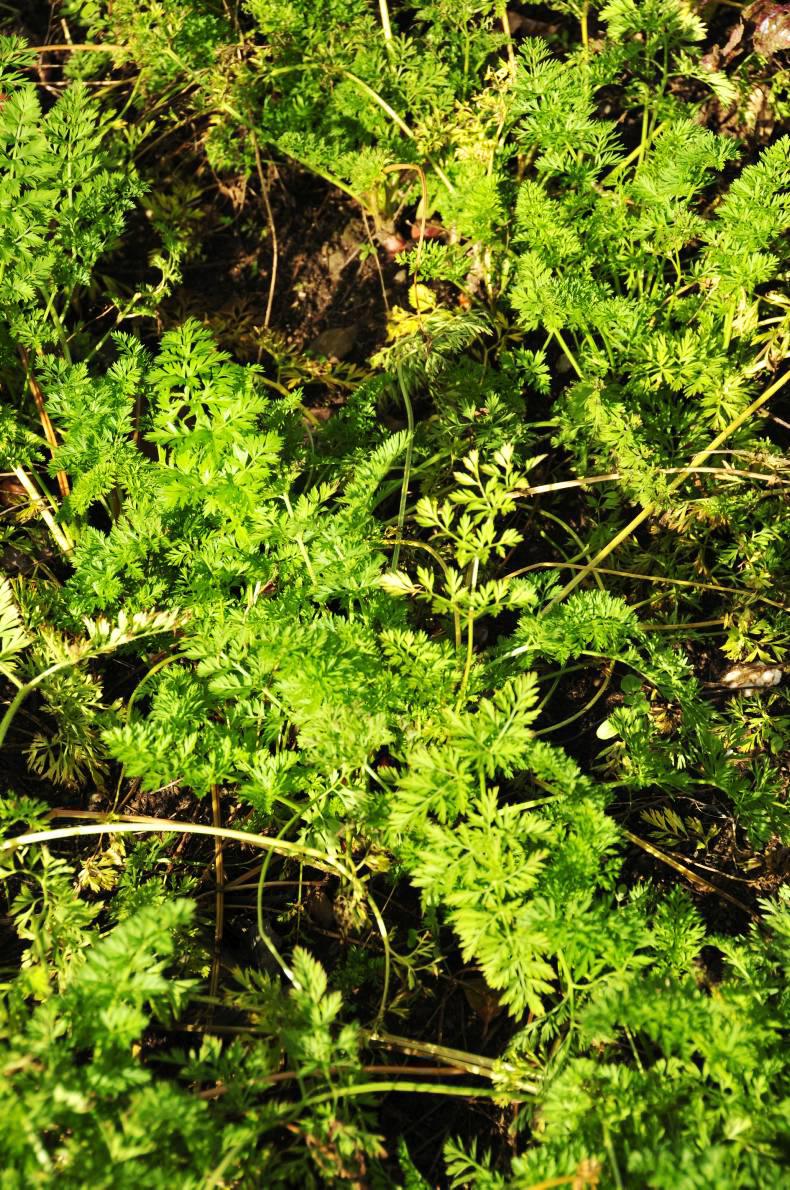
Although the tops of carrots are probably still green, there will be very little further growth and the roots already have a good measure of sugar and flavour constituents stored. On the other hand, leaving them in the soil can allow slugs to do damage and root rots to develop. Mushroom fly maggots can also affect the roots in the open soil.
Making a clamp is a good way to store carrots, in the same way as a potato clamp or pit. Dig out about 15cm of soil, line the base of the pit with straw. Stack the carrots, cover with straw and a layer of soil. This is easily moved when taking out carrots. Or they can be stored in trays in a cool shed with an earthen or concrete floor. Take precautions against rodents. Parsnips generally keep better when left in the ground.
Fruit, vegetables and herbs
Save any tail-end herbs that might still have useable leaves. Raspberries made a lot of late secondary growth this year and still might ripen a few berries, so do not prune yet. Remove old vegetables as soon as they are finished and do not allow weeds to grow and go to seed. Lift potatoes and carrots now to avoid slug damage.
Flowers
Planting of spring bulbs should be completed as soon as possible. Bedding flowers can be replaced now with spring bedding and bulbs. Begin dividing perennial flowers, except grasses, which prefer to be split for new plants in spring. Planting new flower plants from pots can continue and need just a settle-in watering.
Lawn
Lawns are in great shape after a damp summer and warm autumn. Apply lawn moss killer now, if necessary, particularly in shaded areas where moss thrives in the extra dampness. Continue mowing as grass is growing still and soil conditions have been very good, and use an autumn lawn fertiliser if desired.
Tree, shrubs and roses
Plant evergreen trees and shrubs of all kinds, either from pots or as root-balled plants. All kinds of pot-grown trees and shrubs can be planted too. Check that young trees are securely staked if they need it. Rambler roses and climbers can be pruned too, unless there are a few late flowers that are worth keeping.
Greenhouse and house plants
Pick the remaining tomatoes that are bigger than golf-ball size and ripen them indoors, especially if the weather is dull. Tidy the greenhouse and keep it well-ventilated. Do not over-water but keep plants still in active growth just nicely moist. Check for pests, especially greenfly, that can continue to feed in winter.


SHARING OPTIONS